Can We Really Exercise Free Will?

  • Christian Chat is a moderated online Christian community allowing Christians around the world to fellowship with each other in real time chat via webcam, voice, and text, with the Christian Chat app. You can also start or participate in a Bible-based discussion here in the Christian Chat Forums, where members can also share with each other their own videos, pictures, or favorite Christian music.

    If you are a Christian and need encouragement and fellowship, we're here for you! If you are not a Christian but interested in knowing more about Jesus our Lord, you're also welcome! Want to know what the Bible says, and how you can apply it to your life? Join us!

    To make new Christian friends now around the world, click here to join Christian Chat.
So, God is indebted to mankind to save all or provided opportunities for all to potentially become saved? On what judicial basis do you blaspheme the living God for being "unrighteous, partial and unjust"? What is the judicial basis for your accusation that God is partial?

True story: Just yesterday I read a very sad story about a woman who abused her NINE (9) small children by forcing them to live in squalor, filth, hunger, malnourishment and overall poor health. Meanwhile, other kids with other families have it much better. Explain to me how God is "unrighteous, partial and unjust" for decreeing that the nine kids have the kind of broken home and a grossly irresponsible and unloving mother on one hand, while on the other He also decreed in eternity that many other kids have a much better lifestyle with better parents.

Or...more true stories from the bible: How was God "unrighteous, partial and unjust" in decreeing in eternity that Issac and Jacob would participate in the inheritance of the Abrahamic Covenant, while rejecting Ishmael and Esau from this same covenant.

Do you realize that fallen man God had set up on earth before all angels - the fallen and the elect - to learn from man what they see fallen men doing?
 
Romans9plus-Johnandtitus.png

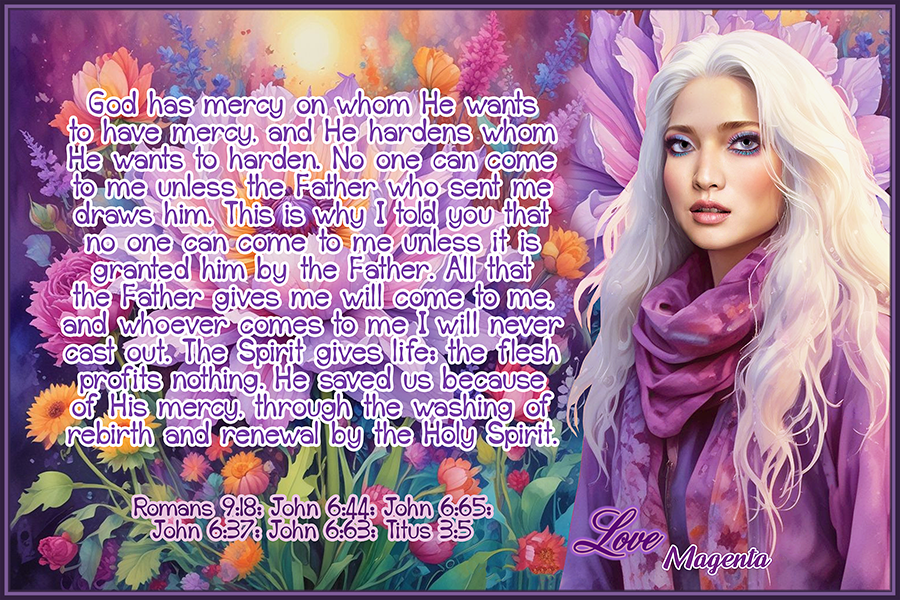
Romans 9 verse 18; John 6 verse 44; John 6 verse 65; John 6 verse 37; John 6 verse63; Titus 3 verse5 ~ God has mercy on whom He wants to have mercy, and He hardens whom He wants to harden. No one can come to me unless the Father who sent me draws him. This is why I told you that no one can come to me unless it is granted him by the Father. All that the Father gives me will come to me, and whoever comes to me I will never cast out. The Spirit gives life; the flesh profits nothing. He saved us because of His mercy, through the washing of rebirth and renewal by the Holy Spirit.
 
The inquiring precocious mind sees the "dividing" occurring in this verse in real time.

Guess it went over the heads of the super-determinists though. But then again, when you have Calvinism glasses on, how could you possibly see it?

I wonder who hands them their glasses.

For they can not find them without wearing them.
 
  • Like
Reactions: HeIsHere
Thank you, Mr. Studier, for pointing out my oversight of a few responses to my 7383. Again, here's what I said in that post:

I have another question for all you freewheeling FWers that pertains to this text:

I wrote:

2 Thess 1:8-10

8 ...in flaming fire, inflicting vengeance on those who do not know God and on those who do not obey the gospel of our Lord Jesus. 9 They will suffer the punishment of eternal destruction, away from the presence of the Lord and from the glory of his might, 10 when he comes on that day to be glorified in his saints, and to be marveled at among all who have believed, because our testimony to you was believed.
ESV

I think most of us can understand the bolded part about not obeying the gospel of Christ, but what's the big deal about those who don't know God? How come Paul lumped them in with those who reject the gospel? It appears that having no true personal knowledge of God is just as serious as not obeying the gospel. What sayest, thou, FWers?


And Studier responded in 7427 with:

Parallelism. Both clauses simply speak of unbelievers. "true personal knowledge" is interpretational error.

So..."true personal knowledge" of God is:

A. Unobtainable in this age?

B. Or like an agnostic you think God is unknowable or unknown?

B. Or unnecessary for salvation?
 
Rufus said in 7383:
I have another question for all you freewheeling FWers that pertains to this text:

2 Thess 1:8-10
8 ...in flaming fire, inflicting vengeance on those who do not know God and on those who do not obey the gospel of our Lord Jesus. 9 They will suffer the punishment of eternal destruction, away from the presence of the Lord and from the glory of his might, 10 when he comes on that day to be glorified in his saints, and to be marveled at among all who have believed, because our testimony to you was believed.
ESV

I think most of us can understand the bolded part about not obeying the gospel of Christ, but what's the big deal about those who don't know God? How come Paul lumped them in with those who reject the gospel? It appears that having no true personal knowledge of God is just as serious as not obeying the gospel. What sayest, thou, FWers?
Click to expand...


Pilgrimshope responded:
??because if you reject the gospel you will never know God. The gospel reveals god to those who will listen so you can know him .

“The beginning of the gospel of Jesus Christ, the Son of God;”
??Mark? ?1:1? ?

If we reject the gospel we’re rejecting him and will never know him

So...faith precedes all personal, intimate knowledge of God?

BTW, I attributed this response to you. I got careless when I was copying and pasting responses to my 7383, so if this wasn't your response, I apologize in advance for my error.
 
So, I've been asking what "spiritual death" means and includes and doesn't include.
I believe Adam was created (spirit), formed (body), made (soul):

Isaiah 43:7 Even every one that is called by my name: for I have created him for my glory, I have formed him; yea, I have made him.

1 Thessalonians 5:23 And the very God of peace sanctify you wholly; and I pray God your whole spirit and soul and body be preserved blameless unto the coming of our Lord Jesus Christ.

Created = God brought into existence something that has never been in existence (something from nothing). Adam was created in the image of God (Gen 1:27).

Formed = God formed the body of Adam from the dust of the ground (Gen 2:7).

Made = God breathed into Adam the breath of life (plural) and man became a living soul (Gen 2:7).

I'm thinking the term "spiritually dead" arose because of what God told Adam in Gen 2:17

Genesis 2:17 But of the tree of the knowledge of good and evil, thou shalt not eat of it: for in the day that thou eatest thereof thou shalt surely die.

Because we know Adam lived physically for some time after he ate, and God, Who cannot lie, stated that Adam would die in the day he ate of the tree knowledge of good and evil, the conclusion was/is that Adam "died" spiritually.

Does this mean that mankind no longer has "spirit"? I do not believe so. However, as has been discussed (and I believe all who have posted in this thread agree) the result of Adam's fall was separation from God. Adam's spirit was no longer inhabited by God's Spirit ... that which allowed Adam to have such a close loving relationship with his Father was absent.

So now we've got descendants of Adam begotten in the likeness of Adam (Gen 5:3) ... body, soul, spirit which was no longer inhabited by Holy Spirit (as opposed to "dead"). While God included in mankind the conscience, it is possible for the conscience ... which should have been restrained by Holy Spirit ... to be easily overridden by self will, emotions, thoughts, senses, etc., etc.

Does this mean that natural man cannot turn to God if and when God reveals Himself (through creation, through Scripture, through faithful men and women preaching)? I do not believe so, but others do and I will not address that issue in this post.

Fast forward to our day and time (time after Pentecost and the giving/receiving of Holy Spirit, the promise of the Father – Luke 24:49, Acts 1:4, Acts 2:33). Those who are born again of Holy Spirit no longer have spirit in which Holy Spirit is absent. Holy Spirit in the born again one is the same Holy Spirit Adam had (there is one Spirit – Eph 4:4) but what we have is somewhat different than what Adam had in that after the fall, Holy Spirit was no longer in Adam because of Adam's uncleanness due to his sin. The relationship Adam had with God was now remote and external to himself ... God had to deal with Adam in the physical realm as opposed to the spiritual realm.

What born again ones have within is a new creation (2 Cor 5:17; Gal 6:15) "birthed" by God and it is eternal life ... meaning that if and when we sin, we do not suffer the same consequence as Adam (i.e. Holy Spirit does not absent Himself).

Holy Spirit within the born again one is also referred to as Christ in you the hope of glory (Col 1:27). This Christ in you is also referred to as this tabernacle which is housed within our earthly house – our physical body (2 Cor 5:1). This is where we are to dwell in the new creation ... the Holy Spirit (aka Comforter) abides with us forever, together with the Father and the Lord Jesus Christ (John 14:26-34).

So, let's think about the fact that when we sin, Holy Spirit is still housed within our earthly house. How does this affect our actions? ... use the brain God gave a us and THINK ... every time we sin, we are drawn away (James 1:13-15) from the tabernacle which is the abode of God, we break fellowship with God (1 John 1:3), we experience the works of the flesh as opposed to the fruit of the Spirit (Gal 5:17-25). In effect, we leave the tabernacle within to dwell in the fleshly body of sin (Rom 6:6).

What are we feeding on in our daily walk? ... are we feeding on the temporal things of this world and thereby maintaining the strength/vitality of the old man (the fleshly body of sin) which is corrupt according to deceitful lusts (4:22)? ... are we feeding on those things which are eternal ... the Word of God, prayer, worship, fellowship with faithful believers? If we feed on earthly/sensual things, we keep the old man/flesh strong. If we feed on heavenly/eternal things, the new man is nourished and strengthened.

2 Corinthians 4:16-5:2

16 For which cause we faint not; but though our outward man perish, yet the inward man is renewed day by day.

17 For our light affliction, which is but for a moment, worketh for us a far more exceeding and eternal weight of glory;

18 While we look not at the things which are seen, but at the things which are not seen: for the things which are seen are temporal; but the things which are not seen are eternal.

5:1 For we know that if our earthly house [our physical body] of this tabernacle [new creation within] were dissolved, we have a building of God [new heaven/earth body], an house not made with hands, eternal in the heavens.

2 For in this we groan, earnestly desiring to be clothed upon with our house which is from heaven


... just a few thoughts on the matter ...

.
 
  • Like
Reactions: cv5
Mounce can be a good resource, IMO. His publications were used in the first-year Greek training I received.

So, we note how he interprets "nekros" ("dead") in various Scriptures. And we note the range of meaning he says it has.

And we note in this range metaphorical concepts like devotion, influence, alienation, etc.

And we note that Mounce includes Eph2:1, 5 in his Definition examples which I earlier pointed out as an inclusio bookending the 5 verses involved as being a unit.

So, Mounce says Eph2:1 is Paul using "dead in trespasses-violations and sins" as metaphor for being alienated from God.

So, do we disagree or agree with Mounce?

Do the verses from Eph2:1-5 describe what metaphorical death - alienation from God - looks like?

Is alienation from God the best we can do in describing those 5 verses where Paul is explaining this metaphorical death?

Do we have to take this metaphorical death into the human spirit being dead? Is the human spirit mentioned in these verses?

Does this metaphorical death sound like a corpse?

God decades ago, encouraged me to ask Him questions and to always listen to the check in my spirit in Christ in Spirit when I heard or read something that prompted it. Until He may tell me to stop, I plan to keep seeking and asking and trusting only Him no matter who thinks their long-dead or still living favorite pastors, teachers, theologians, translators are.

Thanks for the response @HeIsHere

I think each time the term is used it needs to examined individually first within the context of the surrounding text, and then connected to other verses where the word "dead" is used.
 
Rufus said in 7383:
I have another question for all you freewheeling FWers that pertains to this text:


2 Thess 1:8-10
8 ...in flaming fire, inflicting vengeance on those who do not know God and on those who do not obey the gospel of our Lord Jesus. 9 They will suffer the punishment of eternal destruction, away from the presence of the Lord and from the glory of his might, 10 when he comes on that day to be glorified in his saints, and to be marveled at among all who have believed, because our testimony to you was believed.
ESV


I think most of us can understand the bolded part about not obeying the gospel of Christ, but what's the big deal about those who don't know God? How come Paul lumped them in with those who reject the gospel? It appears that having no true personal knowledge of God is just as serious as not obeying the gospel. What sayest, thou, FWers?
Click to expand...


So...faith precedes all personal, intimate knowledge of God?

BTW, I attributed this response to you. I got careless when I was copying and pasting responses to my 7383, so if this wasn't your response, I apologize in advance for my error.


It it would only take the faith of a mustard seed to move a mountain?
How much faith would one need to be saved?

I only knew that Jesus was a good man that loved God so deeply that he refused to sin.

Nothing else.

Guess what?

God saved me when I chose to believe.

After I was saved?
Then I began to hunger for the Truth.
Then, finally with my learning of Bible doctrine, did I first began to form a personal intimate knowledge of God.

With hardly any faith at all, is all it takes to be saved.

"So then faith comes by hearing, and hearing by the word of God."


Romans 10:17
 
Is that what you get from me?

There is with some an unwillingness to learn something beyond what he has glued himself to.
I do not blindly adhere to everything my pastor teaches.

What I love about the teaching is that it is so diverse in subject matter and makes you aware of realities
in the Bible that a great many pastors will not even touch upon. I have constructed my own rationales
after being exposed to accurate translation that do not always agree with a conclusion that was included
in with the expository teaching.....

After all?

He used to complain about those who would only parrot his words.
Don't you remember him exhorting others to... THINK! THINK! THINK!

He was feeding us with Biblical building materials for those who are able to do their own original thinking.

You never heard him openly express that to all listening?

Yes, I did hear it repeatedly and was old and independent enough to take it to heart along with the instruction not to put him on a pedestal and to grow up and stand on our own two feet.

I actually had an interesting experience with church politics come up re: ordination because part of his board was supposedly concerned about ordaining parrots. I don't recall how it got settled but do recall being prepared to answer the concern very directly if it presented with it personally and to walk away from the politics if necessary.

No matter how he exhorted students, he was well known for creating parrots, which of course is not entirely his fault. And his created vocabulary was conducive to it. I found myself in the position of defending him more than a few times. And what was surprising to me is many of his students were well-known for learning his system and hardly ever opening a bible. Ever heard the pejorative "thiemeites"?

But, back to the issue, do you care to explain "spiritual death" and from what I've seen, would it not be from his dichotomous views?
 
Maybe. Or maybe we just get this one further on track. There are some good minds here shutting down a lot of the Reformed nonsense. And ultimately what I'm dealing with is concerning this pejorative "FW" moniker.

While waiting for others to wake up physically or digitally, I've been working on some of these terminology issues - these theological constructs made by men that are not actually in Scripture but systematic interpretations of Scripture. And before anyone says, what about the "Trinity", I don't think there's much disagreement about the meaning of the word.

However, once we get into constructs like "spiritual death" and "total depravity" and words like "repent" we're dealing with interpretation and traditions and arguing about the meaning of manmade phrases and religious words that are not in the Text.

Furthermore, we're dealing with a lot of Philosophy that was brought into Theology ages ago and some of this has affected what man even is and how God created him and what the fall did to him.

It's all a mess and the one thing about being out of the isolating pews is that forums lie this show how much of a chaotic mess christendom and systematic theology is.

The Text/Word and the Spirit is the purity, and we have both. We need to jettison all the inserted terminology and speak God's language if we want to think like Him and thereby behave as His sons.

I get where you are coming from. This is why I try to give a general explanation of what I mean when I say things eg. spiritual death. I realise people have different understandings of what it is but I think everyone (mainstream at least) recognises it stops us having the capacity to connect directly to God. Of course, I could be wrong on that assumption but phrases like "cut off from God" or "dead to God" certainly give me that impression it is how most understand it at a basic level.

As far as the "FW" moniker, I agree, it is being used as a perjorative but you can't police other peoples behaviour, but to get to an understanding of the place and purpose of volition could be rather extensive as we would need to cover how man is made, how he functions in part and on the whole as well as maybe things I can't even think of yet as I haven't had my coffee. ;)

The reason I suggested another thread, as while the topic underlies free will, it doesn't address it directly and I try to be mindful of getting too far from the topic when the thread is started by someone else. I'm more than happy to discuss it in depth and see if we can come to some understanding at least, if not agreement.

Where do you want to go from here? You lead, I'll follow. :)
 
  • Like
Reactions: cv5
I think each time the term is used it needs to examined individually first within the context of the surrounding text, and then connected to other verses where the word "dead" is used.
On this matter, I think patience is key.

I say "spiritually dead" all the time. And believe it.

Everyone here that is trying to explain it.......I agree with for the most part. I know their doctrine. It's just being stated in differing terms.

IMO @Genez explains it correctly. But I am familiar with the terms and wording of his explanation.

I believe we are dichotomous at birth and the moment we believe we become trichotomous....I think of the Trinity?

Dead? Inactive? a part of us all along? Not a part of us all along?......We could debate that for a LONG time.

"in the day that you eat from it you shall surely die."

Many scholars will interpret/parse this as," In the day that you eat from it dying you shall surely die."

Spiritual death instantly. Physical death later.
 
  • Like
Reactions: HeIsHere
My take on foreknowledge is that God certainly knows all which will take place within His creation. But, He does not make decisions based on this foreknowledge. He made a decision long ago about all that would take place according to the good pleasure of His will.

Therefore, what He foreknew will certainly take place.

Col 1:16

Yes, but what you are calling foreknowledge, I have explained I see as omniscience. Foreknowledge is about who He knows, not what He knows and He does make decisions on the basis of His foreknowledge as evident in Rom.8. This is why there is no foreknowledge concerning unbelievers and hence no predestination, calling, justification or glorification. The Lord God does not know unbelievers in a relational sense.

Romans 8:29-30
For those whom he foreknew he also predestined to be conformed to the image of his Son, in order that he might be the first-born among many brethren. And those whom he predestined he also called; and those whom he called he also justified; and those whom he justified he also glorified.

God decided, from His omniscience, He would save believers. Seeing He would have a bunch of people before Him who from their own volition would love Him, just as two thirds of the angels of their own volition remained faithful and just as Christ of His own volition remained faithful, would love Him in time and eternity, He decided what He would do with each of them. As far as God is concerned they were already saved so he is not choosing to save them, He is choosing what to do with the saved.
 
But, back to the issue, do you care to explain "spiritual death" and from what I've seen, would it not be from his dichotomous views?

Spiritual death = unregenerate.
How does the unregenerate soul differ from a regenerate soul?

And, better yet?
Do it from the OT perspective.
For too many assume that being born again means receiving the Holy Spirit.
But, Jesus was telling OT Jewish Nicodemus he needed to be born again,
at a time the Spirit was not yet being given to indwell the believer.


OT saints were able to freely comprehend spiritual realities according to their dispensation.
They were spiritually activated. Not dead.
 
On this matter, I think patience is key.

I say "spiritually dead" all the time. And believe it.

Everyone here that is trying to explain it.......I agree with for the most part. I know their doctrine. It's just being stated in differing terms.

IMO @Genez explains it correctly. But I am familiar with the terms and wording of his explanation.

I believe we are dichotomous at birth and the moment we believe we become trichotomous....I think of the Trinity?

Dead? Inactive? a part of us all along? Not a part of us all along?......We could debate that for a LONG time.

"in the day that you eat from it you shall surely die."

Many scholars will interpret/parse this as," In the day that you eat from it dying you shall surely die."

Spiritual death instantly. Physical death later.

Thank you, I have not thought about it too much beyond refuting Calvinism and their horrible Lazuras analogy.

But I think, I need to go back and reread the posts.
 
Many scholars will interpret/parse this as," In the day that you eat from it dying you shall surely die."

Spiritual death instantly. Physical death later.

" In the day that you eat from it dying you shall surely die."

That spoke cascading deaths.

First death resulted in a second kind of death.

First death = spiritual death.
Spiritual death resulted in what?
Eventually, in physical death.

In dying (one type) you shall surely die (second type).
 
Yes, I did hear it repeatedly and was old and independent enough to take it to heart along with the instruction not to put him on a pedestal and to grow up and stand on our own two feet.

I actually had an interesting experience with church politics come up re: ordination because part of his board was supposedly concerned about ordaining parrots. I don't recall how it got settled but do recall being prepared to answer the concern very directly if it presented with it personally and to walk away from the politics if necessary.

No matter how he exhorted students, he was well known for creating parrots, which of course is not entirely his fault. And his created vocabulary was conducive to it. I found myself in the position of defending him more than a few times. And what was surprising to me is many of his students were well-known for learning his system and hardly ever opening a bible. Ever heard the pejorative "thiemeites"?

But, back to the issue, do you care to explain "spiritual death" and from what I've seen, would it not be from his dichotomous views?
Can you tell us of a pastor teacher that is closer to what Paul taught? I would surely like to learn from him.

1 Cor 4:16
Therefore I urge you, be imitators of me.
 
  • Like
Reactions: Genez
" In the day that you eat from it dying you shall surely die."

That spoke cascading deaths.

First death resulted in a second kind of death.

First death = spiritual death.
Spiritual death resulted in what?
Eventually, in physical death.

In dying (one type) you shall surely die (second type).
And we see it on the cross as well. He was still physically alive when He said," It is finished." He was our substitute in Spiritual death(he paid the price for ALL sin.) His Physical death guaranteed our physical resurrection.

It's all intimately connected, if we are willing to grow in His Grace and knowledge.
 
" In the day that you eat from it dying you shall surely die."

That spoke cascading deaths.

First death resulted in a second kind of death.

First death = spiritual death.
Spiritual death resulted in what?
Eventually, in physical death.

In dying (one type) you shall surely die (second type).

We must remember death does not mean non-existent.