Can We Really Exercise Free Will?

  • Christian Chat is a moderated online Christian community allowing Christians around the world to fellowship with each other in real time chat via webcam, voice, and text, with the Christian Chat app. You can also start or participate in a Bible-based discussion here in the Christian Chat Forums, where members can also share with each other their own videos, pictures, or favorite Christian music.

    If you are a Christian and need encouragement and fellowship, we're here for you! If you are not a Christian but interested in knowing more about Jesus our Lord, you're also welcome! Want to know what the Bible says, and how you can apply it to your life? Join us!

    To make new Christian friends now around the world, click here to join Christian Chat.
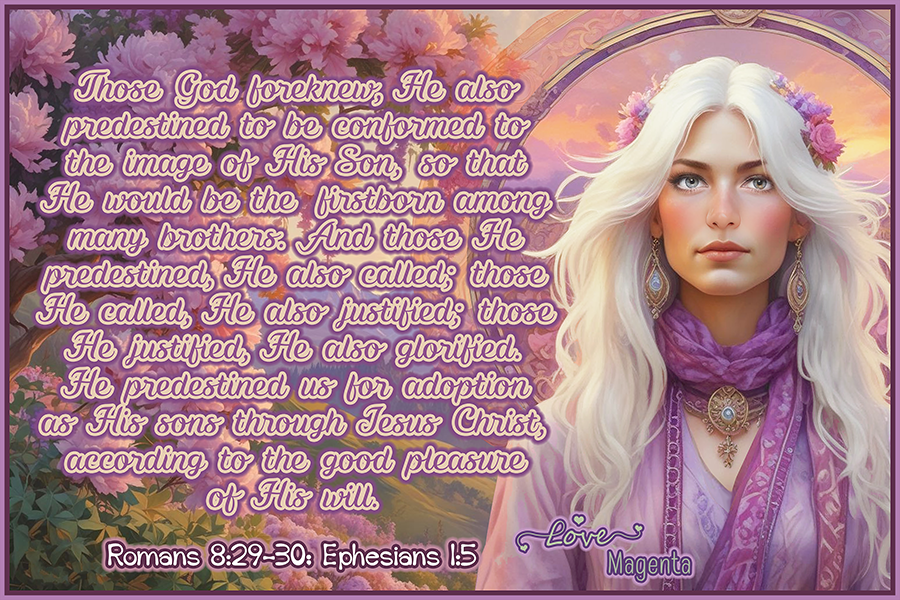
Romans8-29-30-Ephesians1-5.png

Romans 8 verse 29-30; Ephesians 1 verse 5 ~ Those God foreknew, He also predestined to be conformed to the image of His Son, so that He would be the firstborn among many brothers. And those He predestined, He also called; those He called, He also justified; those He justified, He also glorified. He predestined us for adoption as His sons through Jesus Christ, according to the good pleasure of His will.
 
Psalm147-5-Isaiah40-28b-Jeremiah32-17b-Isaiah55-9-Job36-5.png

Psalm 147 verse 5, Isaiah 40 verse 28b, Jeremiah 32 verse 17b, Isaiah 55 verse 9, Job 36 verse 5 ~ Great is our Lord, and mighty in power; His understanding has no limit. Psalm 147 verse 5 His understanding is beyond searching out. Isaiah 40 verse 28b Nothing is too difficult for You! Jeremiah 32 verse 17b For as the heavens are higher than the earth, so My ways are higher than your ways and My thoughts than your thoughts. Isaiah 55 verse 9 His understanding is beyond searching out. Isaiah 40 verse 28b He is mighty in strength of understanding. Job 36 verse 5
Past parent and future God can hold all points of time in one place the meaning of eternal, and life

His omniscience, is his life his will his spirit his everything

The sustainer of all time
 
  • Like
Reactions: rogerg
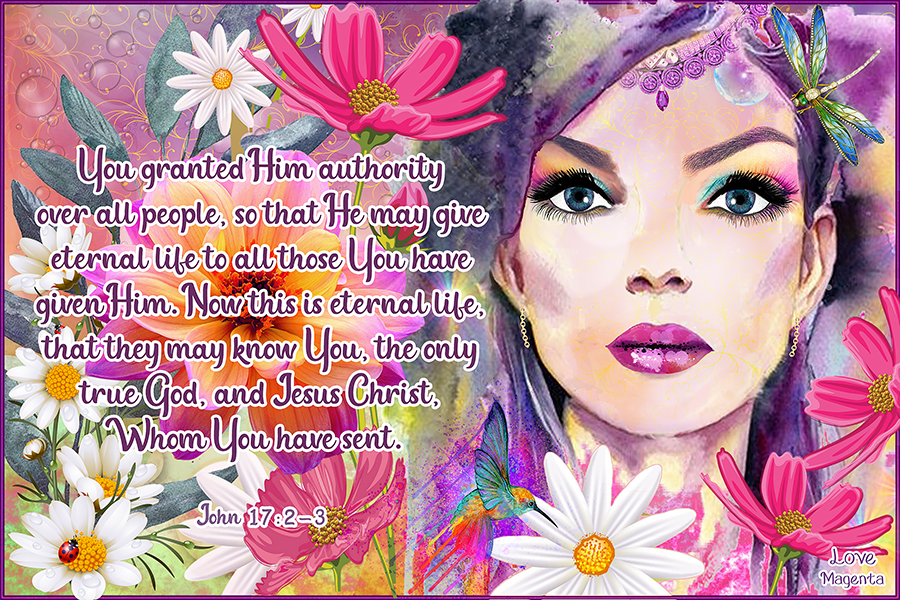
John17-2-3e2s.png

John 17 verses 2-3 ~ You granted Him authority over all people, so that He may give eternal life to all those You have given Him. Now this is eternal life, that they may know You, the only true God, and Jesus Christ, Whom You have sent.:)
 
The key core belief of his faith he wanted us to have ,..was for us to understand that his life is eternal.

So when my mum convinced me as a child that eternal means life has always been, I began to understand that God is a God of the living and that we can live in his living hope that exists every where, but the hope I came knew was the hope that lived in my mum, she spoke and the hope that was, came to be in me.

I Then was told I've no need to not to fear that life can't live for ever including me.
 
That is such a lovely and true comment friend, Col 1:21-23 now has deep roots in me too. I'm still a pretty new believer, don't hesitate to post more scripture recommendations for me.

We often conflate the commandments given by Moses (so confusion is the result) but we are now under the Law of Messiah (LOM) which is a higher law than the Mosaic Law which says "you must love your neighbor as yourself" whereas LOM says "you shall love your neighbor as I have loved you" = higher law and greater Grace...God is interested in our growth in the Spirit, so when we break His Law, we confess our sin, and He Graciously forgives us so we can realign with His Spirit to enable us to walk in His Ways; AND once hid in Christ there is no eternal separation of Covenantal status but we can experience loss of intimacy until we confess our sin and are realigned with the Spirit.

✨ How the Atonement (Justification) Accomplished All
  • Universal Justification (Atonement):
    • At the cross, Messiah’s death, blood, and life were accepted by the Father as the once-for-all payment.
    • This act was universal — gifted to all ungodly men without merit, contrition, or human effort.
    • By this, Christ redeemed all humanity from slavery to sin and death, securing peace with God.
    • This is the foundation: God alone initiated salvation through the Atonement.
  • Invitation to Sanctification (New Birth):
    • Justification opens the door, but only those who accept God’s covenant invitation enter sanctification.
    • The New Birth is given only to those being sanctified — those who receive His Spirit.
    • In sanctification, the Spirit indwells us, transforming us into Christ’s image, and empowering us to walk in the works He prepared.
    • Our overcoming is by His blood and the word of our testimony, not by our own strength.
  • Glorification Guaranteed by the Atonement:
    • God has sworn: those He justified, He will glorify.
    • At judgment, He will purge all sin and present us as though we had never sinned.
    • Even those who resist sanctification may face temporal punishment (Hell as purging fire), but ultimately they too will be humbled, purified, and glorified — because the Atonement was God’s unilateral act.
  • God’s Covenant Faithfulness Displayed:
    • The Mosaic covenant exposed human sinfulness and became a covenant of death, but the Father of Mercy and Justice fulfilled His unconditional covenant through the Atonement.
    • Christ, as our Kinsman Redeemer, took our place, defeated death, and hid us in Himself.
    • The Atonement was the “failsafe” from before the beginning — Christ crucified was God’s eternal plan to ensure His children (made in His image) would be brought home.
    • Even temporal punishments (Adam, Cain, Pharaoh) reveal God’s parental love — judgment is corrective, not final separation.
  • Textual Witness (Hebrew vs. Greek):
    • The Septuagint stylized Hebrew covenantal language into Greek constructs, but it never predated or displaced the Hebrew OT.
    • In the same way, the abundance of Greek NT manuscripts does not prove Greek originality.
    • The NT is saturated with Hebraic chiasms, idioms, and covenantal imagery, pointing to Hebrew primacy.
    • Greek manuscripts often abstract concepts into “faith” as human belief, while Hebrew manuscripts emphasize God’s faithfulness in the Atonement.
    • Example: John 1 in Sephardic Hebrew manuscripts says “The Son” rather than “The Word,” keeping the covenantal focus intact.
    • For manuscript evidence and study, see HebrewGospeldotcom, which highlights the surviving Sephardic Hebrew NT manuscripts and their covenantal constructs.
🌍 The Big Picture
  • Justification (Atonement) is the fountainhead: universally accomplished, inviting all into sanctification.
  • Sanctification (New Birth) is given only to those who accept the covenant invitation and receive His Spirit.
  • Glorification is guaranteed for all who were justified, whether through sanctification now or eventual purging later.
  • God’s covenant faithfulness ensures the plan cannot fail — Christ crucified was the eternal failsafe.
  • Textual witness confirms the Hebraic foundation of both OT and NT, resisting the claim that Greek abundance equals originality.
Everything — sanctification, glorification, covenant faithfulness, even the textual witness of Scripture — flows from the Atonement.

📖 NT Understanding: Hebraic Lens vs. Greek Lens
Theme
Hebraic Lens (Covenantal, Relational)
Greek Lens (Philosophical, Abstract)
Source of Salvation
Rooted in God’s covenant faithfulness. Salvation is His unilateral act through Messiah’s Atonement.
Rooted in human response of faith/belief. Salvation often framed as dependent on individual assent.
Justification
Universal gift accomplished at the Atonement for all ungodly men, without merit or contrition. God reconciles humanity to Himself.
Conditional acceptance based on personal belief or fidelity. Justification is often seen as applied only to those who “believe.”
Sanctification (New Birth)
Invitation into covenant relationship. Those who receive His Spirit are transformed into Messiah’s image. The Spirit indwells and empowers.
Emphasis on moral striving and intellectual assent. Transformation is often tied to human discipline or fidelity.
Glorification
Guaranteed by God’s promise: those He justified, He will glorify. Even temporal punishment is corrective, leading ultimately to restoration.
Often conditional: glorification is reserved for those who persist in belief or fidelity. Eternal separation is emphasized for those who fail.
Covenant Framework
God’s unconditional covenants (Abrahamic, Davidic, New Covenant) are fulfilled in Messiah. The Mosaic covenant exposed sin but was overcome by His mercy.
Focus on law, ethics, and philosophy. The Mosaic covenant is often interpreted as a moral system rather than a relational exposure of sin.
Language & Imagery
Rich in chiasms, idioms, covenantal imagery, parental love. Example: John 1 in Hebrew manuscripts says “The Son” — relational and covenantal.
Abstract concepts dominate: “The Word” in John 1 emphasizes logos (reason, principle) rather than relational Sonship.
Judgment & Punishment
Temporal, corrective, parental discipline. Even Hell is purging fire meant to humble and restore.
Eternal, retributive punishment. Judgment is final separation rather than corrective discipline.
Textual Witness
Hebrew manuscripts (Sephardic NT) preserve covenantal constructs. God always goes to the Jew first, then Gentile.
Abundance of Greek manuscripts seen as proof of originality, though they stylize Hebraic thought into Greek constructs.
Human Role
Humanity is invited to participate in sanctification, but the foundation is always God’s action.
Humanity is seen as the decisive factor: salvation hinges on personal belief/fidelity.
✨ Key Takeaway
  • Hebraic lens: Salvation is God’s covenantal act — initiated, sustained, and completed by Him. Justification is universal, sanctification is an invitation into covenant relationship, and glorification is guaranteed by His promise. Punishment is corrective, never final.
  • Greek lens: Salvation is often human-centered — dependent on belief, fidelity, or intellectual assent. Justification and glorification are conditional, punishment is eternal, and the relational covenantal imagery is abstracted into philosophical categories.
This contrast shows why the Hebraic lens preserves the parental love, covenant faithfulness, and relational action of God, while the Greek lens shifts emphasis toward human belief and abstract philosophy.
 
Matthew 19:26
But Jesus beheld them, and said unto them, With men this is impossible; but with God all things are possible.

See, believe and see truth over error once Father leads in risen Son for anyone that decides to be willing to see, will see, not necessarily at first. There might be a lot of trouble to go through first, I have and might go through more as have still go, gone through, even after I have physically died more than seven times, I see to remain willing sincerely as Jesus who went willingly first. Now risen where new life is given by Father in risen Son for us all to believe and not quit, no matter what happens here on earth, to me at least
I tell you the truth, seeing the last chapter of Job, seeing Phil 1-3, seeing Ephesians. reading Colossians, Corinthians the whole not scripting out verses, reading the whole, trusting Daddy, PaPa, the Father of risen Son to reveal the truth of love to us all
God loves us all y'all that is fact over everything else, start there in thanksgiving and praise, you will see through if you will continue willingly
Col 1:21-23 has deep roots in truth to me anyways

We often conflate the commandments given by Moses (so confusion is the result) but we are now under the Law of Messiah (LOM) which is a higher law than the Mosaic Law which says "you must love your neighbor as yourself" whereas LOM says "you shall love your neighbor as I have loved you" = higher law and greater Grace...God is interested in our growth in the Spirit, so when we break His Law, we confess our sin, and He Graciously forgives us so we can realign with His Spirit to enable us to walk in His Ways; AND once hid in Christ there is no eternal separation of Covenantal status but we can experience loss of intimacy until we confess our sin and are realigned with the Spirit.

✨ How the Atonement (Justification) Accomplished All
  • Universal Justification (Atonement):
    • At the cross, Messiah’s death, blood, and life were accepted by the Father as the once-for-all payment.
    • This act was universal — gifted to all ungodly men without merit, contrition, or human effort.
    • By this, Christ redeemed all humanity from slavery to sin and death, securing peace with God.
    • This is the foundation: God alone initiated salvation through the Atonement.
  • Invitation to Sanctification (New Birth):
    • Justification opens the door, but only those who accept God’s covenant invitation enter sanctification.
    • The New Birth is given only to those being sanctified — those who receive His Spirit.
    • In sanctification, the Spirit indwells us, transforming us into Christ’s image, and empowering us to walk in the works He prepared.
    • Our overcoming is by His blood and the word of our testimony, not by our own strength.
  • Glorification Guaranteed by the Atonement:
    • God has sworn: those He justified, He will glorify.
    • At judgment, He will purge all sin and present us as though we had never sinned.
    • Even those who resist sanctification may face temporal punishment (Hell as purging fire), but ultimately they too will be humbled, purified, and glorified — because the Atonement was God’s unilateral act.
  • God’s Covenant Faithfulness Displayed:
    • The Mosaic covenant exposed human sinfulness and became a covenant of death, but the Father of Mercy and Justice fulfilled His unconditional covenant through the Atonement.
    • Christ, as our Kinsman Redeemer, took our place, defeated death, and hid us in Himself.
    • The Atonement was the “failsafe” from before the beginning — Christ crucified was God’s eternal plan to ensure His children (made in His image) would be brought home.
    • Even temporal punishments (Adam, Cain, Pharaoh) reveal God’s parental love — judgment is corrective, not final separation.
  • Textual Witness (Hebrew vs. Greek):
    • The Septuagint stylized Hebrew covenantal language into Greek constructs, but it never predated or displaced the Hebrew OT.
    • In the same way, the abundance of Greek NT manuscripts does not prove Greek originality.
    • The NT is saturated with Hebraic chiasms, idioms, and covenantal imagery, pointing to Hebrew primacy.
    • Greek manuscripts often abstract concepts into “faith” as human belief, while Hebrew manuscripts emphasize God’s faithfulness in the Atonement.
    • Example: John 1 in Sephardic Hebrew manuscripts says “The Son” rather than “The Word,” keeping the covenantal focus intact.
    • For manuscript evidence and study, see HebrewGospeldotcom, which highlights the surviving Sephardic Hebrew NT manuscripts and their covenantal constructs.
🌍 The Big Picture
  • Justification (Atonement) is the fountainhead: universally accomplished, inviting all into sanctification.
  • Sanctification (New Birth) is given only to those who accept the covenant invitation and receive His Spirit.
  • Glorification is guaranteed for all who were justified, whether through sanctification now or eventual purging later.
  • God’s covenant faithfulness ensures the plan cannot fail — Christ crucified was the eternal failsafe.
  • Textual witness confirms the Hebraic foundation of both OT and NT, resisting the claim that Greek abundance equals originality.
Everything — sanctification, glorification, covenant faithfulness, even the textual witness of Scripture — flows from the Atonement.

📖 NT Understanding: Hebraic Lens vs. Greek Lens
Theme
Hebraic Lens (Covenantal, Relational)
Greek Lens (Philosophical, Abstract)
Source of Salvation
Rooted in God’s covenant faithfulness. Salvation is His unilateral act through Messiah’s Atonement.
Rooted in human response of faith/belief. Salvation often framed as dependent on individual assent.
Justification
Universal gift accomplished at the Atonement for all ungodly men, without merit or contrition. God reconciles humanity to Himself.
Conditional acceptance based on personal belief or fidelity. Justification is often seen as applied only to those who “believe.”
Sanctification (New Birth)
Invitation into covenant relationship. Those who receive His Spirit are transformed into Messiah’s image. The Spirit indwells and empowers.
Emphasis on moral striving and intellectual assent. Transformation is often tied to human discipline or fidelity.
Glorification
Guaranteed by God’s promise: those He justified, He will glorify. Even temporal punishment is corrective, leading ultimately to restoration.
Often conditional: glorification is reserved for those who persist in belief or fidelity. Eternal separation is emphasized for those who fail.
Covenant Framework
God’s unconditional covenants (Abrahamic, Davidic, New Covenant) are fulfilled in Messiah. The Mosaic covenant exposed sin but was overcome by His mercy.
Focus on law, ethics, and philosophy. The Mosaic covenant is often interpreted as a moral system rather than a relational exposure of sin.
Language & Imagery
Rich in chiasms, idioms, covenantal imagery, parental love. Example: John 1 in Hebrew manuscripts says “The Son” — relational and covenantal.
Abstract concepts dominate: “The Word” in John 1 emphasizes logos (reason, principle) rather than relational Sonship.
Judgment & Punishment
Temporal, corrective, parental discipline. Even Hell is purging fire meant to humble and restore.
Eternal, retributive punishment. Judgment is final separation rather than corrective discipline.
Textual Witness
Hebrew manuscripts (Sephardic NT) preserve covenantal constructs. God always goes to the Jew first, then Gentile.
Abundance of Greek manuscripts seen as proof of originality, though they stylize Hebraic thought into Greek constructs.
Human Role
Humanity is invited to participate in sanctification, but the foundation is always God’s action.
Humanity is seen as the decisive factor: salvation hinges on personal belief/fidelity.
✨ Key Takeaway
  • Hebraic lens: Salvation is God’s covenantal act — initiated, sustained, and completed by Him. Justification is universal, sanctification is an invitation into covenant relationship, and glorification is guaranteed by His promise. Punishment is corrective, never final.
  • Greek lens: Salvation is often human-centered — dependent on belief, fidelity, or intellectual assent. Justification and glorification are conditional, punishment is eternal, and the relational covenantal imagery is abstracted into philosophical categories.
This contrast shows why the Hebraic lens preserves the parental love, covenant faithfulness, and relational action of God, while the Greek lens shifts emphasis toward human belief and abstract philosophy.
 
We often conflate the commandments given by Moses (so confusion is the result) but we are now under the Law of Messiah (LOM) which is a higher law than the Mosaic Law which says "you must love your neighbor as yourself" whereas LOM says "you shall love your neighbor as I have loved you" = higher law and greater Grace...God is interested in our growth in the Spirit, so when we break His Law, we confess our sin, and He Graciously forgives us so we can realign with His Spirit to enable us to walk in His Ways; AND once hid in Christ there is no eternal separation of Covenantal status but we can experience loss of intimacy until we confess our sin and are realigned with the Spirit.

✨ How the Atonement (Justification) Accomplished All
  • Universal Justification (Atonement):
    • At the cross, Messiah’s death, blood, and life were accepted by the Father as the once-for-all payment.
    • This act was universal — gifted to all ungodly men without merit, contrition, or human effort.
    • By this, Christ redeemed all humanity from slavery to sin and death, securing peace with God.
    • This is the foundation: God alone initiated salvation through the Atonement.
  • Invitation to Sanctification (New Birth):
    • Justification opens the door, but only those who accept God’s covenant invitation enter sanctification.
    • The New Birth is given only to those being sanctified — those who receive His Spirit.
    • In sanctification, the Spirit indwells us, transforming us into Christ’s image, and empowering us to walk in the works He prepared.
    • Our overcoming is by His blood and the word of our testimony, not by our own strength.
  • Glorification Guaranteed by the Atonement:
    • God has sworn: those He justified, He will glorify.
    • At judgment, He will purge all sin and present us as though we had never sinned.
    • Even those who resist sanctification may face temporal punishment (Hell as purging fire), but ultimately they too will be humbled, purified, and glorified — because the Atonement was God’s unilateral act.
  • God’s Covenant Faithfulness Displayed:
    • The Mosaic covenant exposed human sinfulness and became a covenant of death, but the Father of Mercy and Justice fulfilled His unconditional covenant through the Atonement.
    • Christ, as our Kinsman Redeemer, took our place, defeated death, and hid us in Himself.
    • The Atonement was the “failsafe” from before the beginning — Christ crucified was God’s eternal plan to ensure His children (made in His image) would be brought home.
    • Even temporal punishments (Adam, Cain, Pharaoh) reveal God’s parental love — judgment is corrective, not final separation.
  • Textual Witness (Hebrew vs. Greek):
    • The Septuagint stylized Hebrew covenantal language into Greek constructs, but it never predated or displaced the Hebrew OT.
    • In the same way, the abundance of Greek NT manuscripts does not prove Greek originality.
    • The NT is saturated with Hebraic chiasms, idioms, and covenantal imagery, pointing to Hebrew primacy.
    • Greek manuscripts often abstract concepts into “faith” as human belief, while Hebrew manuscripts emphasize God’s faithfulness in the Atonement.
    • Example: John 1 in Sephardic Hebrew manuscripts says “The Son” rather than “The Word,” keeping the covenantal focus intact.
    • For manuscript evidence and study, see HebrewGospeldotcom, which highlights the surviving Sephardic Hebrew NT manuscripts and their covenantal constructs.
🌍 The Big Picture
  • Justification (Atonement) is the fountainhead: universally accomplished, inviting all into sanctification.
  • Sanctification (New Birth) is given only to those who accept the covenant invitation and receive His Spirit.
  • Glorification is guaranteed for all who were justified, whether through sanctification now or eventual purging later.
  • God’s covenant faithfulness ensures the plan cannot fail — Christ crucified was the eternal failsafe.
  • Textual witness confirms the Hebraic foundation of both OT and NT, resisting the claim that Greek abundance equals originality.
Everything — sanctification, glorification, covenant faithfulness, even the textual witness of Scripture — flows from the Atonement.

📖 NT Understanding: Hebraic Lens vs. Greek Lens
Theme
Hebraic Lens (Covenantal, Relational)
Greek Lens (Philosophical, Abstract)
Source of Salvation
Rooted in God’s covenant faithfulness. Salvation is His unilateral act through Messiah’s Atonement.
Rooted in human response of faith/belief. Salvation often framed as dependent on individual assent.
Justification
Universal gift accomplished at the Atonement for all ungodly men, without merit or contrition. God reconciles humanity to Himself.
Conditional acceptance based on personal belief or fidelity. Justification is often seen as applied only to those who “believe.”
Sanctification (New Birth)
Invitation into covenant relationship. Those who receive His Spirit are transformed into Messiah’s image. The Spirit indwells and empowers.
Emphasis on moral striving and intellectual assent. Transformation is often tied to human discipline or fidelity.
Glorification
Guaranteed by God’s promise: those He justified, He will glorify. Even temporal punishment is corrective, leading ultimately to restoration.
Often conditional: glorification is reserved for those who persist in belief or fidelity. Eternal separation is emphasized for those who fail.
Covenant Framework
God’s unconditional covenants (Abrahamic, Davidic, New Covenant) are fulfilled in Messiah. The Mosaic covenant exposed sin but was overcome by His mercy.
Focus on law, ethics, and philosophy. The Mosaic covenant is often interpreted as a moral system rather than a relational exposure of sin.
Language & Imagery
Rich in chiasms, idioms, covenantal imagery, parental love. Example: John 1 in Hebrew manuscripts says “The Son” — relational and covenantal.
Abstract concepts dominate: “The Word” in John 1 emphasizes logos (reason, principle) rather than relational Sonship.
Judgment & Punishment
Temporal, corrective, parental discipline. Even Hell is purging fire meant to humble and restore.
Eternal, retributive punishment. Judgment is final separation rather than corrective discipline.
Textual Witness
Hebrew manuscripts (Sephardic NT) preserve covenantal constructs. God always goes to the Jew first, then Gentile.
Abundance of Greek manuscripts seen as proof of originality, though they stylize Hebraic thought into Greek constructs.
Human Role
Humanity is invited to participate in sanctification, but the foundation is always God’s action.
Humanity is seen as the decisive factor: salvation hinges on personal belief/fidelity.
✨ Key Takeaway
  • Hebraic lens: Salvation is God’s covenantal act — initiated, sustained, and completed by Him. Justification is universal, sanctification is an invitation into covenant relationship, and glorification is guaranteed by His promise. Punishment is corrective, never final.
  • Greek lens: Salvation is often human-centered — dependent on belief, fidelity, or intellectual assent. Justification and glorification are conditional, punishment is eternal, and the relational covenantal imagery is abstracted into philosophical categories.
This contrast shows why the Hebraic lens preserves the parental love, covenant faithfulness, and relational action of God, while the Greek lens shifts emphasis toward human belief and abstract philosophy.
ChatGPT??
 
ChatGPT??

This is what I originally wrote...so yes chat was able to present what i wrote in a digestible way "Here's a different perspective...Salvation is a three-phase process that is initiated by God alone via the Atonement. What was accomplished at the Atonement was universal Justification for all ungodly men (without merit or contrition of any kind by the sinner man). This was an unmerited gift from God. Messiah's Death, Blood and Life was accepted by the Father and in so doing Christ redeemed all men from the slavery of sin and death (making our Peace with God) and made it possible by trusting in His Faithfulness for us to enter into a living relationship with the Father that begins the New Birth at our Sanctification. This is where we are given His Spirit and are cooperatively transformed into the image of Christ; these are the works He has given us to walk in. He works in us by His Spirit that we have now indwelling in us; this is how we overcome..by His Blood and the word of our testimony. God at the Judgement will then purge us completely of all sin and present us as though we have never sinned; and we will be like the sinless Son of God. Those of mankind who are Justified by His Atonement but choose to resist God's offer of Covenant relationship by willingly being transformed into His image (Sanctification) will be punished in Hell for a time but after (God knows) they have been humbled and purged by the cleansing of the fiery punishment will eventually call on God as we all have who are Sanctified now into covenant relationship; so eventually they too will be Glorified and made to be like the sinless Son of God. How do we know this...? God has sworn that those He Justified "HE" will Glorify. It's not dependent on man (we would screw it up), but He has promised those He Justified He Will Glorify; you can't get any plainer than that! Evidenced by the fact that we all were made in His image; and God had a failsafe from before the Beginning...Christ crucified! When Adam sinned and his first-born son killed his youngest son...in both cases though both Adam and Cain had direct warning from God…they sinned anyway, but what did God do...He cursed the ground not Adam and He put a sign on Cain forehead to protect him. This is parental Love of a Father...His unconditional Covenants are His to accomplish...the one conditional Mosaic Covenant exposed just how sinful we are, and it became a Covenant of death to us! SO, the Father of Mercy and Justice paid the price for our freedom and wholeness because we could never meet His righteousness on our own, so as our Kinsman Redeemer He took our place and became victorious over death and He hid us in Christ, so we have perfect Peace now with God. The thing we need to remember is that though God does allow temporal punishment, that is only meant to humble us for our good; and even physical death like what happened to Pharaoh because of hard heartedness was only temporal. He intends to bring all His children (image of God) home that the enemy has corrupted. See Hebrewgospeldotcom to learn that the NT was originally written to the church in Hebrew and then translated into Greek later. There are only 4 surviving NT Sephardic Hebrew manuscripts. Scholars would have you believe that because there are tons and tons of Greek NT manuscripts (compared to the Sephardic Hebrew) and that they are the oldest…that this = "original" NT writtings.... that is flimsy at best and purposely biased. God always goes to the Jew first and then the Gentile..this is the model Jesus also followed. The first century Believers were mostly Jewish and all the Disciples who wrote the NT were Jewish eyewitnesses of Christ. The reason the Hebrew NT manuscripts are so rare is because very quickly many more Gentiles became believers and fewer and fewer Jews were continuing to convert to Christianity, so the need for Greek translations was practical. The OT Greek translation took OT Hebrew and stylized it into a Greek linguistic construct, but no one ever says the Greek Septuagint predates the OT Hebrew! The Greek NT is obviously a translation from the Hebrew...the evidence of its Hebraic originality is the chiasms, idioms and Covenantal imagery. The Hebrew NT is written in a Conventual relationship construct whereas the Greek is abstract in its concepts and emphasizes our faith not His Faithfulness; as an example, Greek says in John 1 "The Word","The Word","The Word" and the Sephardic Hebrew manuscripts say "The Son", "The Son", "The Son".
 
Do you believe Rufus is yet unsaved?

.
I missed a word out in my in my last sentence,. To your reply. It's just a memory lasp, I have,

Its called jumping the gun, do you ever do that ?

Well it's quite common, I'm sharing only what I believe, it's more than enough for me to appreciate what you believe,

I hope this floats your boat.

And the word I missed was

Romans 9:18 says he could be saved, in both ways

So there is a difference I know,

But to ponder on the thought for to long could only reflect in hope.

And where there is hope there is life.
 
  • Like
Reactions: OLDBUTNEW
You still don't get it. Christ builds his church through his church! (See also Heb 3:3-4 where God is the builder of EVERYTHING!) And if the apostles wrote it down for us, then that means the limiting of revelation has application for Christ's entire church right here and now. You also conveniently forget that it's God who gives the increase to gospel preaching and teaching -- not the apostles! His Church would be a big ZERO if God were not the builder.

How many people would be in the church if God's builders didnt go out and spread the word?
 
We often conflate the commandments given by Moses (so confusion is the result) but we are now under the Law of Messiah (LOM) which is a higher law than the Mosaic Law which says "you must love your neighbor as yourself" whereas LOM says "you shall love your neighbor as I have loved you" = higher law and greater Grace...God is interested in our growth in the Spirit, so when we break His Law, we confess our sin, and He Graciously forgives us so we can realign with His Spirit to enable us to walk in His Ways; AND once hid in Christ there is no eternal separation of Covenantal status but we can experience loss of intimacy until we confess our sin and are realigned with the Spirit.

✨ How the Atonement (Justification) Accomplished All
  • Universal Justification (Atonement):
    • At the cross, Messiah’s death, blood, and life were accepted by the Father as the once-for-all payment.
    • This act was universal — gifted to all ungodly men without merit, contrition, or human effort.
    • By this, Christ redeemed all humanity from slavery to sin and death, securing peace with God.
    • This is the foundation: God alone initiated salvation through the Atonement.
  • Invitation to Sanctification (New Birth):
    • Justification opens the door, but only those who accept God’s covenant invitation enter sanctification.
    • The New Birth is given only to those being sanctified — those who receive His Spirit.
    • In sanctification, the Spirit indwells us, transforming us into Christ’s image, and empowering us to walk in the works He prepared.
    • Our overcoming is by His blood and the word of our testimony, not by our own strength.
  • Glorification Guaranteed by the Atonement:
    • God has sworn: those He justified, He will glorify.
    • At judgment, He will purge all sin and present us as though we had never sinned.
    • Even those who resist sanctification may face temporal punishment (Hell as purging fire), but ultimately they too will be humbled, purified, and glorified — because the Atonement was God’s unilateral act.
  • God’s Covenant Faithfulness Displayed:
    • The Mosaic covenant exposed human sinfulness and became a covenant of death, but the Father of Mercy and Justice fulfilled His unconditional covenant through the Atonement.
    • Christ, as our Kinsman Redeemer, took our place, defeated death, and hid us in Himself.
    • The Atonement was the “failsafe” from before the beginning — Christ crucified was God’s eternal plan to ensure His children (made in His image) would be brought home.
    • Even temporal punishments (Adam, Cain, Pharaoh) reveal God’s parental love — judgment is corrective, not final separation.
  • Textual Witness (Hebrew vs. Greek):
    • The Septuagint stylized Hebrew covenantal language into Greek constructs, but it never predated or displaced the Hebrew OT.
    • In the same way, the abundance of Greek NT manuscripts does not prove Greek originality.
    • The NT is saturated with Hebraic chiasms, idioms, and covenantal imagery, pointing to Hebrew primacy.
    • Greek manuscripts often abstract concepts into “faith” as human belief, while Hebrew manuscripts emphasize God’s faithfulness in the Atonement.
    • Example: John 1 in Sephardic Hebrew manuscripts says “The Son” rather than “The Word,” keeping the covenantal focus intact.
    • For manuscript evidence and study, see HebrewGospeldotcom, which highlights the surviving Sephardic Hebrew NT manuscripts and their covenantal constructs.
🌍 The Big Picture
  • Justification (Atonement) is the fountainhead: universally accomplished, inviting all into sanctification.
  • Sanctification (New Birth) is given only to those who accept the covenant invitation and receive His Spirit.
  • Glorification is guaranteed for all who were justified, whether through sanctification now or eventual purging later.
  • God’s covenant faithfulness ensures the plan cannot fail — Christ crucified was the eternal failsafe.
  • Textual witness confirms the Hebraic foundation of both OT and NT, resisting the claim that Greek abundance equals originality.
Everything — sanctification, glorification, covenant faithfulness, even the textual witness of Scripture — flows from the Atonement.

📖 NT Understanding: Hebraic Lens vs. Greek Lens
Theme
Hebraic Lens (Covenantal, Relational)
Greek Lens (Philosophical, Abstract)
Source of Salvation
Rooted in God’s covenant faithfulness. Salvation is His unilateral act through Messiah’s Atonement.
Rooted in human response of faith/belief. Salvation often framed as dependent on individual assent.
Justification
Universal gift accomplished at the Atonement for all ungodly men, without merit or contrition. God reconciles humanity to Himself.
Conditional acceptance based on personal belief or fidelity. Justification is often seen as applied only to those who “believe.”
Sanctification (New Birth)
Invitation into covenant relationship. Those who receive His Spirit are transformed into Messiah’s image. The Spirit indwells and empowers.
Emphasis on moral striving and intellectual assent. Transformation is often tied to human discipline or fidelity.
Glorification
Guaranteed by God’s promise: those He justified, He will glorify. Even temporal punishment is corrective, leading ultimately to restoration.
Often conditional: glorification is reserved for those who persist in belief or fidelity. Eternal separation is emphasized for those who fail.
Covenant Framework
God’s unconditional covenants (Abrahamic, Davidic, New Covenant) are fulfilled in Messiah. The Mosaic covenant exposed sin but was overcome by His mercy.
Focus on law, ethics, and philosophy. The Mosaic covenant is often interpreted as a moral system rather than a relational exposure of sin.
Language & Imagery
Rich in chiasms, idioms, covenantal imagery, parental love. Example: John 1 in Hebrew manuscripts says “The Son” — relational and covenantal.
Abstract concepts dominate: “The Word” in John 1 emphasizes logos (reason, principle) rather than relational Sonship.
Judgment & Punishment
Temporal, corrective, parental discipline. Even Hell is purging fire meant to humble and restore.
Eternal, retributive punishment. Judgment is final separation rather than corrective discipline.
Textual Witness
Hebrew manuscripts (Sephardic NT) preserve covenantal constructs. God always goes to the Jew first, then Gentile.
Abundance of Greek manuscripts seen as proof of originality, though they stylize Hebraic thought into Greek constructs.
Human Role
Humanity is invited to participate in sanctification, but the foundation is always God’s action.
Humanity is seen as the decisive factor: salvation hinges on personal belief/fidelity.
✨ Key Takeaway
  • Hebraic lens: Salvation is God’s covenantal act — initiated, sustained, and completed by Him. Justification is universal, sanctification is an invitation into covenant relationship, and glorification is guaranteed by His promise. Punishment is corrective, never final.
  • Greek lens: Salvation is often human-centered — dependent on belief, fidelity, or intellectual assent. Justification and glorification are conditional, punishment is eternal, and the relational covenantal imagery is abstracted into philosophical categories.
This contrast shows why the Hebraic lens preserves the parental love, covenant faithfulness, and relational action of God, while the Greek lens shifts emphasis toward human belief and abstract philosophy.

Sorry I did not read it all, you are still under Law so I see what Jesus has said about not going to Churches here on earth, Hebrews 8:1-4 and where the true Tabernacle is. In Heaven

King James Version
John 18:36

36 Jesus answered, My kingdom is not of this world: if my kingdom were of this world, then would my servants fight, that I should not be delivered to the Jews: but now is my kingdom not from hence.

And today we the people are fighting and arguing, evil laughing, ask God personally please to see new thank you, Love all the same as Son dod first John 13:34
 
Sorry I did not read it all, you are still under Law so I see what Jesus has said about not going to Churches here on earth, Hebrews 8:1-4 and where the true Tabernacle is. In Heaven

King James Version
John 18:36

36 Jesus answered, My kingdom is not of this world: if my kingdom were of this world, then would my servants fight, that I should not be delivered to the Jews: but now is my kingdom not from hence.

And today we the people are fighting and arguing, evil laughing, ask God personally please to see new thank you, Love all the same as Son dod first John 13:34

we are under the Law of Messiah now and we are the living Tabernacle of God
 
  • Like
Reactions: homwardbound
Can a person be saved in both ways, ?

To the unsaved this verse applies to

Romans 9:18


In both ways yes

The lord will hardens heart untill there humbled, and every knee will bow.

The lord humbles the heart that has been hardened.

Now to the saved Once saved

Romans 9:18

The lord wills the heart to have mercy.

The lord wills the heart to be hardened to,

in mercy of give and take. Through the good times and bad, through life and death, he is a giver of living hope, that can harden the heart to suffering with his strength and can harden the heart in fear and strength within strength, in faith building, the main part of regeneration

If the lord wills a heart to unbelief, then that means he hardens the heart to show no mercy to unbelieve, Deuteronomy 7 judges 7 the bread from heaven, in many ways, he says what ever you ask in my name will be done. As he says to some I will have mercy to those I will harden to.


And his will determines disciplines.

So yes I am a determined person.


The lord was determined to have his will spoke through whom ever he desires.

The Pharaoh last spoken words to the Israelites was worship your lord.

Thats was the lords will 🤩

That makes the lords will a determined will, and me determined with him.,
To get this message across.

So therefore let your yays be yay.

The moral of the story is will you or won't you believe 😆

So his will for me now is say goodnight.
 
  • Like
Reactions: OLDBUTNEW
We often conflate the commandments given by Moses (so confusion is the result) but we are now under the Law of Messiah (LOM) which is a higher law than the Mosaic Law which says "you must love your neighbor as yourself" whereas LOM says "you shall love your neighbor as I have loved you" = higher law and greater Grace...God is interested in our growth in the Spirit, so when we break His Law, we confess our sin, and He Graciously forgives us so we can realign with His Spirit to enable us to walk in His Ways; AND once hid in Christ there is no eternal separation of Covenantal status but we can experience loss of intimacy until we confess our sin and are realigned with the Spirit.

✨ How the Atonement (Justification) Accomplished All
  • Universal Justification (Atonement):
    • At the cross, Messiah’s death, blood, and life were accepted by the Father as the once-for-all payment.
    • This act was universal — gifted to all ungodly men without merit, contrition, or human effort.
    • By this, Christ redeemed all humanity from slavery to sin and death, securing peace with God.
    • This is the foundation: God alone initiated salvation through the Atonement.
  • Invitation to Sanctification (New Birth):
    • Justification opens the door, but only those who accept God’s covenant invitation enter sanctification.
    • The New Birth is given only to those being sanctified — those who receive His Spirit.
    • In sanctification, the Spirit indwells us, transforming us into Christ’s image, and empowering us to walk in the works He prepared.
    • Our overcoming is by His blood and the word of our testimony, not by our own strength.
  • Glorification Guaranteed by the Atonement:
    • God has sworn: those He justified, He will glorify.
    • At judgment, He will purge all sin and present us as though we had never sinned.
    • Even those who resist sanctification may face temporal punishment (Hell as purging fire), but ultimately they too will be humbled, purified, and glorified — because the Atonement was God’s unilateral act.
  • God’s Covenant Faithfulness Displayed:
    • The Mosaic covenant exposed human sinfulness and became a covenant of death, but the Father of Mercy and Justice fulfilled His unconditional covenant through the Atonement.
    • Christ, as our Kinsman Redeemer, took our place, defeated death, and hid us in Himself.
    • The Atonement was the “failsafe” from before the beginning — Christ crucified was God’s eternal plan to ensure His children (made in His image) would be brought home.
    • Even temporal punishments (Adam, Cain, Pharaoh) reveal God’s parental love — judgment is corrective, not final separation.
  • Textual Witness (Hebrew vs. Greek):
    • The Septuagint stylized Hebrew covenantal language into Greek constructs, but it never predated or displaced the Hebrew OT.
    • In the same way, the abundance of Greek NT manuscripts does not prove Greek originality.
    • The NT is saturated with Hebraic chiasms, idioms, and covenantal imagery, pointing to Hebrew primacy.
    • Greek manuscripts often abstract concepts into “faith” as human belief, while Hebrew manuscripts emphasize God’s faithfulness in the Atonement.
    • Example: John 1 in Sephardic Hebrew manuscripts says “The Son” rather than “The Word,” keeping the covenantal focus intact.
    • For manuscript evidence and study, see HebrewGospeldotcom, which highlights the surviving Sephardic Hebrew NT manuscripts and their covenantal constructs.
🌍 The Big Picture
  • Justification (Atonement) is the fountainhead: universally accomplished, inviting all into sanctification.
  • Sanctification (New Birth) is given only to those who accept the covenant invitation and receive His Spirit.
  • Glorification is guaranteed for all who were justified, whether through sanctification now or eventual purging later.
  • God’s covenant faithfulness ensures the plan cannot fail — Christ crucified was the eternal failsafe.
  • Textual witness confirms the Hebraic foundation of both OT and NT, resisting the claim that Greek abundance equals originality.
Everything — sanctification, glorification, covenant faithfulness, even the textual witness of Scripture — flows from the Atonement.

📖 NT Understanding: Hebraic Lens vs. Greek Lens
Theme
Hebraic Lens (Covenantal, Relational)
Greek Lens (Philosophical, Abstract)
Source of Salvation
Rooted in God’s covenant faithfulness. Salvation is His unilateral act through Messiah’s Atonement.
Rooted in human response of faith/belief. Salvation often framed as dependent on individual assent.
Justification
Universal gift accomplished at the Atonement for all ungodly men, without merit or contrition. God reconciles humanity to Himself.
Conditional acceptance based on personal belief or fidelity. Justification is often seen as applied only to those who “believe.”
Sanctification (New Birth)
Invitation into covenant relationship. Those who receive His Spirit are transformed into Messiah’s image. The Spirit indwells and empowers.
Emphasis on moral striving and intellectual assent. Transformation is often tied to human discipline or fidelity.
Glorification
Guaranteed by God’s promise: those He justified, He will glorify. Even temporal punishment is corrective, leading ultimately to restoration.
Often conditional: glorification is reserved for those who persist in belief or fidelity. Eternal separation is emphasized for those who fail.
Covenant Framework
God’s unconditional covenants (Abrahamic, Davidic, New Covenant) are fulfilled in Messiah. The Mosaic covenant exposed sin but was overcome by His mercy.
Focus on law, ethics, and philosophy. The Mosaic covenant is often interpreted as a moral system rather than a relational exposure of sin.
Language & Imagery
Rich in chiasms, idioms, covenantal imagery, parental love. Example: John 1 in Hebrew manuscripts says “The Son” — relational and covenantal.
Abstract concepts dominate: “The Word” in John 1 emphasizes logos (reason, principle) rather than relational Sonship.
Judgment & Punishment
Temporal, corrective, parental discipline. Even Hell is purging fire meant to humble and restore.
Eternal, retributive punishment. Judgment is final separation rather than corrective discipline.
Textual Witness
Hebrew manuscripts (Sephardic NT) preserve covenantal constructs. God always goes to the Jew first, then Gentile.
Abundance of Greek manuscripts seen as proof of originality, though they stylize Hebraic thought into Greek constructs.
Human Role
Humanity is invited to participate in sanctification, but the foundation is always God’s action.
Humanity is seen as the decisive factor: salvation hinges on personal belief/fidelity.
✨ Key Takeaway
  • Hebraic lens: Salvation is God’s covenantal act — initiated, sustained, and completed by Him. Justification is universal, sanctification is an invitation into covenant relationship, and glorification is guaranteed by His promise. Punishment is corrective, never final.
  • Greek lens: Salvation is often human-centered — dependent on belief, fidelity, or intellectual assent. Justification and glorification are conditional, punishment is eternal, and the relational covenantal imagery is abstracted into philosophical categories.
This contrast shows why the Hebraic lens preserves the parental love, covenant faithfulness, and relational action of God, while the Greek lens shifts emphasis toward human belief and abstract philosophy.

These are my thoughts, but I have AI clean it up in a more presentable way...The problem is the Greek lens has your salvation dependent on you (we are a weak link and is why the New Covenant was given), but the Good News is God so loved us that He made Atonement for every ungodly person through His Son.

The Greek lens will conflate and confuse the Gospel because the Greek puts the emphasis on us "our faith, faithfulness, loyalty and belief" but the Hebraic lens emphasizes the Covenantal Faithfulness of God who has accomplished our total Salvation. If we accept His kind invitation once we have been Justified by His Atonement, we may receive His Spirit and become a New Creature in Him or although we are all justified we can resist His invitation and experience His chastisement which is lovingly meant to humble us to call on Him and accept His invitation to become transformed into the likeness of Christ through Sanctification. Either way He eventually Glorifies everyone He Justified and He justified everyone at the Cross.

 
This is what I originally wrote...so yes chat was able to present what i wrote in a digestible way "Here's a different perspective...Salvation is a three-phase process that is initiated by God alone via the Atonement. What was accomplished at the Atonement was universal Justification for all ungodly men (without merit or contrition of any kind by the sinner man). This was an unmerited gift from God. Messiah's Death, Blood and Life was accepted by the Father and in so doing Christ redeemed all men from the slavery of sin and death (making our Peace with God) and made it possible by trusting in His Faithfulness for us to enter into a living relationship with the Father that begins the New Birth at our Sanctification. This is where we are given His Spirit and are cooperatively transformed into the image of Christ; these are the works He has given us to walk in. He works in us by His Spirit that we have now indwelling in us; this is how we overcome..by His Blood and the word of our testimony. God at the Judgement will then purge us completely of all sin and present us as though we have never sinned; and we will be like the sinless Son of God. Those of mankind who are Justified by His Atonement but choose to resist God's offer of Covenant relationship by willingly being transformed into His image (Sanctification) will be punished in Hell for a time but after (God knows) they have been humbled and purged by the cleansing of the fiery punishment will eventually call on God as we all have who are Sanctified now into covenant relationship; so eventually they too will be Glorified and made to be like the sinless Son of God. How do we know this...? God has sworn that those He Justified "HE" will Glorify. It's not dependent on man (we would screw it up), but He has promised those He Justified He Will Glorify; you can't get any plainer than that! Evidenced by the fact that we all were made in His image; and God had a failsafe from before the Beginning...Christ crucified! When Adam sinned and his first-born son killed his youngest son...in both cases though both Adam and Cain had direct warning from God…they sinned anyway, but what did God do...He cursed the ground not Adam and He put a sign on Cain forehead to protect him. This is parental Love of a Father...His unconditional Covenants are His to accomplish...the one conditional Mosaic Covenant exposed just how sinful we are, and it became a Covenant of death to us! SO, the Father of Mercy and Justice paid the price for our freedom and wholeness because we could never meet His righteousness on our own, so as our Kinsman Redeemer He took our place and became victorious over death and He hid us in Christ, so we have perfect Peace now with God. The thing we need to remember is that though God does allow temporal punishment, that is only meant to humble us for our good; and even physical death like what happened to Pharaoh because of hard heartedness was only temporal. He intends to bring all His children (image of God) home that the enemy has corrupted. See Hebrewgospeldotcom to learn that the NT was originally written to the church in Hebrew and then translated into Greek later. There are only 4 surviving NT Sephardic Hebrew manuscripts. Scholars would have you believe that because there are tons and tons of Greek NT manuscripts (compared to the Sephardic Hebrew) and that they are the oldest…that this = "original" NT writtings.... that is flimsy at best and purposely biased. God always goes to the Jew first and then the Gentile..this is the model Jesus also followed. The first century Believers were mostly Jewish and all the Disciples who wrote the NT were Jewish eyewitnesses of Christ. The reason the Hebrew NT manuscripts are so rare is because very quickly many more Gentiles became believers and fewer and fewer Jews were continuing to convert to Christianity, so the need for Greek translations was practical. The OT Greek translation took OT Hebrew and stylized it into a Greek linguistic construct, but no one ever says the Greek Septuagint predates the OT Hebrew! The Greek NT is obviously a translation from the Hebrew...the evidence of its Hebraic originality is the chiasms, idioms and Covenantal imagery. The Hebrew NT is written in a Conventual relationship construct whereas the Greek is abstract in its concepts and emphasizes our faith not His Faithfulness; as an example, Greek says in John 1 "The Word","The Word","The Word" and the Sephardic Hebrew manuscripts say "The Son", "The Son", "The Son".
ChatGPT can be useful when used responsibly and correctly. Like anything else, it’s a tool that can be abused. I’m not accusing you of that though, just stating the obvious. There is an individual on here who uses a type of AI format generator, and he uses it irresponsibly. Talking to him is like talking to a computer.
 
ChatGPT can be useful when used responsibly and correctly. Like anything else, it’s a tool that can be abused. I’m not accusing you of that though, just stating the obvious. There is an individual on here who uses a type of AI format generator, and he uses it irresponsibly. Talking to him is like talking to a computer.

Thanks for letting me know...I write my own thoughts, but I want sometimes it's formatting help...and as you can see from my original writings it was much better :)
 
  • Like
Reactions: Blue155
Can a person be saved in both ways, ?

To the unsaved this verse applies to

Romans 9:18


In both ways yes

The lord will hardens heart untill there humbled, and every knee will bow.

The lord humbles the heart that has been hardened.

Now to the saved Once saved

Romans 9:18

The lord wills the heart to have mercy.

The lord wills the heart to be hardened to,

in mercy of give and take. Through the good times and bad, through life and death, he is a giver of living hope, that can harden the heart to suffering with his strength and can harden the heart in fear and strength within strength, in faith building, the main part of regeneration

If the lord wills a heart to unbelief, then that means he hardens the heart to show no mercy to unbelieve, Deuteronomy 7 judges 7 the bread from heaven, in many ways, he says what ever you ask in my name will be done. As he says to some I will have mercy to those I will harden to.


And his will determines disciplines.

So yes I am a determined person.


The lord was determined to have his will spoke through whom ever he desires.

The Pharaoh last spoken words to the Israelites was worship your lord.

Thats was the lords will 🤩

That makes the lords will a determined will, and me determined with him.,
To get this message across.

So therefore let your yays be yay.

The moral of the story is will you or won't you believe 😆

So his will for me now is say goodnight.

God did not harden Pharoah's heart as in the Greek western view...He strengthen Pharoah's heart because he was beaten down and wanted to surrender; not in humility but just plain beaten down and want out of the fight, but God gave him rest enough to recharge and strengthen his heart enough to continue the fight...this is the true meaning of the scripture that speaks to God "hardening Pharoah's heart". Quite different than the Greek western view huh? See HebrewGospeldotcom to find out other interesting revelations.
 

Hey Blue155 did you know this..."God did not harden Pharoah's heart as in the Greek western view...He strengthen Pharoah's heart because he was beaten down and wanted to surrender; not in humility but just plain beaten down and he wanted out of the fight, but God gave him rest enough to recharge and strengthen his heart enough to continue the fight...this is the true meaning of the scripture that speaks to God "hardening Pharoah's heart". Pharoah hardened his own heart....Quite different than the Greek western view huh? See HebrewGospeldotcom to find out other interesting revelations".