Is it Total Depravity?

  • Christian Chat is a moderated online Christian community allowing Christians around the world to fellowship with each other in real time chat via webcam, voice, and text, with the Christian Chat app. You can also start or participate in a Bible-based discussion here in the Christian Chat Forums, where members can also share with each other their own videos, pictures, or favorite Christian music.

    If you are a Christian and need encouragement and fellowship, we're here for you! If you are not a Christian but interested in knowing more about Jesus our Lord, you're also welcome! Want to know what the Bible says, and how you can apply it to your life? Join us!

    To make new Christian friends now around the world, click here to join Christian Chat.
There are many here who do not believe man is incapacitated. They are known as Pelagian heretics.

This is a false framing that confuses the issue. If anyone wants to know what a pelagian believes research what Charles Finney taught. He was a total heretic. Nothing like what I believe.
 
yes ai follows mans ideas just like you 🤩😜

We're all following what men have written. The question is who is following those whose writings were inspired by God.
  • The apostles' writings are inspired
  • Those they taught were inspired and they wrote that man has free will
  • Christian gnostics were not inspired and taught that man does not have free will
  • Augustine was a former gnostic who formed the seeds of total depravity/inability into his theology
  • Calvin developed his theology primarily from Augustine's writings and basically ignored what the earliest church fathers wrote on free will. He expanded on the idea of total depravity/inability
  • Calvignostics get their theology from Calvin, while ignoring what the earliest church fathers wrote.
 
AI, did the Christian doctrine of total inability originate from Paul?

Yes, the Christian doctrine of total inability is strongly supported by Paul's writings, especially in Romans ch 3,
Romans ch 8, and Ephesians ch 2, where he describes humanity's universal sinfulness and spiritual death, making
them incapable of seeking or pleasing God apart from His grace. The doctrine draws directly from these Pauline
passages to explain the pervasive effects of sin on human nature.

John 14 v 17a, Romans 8 v 6-9 ~ “Inability” in Bible. The world cannot receive the Spirit of truth. The mind of the flesh is death, but the mind of the Spirit is life and peace, because the mind of the flesh is hostile to God: It does not submit to God’s law, nor can it do so. Those controlled by the flesh cannot please God. You, however, are controlled not by the flesh, but by the Spirit, if the Spirit of God lives in you. And if anyone does not have the Spirit of Christ, he does not belong to Christ. Praise be to God for calling me out of the world.
Mr. AI, did the Christian doctrine of total inability originate from Augustine's association with Manichaean gnosticism?

"Yes, the Christian doctrine of total inability is believed to have been influenced by Augustine's association with Manichaean Gnosticism, which taught that humans are inherently unable to choose good without divine intervention. Augustine adapted these ideas into his own theological framework, particularly regarding original sin and predestination."

Mr AI, does the Christian belief of total inability derive from the Manichaean gnostic belief that the material world was incapable of doing anything good?

"The Christian belief in total inability does share similarities with Manichaean Gnostic views, particularly in the belief that the material world is flawed. However, early Christian teachings emphasized free will, contrasting with the Gnostic perspective that denied human capacity for good due to inherent corruption. "
Let these two messages be proof: Never ask AI. It doesnt know a thing.

You can ask two different AIs to rank christian doctrines and they give different answers.
 
https://biblehub.com/topical/d/depravity.htm

Depravity

Topical Encyclopedia
Depravity, in theological terms, refers to the inherent corruption and sinfulness of human nature due to the Fall of Man. This concept is rooted in the belief that all humans are born with a sinful nature as a result of Adam and Eve's disobedience in the Garden of Eden. The doctrine of depravity underscores the need for divine grace and redemption through Jesus Christ.

Biblical Foundation

The concept of depravity is primarily derived from several key passages in the Bible. In Genesis 6:5, the extent of human wickedness is described: "Then the LORD saw that the wickedness of man was great upon the earth, and that every inclination of the thoughts of his heart was altogether evil all the time." This verse highlights the pervasive nature of sin in humanity.

The Apostle Paul further elaborates on human depravity in his epistle to the Romans. Romans 3:10-12 states, "As it is written: 'There is no one righteous, not even one. There is no one who understands, no one who seeks God. All have turned away; they have together become worthless; there is no one who does good, not even one.'" This passage emphasizes the universality of sin and the inability of humans to achieve righteousness on their own.

Total Depravity

The doctrine of total depravity, a key tenet in Reformed theology, asserts that every aspect of human nature is tainted by sin. This does not mean that humans are as evil as they could be, but rather that sin affects all parts of a person, including their will, emotions, and intellect. Ephesians 2:1-3 describes the spiritual state of humanity: "As for you, you were dead in your trespasses and sins, in which you used to walk when you conformed to the ways of this world and of the ruler of the power of the air, the spirit who is now at work in the sons of disobedience. All of us also lived among them at one time, fulfilling the cravings of our flesh and indulging its desires and thoughts. Like the rest, we were by nature children of wrath."

The Need for Redemption

The doctrine of depravity underscores the necessity of salvation through Jesus Christ. Romans 5:12-19 contrasts the disobedience of Adam with the redemptive work of Christ: "Therefore, just as sin entered the world through one man, and death through sin, so also death was passed on to all men, because all sinned... For just as through the disobedience of the one man the many were made sinners, so also through the obedience of the one man the many will be made righteous."

Human Inability and Divine Grace

Depravity highlights human inability to achieve salvation through personal effort or merit. Ephesians 2:8-9 affirms, "For it is by grace you have been saved through faith, and this not from yourselves; it is the gift of God, not by works, so that no one can boast." This passage emphasizes that salvation is a result of God's grace, not human effort.

Conclusion

The doctrine of depravity serves as a foundational element in understanding the human condition and the necessity of divine intervention for salvation. It points to the profound need for the transformative power of the Gospel and the work of the Holy Spirit in regenerating and sanctifying believers.

Topical Bible Verses
Ephesians 2:1-3
And you has he quickened, who were dead in trespasses and sins;
Topicalbible.org
Psalm 51:5
Behold, I was shaped in iniquity; and in sin did my mother conceive me.
Topicalbible.org

 
  • Like
Reactions: Jordon
Whatever are you talking about? The natural man? Are you blind that you have seen none of my posts about the natural man? It is the central theme of many of my posts because those who promote the free will of the natural man totally overlook what is said of him in the Bible. They rewrite verses to make them fit what they believe over what the Bible actually says. They contradict and outright deny what is said of the natural man, and I am constantly addressing the fact that the FWer ascribes to the natural unregenerated man what is only possible of the spiritual regenerated man. But another thing I have noticed about FWers is how they love to misrepresent, not just the Bible, and not just what others believe, but their own selves as well. I doubt you have a clue, really.

The natural man is minus the capacity and ability to think with spiritual realities.

I agree.

But that is where the train switches tracks with you.

Obviously, you now can comprehend spiritual realities.

I ask you?
What changes took place in you to make that possible?
 
There are many here who do not believe man is incapacitated. They are known as Pelagian heretics.

Yes, they do come against God's grace and sovereignty while elevating man. It is concerning, to be sure...

Your whole post was altogether lovely but I did just want to respond to that part.

You're distorting it...

Pelagianism is a Christian theological position that denies original sin and asserts that humans have the free will to achieve perfection without divine grace. It was condemned as heresy by the early Church, particularly by St. Augustine, who argued that humans are dependent on God's grace for salvation.

No one here is saying that.
 
  • Like
Reactions: sawdust and GWH
Is treating another like you want to be treated a human good? No, it's the highest divine law.


So, what happens when a homosexual wants to treat another as he wants to be treated?

Human good has its limits.

On the other hand...

Divine good may anger another, and will do so, when divine prerogatives are upheld in the face of human good.
 
This is a false framing that confuses the issue. If anyone wants to know what a pelagian believes research what Charles Finney taught. He was a total heretic. Nothing like what I believe.
False framing is what you do denying that inability is taught in the Bible by Paul,
while continually bring in Gnosticism to confuse the issue and displaying your CDS.
Pelagian heretics claim man is good and can choose to believe with their God-hating hearts.
If that is your stance and it sure seems like it is, then you are a heretic who opposes what Scripture teaches.


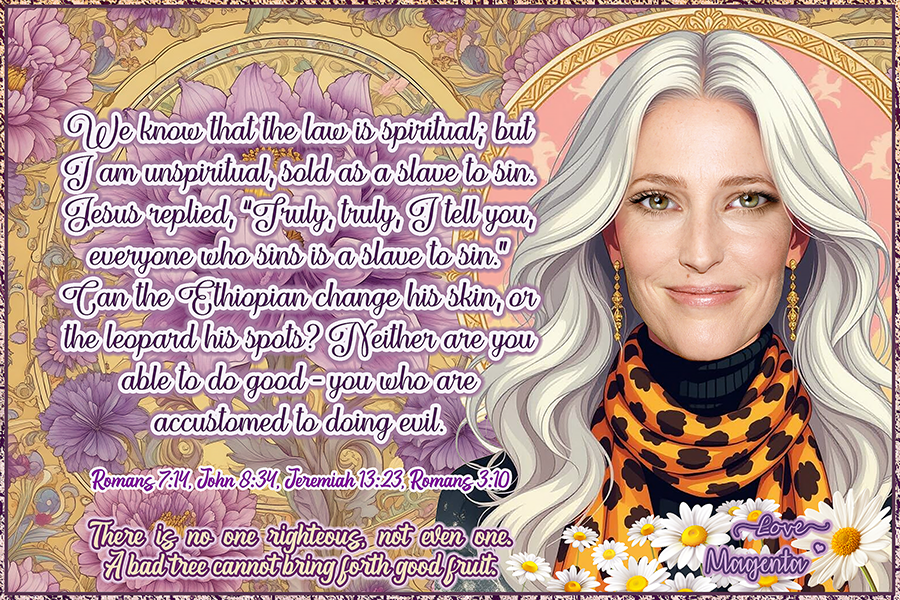
Romans7-14-John8-34-Jeremiah13-23-Romans3-10.png

Romans 7 v 14, John 8 v 34, Jeremiah 13 v 23, Romans 3 v 10 ~ We know that the law is spiritual; but
I am unspiritual, sold as a slave to sin. Jesus replied, “Truly, truly, I tell you, everyone who sins is a slave to sin.” Can the Ethiopian change his skin, or the leopard his spots? Neither are you able to do good - you who are accustomed to doing evil. There is no one righteous, not even one.
 
False framing is what you do denying that inability is taught in the Bible by Paul,
while continually bring in Gnosticism to confuse the issue and displaying your CDS.
Pelagian heretics claim man is good and can choose to believe with their God-hating hearts.
If that is your stance and it sure seems like it is, then you are a heretic who opposes what Scripture teaches.
ne.

She has me on ignore.

Somebody else tell her that her own depravity is over-riding her reasoning ability, please?

Tell her the following:

Pelagianism is a Christian theological position that denies original sin and asserts that humans have the free will to achieve perfection without divine grace. It was condemned as heresy by the early Church, particularly by St. Augustine, who argued that humans are dependent on God's grace for salvation.

No one here is saying that.
We are not Pelagians.

It's an easy win for her as long as she keeps presenting her, 10,000 pound straw man.

She likes winning so much that she plugs her ears and covers her eyes in order to keep citing her wrongly placed position.
 
So, what happens when a homosexual wants to treat another as he wants to be treated?

The same thing can be said about love thy neighbor as thyself. I look at it as instruction for the righteous who are seeking God on how to enter the sheepfold (see following verse Matthew 7:13). It is the ultimate righteousness, ie, justice/equity, because each will be judged by how they treat others.
 
The same thing can be said about love thy neighbor as thyself. I look at it as instruction for the righteous who are seeking God for how to enter the sheepfold (see following verse Matthew 7:13). It is the ultimate righteousness, ie, justice/equity, because each will be judged by how they treat others.


How we treat others should be according to having, or not having, sound doctrine.
Having the Word.
Having Christ.
 
One is not having the use of something the other is having it full of disease.
I don't know really, it's a word salad really.
I mean a person can't win when it comes to reasoning with there own human emotions unless they've learned how to handle them.

How many times must you get bit before you learn to cope with being bit, coz if so many people doing the biting are all saying totally depraved means something else, then why choose to keep biting them people ?

unless somebody feels there totally depraved and there attacking you because they don't feel it's there fault ?.