Can We Really Exercise Free Will?

  • Christian Chat is a moderated online Christian community allowing Christians around the world to fellowship with each other in real time chat via webcam, voice, and text, with the Christian Chat app. You can also start or participate in a Bible-based discussion here in the Christian Chat Forums, where members can also share with each other their own videos, pictures, or favorite Christian music.

    If you are a Christian and need encouragement and fellowship, we're here for you! If you are not a Christian but interested in knowing more about Jesus our Lord, you're also welcome! Want to know what the Bible says, and how you can apply it to your life? Join us!

    To make new Christian friends now around the world, click here to join Christian Chat.
from1-Corinthians1-18-21.png

The message of the cross is foolishness to those who are perishing, but to us who are being saved it is the power of God. For it is written: “I will destroy the wisdom of the wise; the intelligence of the intelligent I will frustrate.” Since the world through its wisdom did not know Him, God was pleased through the foolishness of what was preached to save those who believe. from 1 Corinthians 1 verses 18-21 The natural man does not choose to believe that which he can neither receive nor comprehend, for it is foolishness to him.
 
  • Like
Reactions: Komentaja
Welcome to the thread.

To answer your question as briefly as I can, I'll use the title to a classic work on the Christian life that was written by the late Francis Schaeffer (a Calvinist): "How Shall We Then Live?", as springboard. To follow up on this question, we could also reasonably ask: Who or what should inform how we live our Christian life?

We dare not compare ourselves against our fellow man since we would inevitably judge unrighteously, but even worse we don't want to fall under God's curse for going that route (Jer 17:5).

Nor do we want to place trust in ourselves or our own judgment since man's heart is utterly deceitful (Jer 17:9). All mankind is generally untrustworthy. Even our own consciences are corrupt and cannot be our infallible guide. And we can see this truth plainly in the real world, since neither civil authorities nor the private sectors throughout this fallen world operate on the honor system. Rather, the universal principle (law) that we witness is one of DISTRUST. Mankind is inherently untrustworthy! (If you're interested I wrote some on this universal law in my 2,771 on 7/14 since some here are pretty dismissive of Jer 17:9)

The only option left is to trust in God (Jer 17:7). God revealed his holy, perfect will in scripture. The Gold Standard, therefore, is God's Word. His Word is the only infallible, authoritative standard for judging ourselves. By using another standard, we would definitely fall short just on the basis of an inferior standard alone.

Therefore, all the conditional statements, sobering exhortations and chilling warnings are designed to test ourselves against God's Word. We are called to examine ourselves to see if we're in the [revealed objective] faith (1Cor 11:28; 2Cor 13:5). It's no accident that both of these exhortations are found in a church that had more than its share of spiritual problems. But there's also a lot of irony in these two passages since the Lord himself told Paul that He had "many people" in Corinth (Act 18:7-10), which is why Paul ministered there for so long.

Another reason for examining ourselves is the Sheep metaphor. Sheep aren't the brightest animals on this planet, nor are they high up on the food chain, nor are they swift of foot. And Sheep are a lot like lost human beings and can be their own worst enemy since they have this strong proclivity to stray from their shepherds and the flock (Isa 53:6). Sheep, therefore, are helpless and need to be under the constant care and watch of the Good Shepherd who will rescue a lost sheep. (For your info Freewill Theology is totally dismissive of the dire and helpless state of mankind.)

To sum up, then, all these dire warnings and conditional statements in scripture are God's gracious way to get us to examine ourselves for our own good. Both "backsliders" and pious, God-fearing saints benefit from these kinds of texts. A repentant backslider (a wayward sheep) benefits because God has put the fear of himself in that person and turned him away from his sin; likewise a godly person benefits because his heart is filled with praise and thanksgiving to the Lord for the gift of His precious, persevering grace that has kept him on the narrow path to Life. Moreover, such texts can be beneficial to someone who has been living under the delusion of biblical faith but in reality deceived himself into believing his faith was genuine. God can use such a text to get this person, too, to come to his senses, repent and believe the gospel.

In a separate post, I'll to beam up a copy of Charles Spurgeon's meditation for today which, providentially, is appropriate for this topic. If you have any questions, feel free to ask.
Thank you. That is one question off my list. I now understand what the warning passages are there for. My reasoning for asking was what I saw in John 6, how all those who are given to the Son actually come. So it is an invitation with a guarantee that they will come and will be raised up on the last day. It is hard to reconcile that with apostasy, but I remained in the belief that genuine believers can fall because of passages like Hebrews 10:26-29 and Hebrews 6:4-6 and others.

The brick wall I kept running into was if these people that are given are guaranteed to come and be raised and are said to never perish, how could they be unborn again since you are born of incorruptible seed. I explained this by saying they can be spit out of Jesus' mouth (This is a verse in Revelation) but it still contradicts the never perish and guarantee.

Very enlightning this. I am on your side. Could you comment on Ezekiel 22:30 which says this:
"I searched for a man among them to repair the wall and stand in the gap before Me on behalf of the land, so that I should not destroy it. But I found no one."

Couldn't God have just regenerated someone to stand the gap He wanted to be filled? Or is this a case of God using anthropomorphisms. What do you believe, sir?

I will look into some of the material to study it further. God is calling me to do it.
 
Ezekiel 18:32

King James Version


32 For I have no pleasure in the death of him that dieth, saith the Lord God: wherefore turn yourselves, and live ye.
God indeed has no pleasure in sin, yet commands to turn and live; otherwise, they will be utterly condemned if they don't. It's a matter of choice, like, you have to believe it or not.
 
I fully understand the interpretation and am simply explaining another perspective based in legitimate use of Greek language, historical forms of argument, and relatively recent scholarship. The debating over this part of Scripture has a long history and there is more in the context than what you've included and highlighted above.
Sorry bro.

Its not there. nor would it make sense. You can not force something into a text that is not there. Paul had no war before he was saved,, He could only do bad..

As said, there is relatively recent scholarship doing a lot of work in Paul's writings and one area of focus is on his use of rhetorical devises to thread the combining of Hebrew and Greek cultures as he was assigned to do. So, whether or not we're dogmatic on our interpretation there are some who are focusing on things like this and bringing extensive research to bear on Paul's work. Some of this effort is attempting to settle long term debates.

I can see how this rhetoric point of view makes sense. It's obviously fine if you don't.

If you read what I wrote I'd hope you'd see that I see a bit of both views in the context and flow of Rom6-8.
lol. Yes. alot of people are trying to change the words of God. they have been doing that for years,

And no. I can not see both views. the view paul spoke of past tense. before he was saved does not fit.

Again, He had no law

And again, he could not serve Christ.

romans 7: So then, with the mind I myself serve the law of God, but with the flesh the law of sin.

These are the two laws Paul said he struggled with. and this is his answer to how he will work through it. it is present tense. it is not he struggled with the flesh before he was saved and now he can serve God in his present state of salvation.

That does not fit.

It is not a past issue, it is a present issue.
 
This is what I wrote: "Paul is talking about his past unsaved state" and you respond with the above? If English is not your first language it would be understandable but otherwise when someone says they are taking about their past, it means they are talking in the present about their past. I'm not misapplying anything.

Is english your language?

When I talk about my past state in the present. I say things like I struggled mightily (past tense) or I walked to the church (past tense) or I had a decision to make. and I chose to take the car, not the truck All of these are past tense reviews of what I did.

If I was talking about present tense. I would say I struggle between the flesh and the spirit, I am walking to church, or I have a decision to make, shouold I take the care or the truck.

what your doing is trying to fit your belief system into what Paul wrote.. not actually listening to what paul said

He was not talking about his past unsaved state, he was talking about his present state and the battle we all face daily. And what was pauls final conclusion?

rom 7: So then, with the mind I myself serve the law of God, but with the flesh the law of sin.

This is how he will work through this battle between the flesh and the spirit

Which is what I said.
Yes. But there was no struggle with the spirit. because he did not have the spirit yet.

The struggle is not with his spirit, it is with his mind (soul) and flesh (body). Our spirit has no struggle with God's word because our spirits are born of God. Jn.3:6 We all had a mind before we became saved but we had no spirit until we were born again.
lol.. Your souls is born again, your soul could not do good before you were saved, before ther spirit changed it.
As for the rest of your post, I think you have misunderstood what I said in the first place and it has thrown you offside for I can make no sense of it except to say walking after the flesh when one is saved was not the point of Rom.7 The point was to show our helplessness in saving ourselves no matter how much we try to do what is right and good.
Paul was not talking about his presaved state.

unless I misunderstand you. this is what you said.

Again, the fact paul used the last sentence to show how he would serve one law this way and another law another way. Proves he was speaking of a battle he was going through.

am I to assume to do not go through this struggle yourself?
 
I don't understand the confusion of me saying "he is talking about his past unsaved state" as if it is some mystery writing. He is in the present talking about his past. I don't see why that is so hard to understand from what I said but I appreciate your thoughts on the matter. :)
Its not hard to see if you could prove it

But the text does not insinuate this at all

It is only a part of the Christian life if we fail to be led of the Spirit otherwise, there is no struggle. It does take awhile to learn how to walk according to the Spirit so usually our early walk, just like a baby/toddler, looks pretty shaky but that is why we persevere. But, if one is walking after the Spirit, you will not see Romans 7 active within one's life instead it will be Romans 8:1-2 . Freedom all the way, Hallelujah! :D

But if you look at a child of Gods life as a whole. you see romans 7.

Paul in his late stage struggled.

Like I said, should I assume you do not?

are you sinless?
 
I know ... I get tired of folks just putting blinders on when it comes to what God reveals concerning the gospel being presented and one either believes and receives blessing or suppresses the truth in unrighteousness and receives the consequence ... somewhat astounding when you think about who does what in those verses.


.
Yes

He who believes is not condemned,

he who does not obey (does not believe) is condemned already. because they have not believed.

in the end God is glorified. He paid their way in, they rejected the offer..
 
Because believers never ever ever talk about what is true of non-believers? And Paul never did? Psshhhh.
He never mentioned what he was like as an unbeliever? Never said anything about them being blinded,
under the power and influence of the devil? Gosh. Who then said all those thing, about children of wrath,
of being once like them, a lot was said in that regard. An awful lot. Are you really trying to tell us it was not Paul???


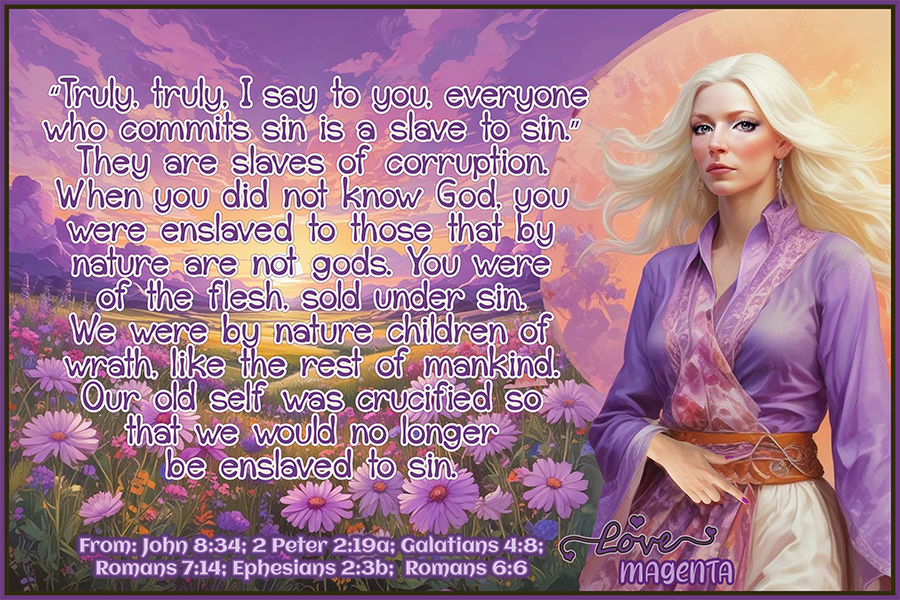
From-John8-34-2-Peter2-19a-Gal4-8-Rom7-14-Eph2-3-Rom6-6.png

From: John 8 verse 34; 2 Peter 2 verse 19a; Galatians 4 verse 8; Romans 7 verse 14; Ephesians 2 verse 3b; Romans 6 v 6 ~ “Truly, truly, I say to you, everyone who commits sin is a slave to sin.” They are slaves of corruption. When you did not know God, you were enslaved to those that by nature are not gods. You were of the flesh, sold under sin. We were by nature children of wrath, like the rest of mankind. Our old self was crucified so that we would no longer be enslaved to sin.
so because you see this in how you read

we make God into a dictator who forces people to believe. and does not even offer others the chance to be saved.

People should be sickened by the thought of this
 
Thank you. That is one question off my list. I now understand what the warning passages are there for. My reasoning for asking was what I saw in John 6, how all those who are given to the Son actually come. So it is an invitation with a guarantee that they will come and will be raised up on the last day. It is hard to reconcile that with apostasy, but I remained in the belief that genuine believers can fall because of passages like Hebrews 10:26-29 and Hebrews 6:4-6 and others.

The brick wall I kept running into was if these people that are given are guaranteed to come and be raised and are said to never perish, how could they be unborn again since you are born of incorruptible seed. I explained this by saying they can be spit out of Jesus' mouth (This is a verse in Revelation) but it still contradicts the never perish and guarantee.

Very enlightning this. I am on your side. Could you comment on Ezekiel 22:30 which says this:
"I searched for a man among them to repair the wall and stand in the gap before Me on behalf of the land, so that I should not destroy it. But I found no one."

Couldn't God have just regenerated someone to stand the gap He wanted to be filled? Or is this a case of God using anthropomorphisms. What do you believe, sir?

I will look into some of the material to study it further. God is calling me to do it.
Keep reading John 6.

John 6: 38 For I have come down from heaven, not to do My own will, but the will of Him who sent Me. 39 This is the will of the Father who sent Me, that of all He has given Me I should lose nothing, but should raise it up at the last day. 40 And this is the will of Him who sent Me, that everyone who sees the Son and believes in Him may have everlasting life; and I will raise him up at the last day.”

sadly. some want to focus on no one will be lost. and amen to that, no one will be lost (salvation can not be lost) but they do not focus on who they are.

they are they who sees and believes.

it is these who are predestined.
 
Ezekiel 18:32

King James Version


32 For I have no pleasure in the death of him that dieth, saith the Lord God: wherefore turn yourselves, and live ye.
God indeed has no pleasure in sin, yet commands to turn and live; otherwise, they will be utterly condemned if they don't. It's a matter of choice, like, you have to believe it or not.
its sad God had no pleasure. but their is a group of people who seem to boast in glory they were chosen. and others are lost. and it was all Gods doing
 
  • Like
Reactions: fredoheaven
15 But he that is spiritual judgeth all things, yet he himself is judged of no man.

This passage has proved quite perplexing to me. But, presented in the context of your expository discourse, the meaning of this verse seems a bit clearer that no man is capable of judging him because they lack the spiritual insight needed to judge rightly, except those given that mystery and those are aware that 'there is no condemnation for those in Christ Jesus.'
 
Its not hard to see if you could prove it

But the text does not insinuate this at all


But if you look at a child of Gods life as a whole. you see romans 7.

Paul in his late stage struggled.

Like I said, should I assume you do not?

are you sinless?
so because you see this in how you read

we make God into a dictator who forces people to believe. and does not even offer others the chance to be saved.

People should be sickened by the thought of this
It would be a spectacular feat if anyone could reconcile the thought that God causes someone's heart to believe but stops short in taking any residue of sin completely out of their hearts, so it makes sense why some might have to 'believe' they are sinless. I suppose they need to think this for some sort of 'proof' one is saved. But it doesn't seem that God regards works as not proof an anything. Fruit, on the other hand, are spiritual, joy, peace, longsuffering, cannot be measured in the sense that works can be measured. Everyone can give but is the joy genuine. Everyone can keep quiet, but is the peace genuine, and so on.
 
None could keep the commandments perfectly. And in fact Scripture explicitly states that the man of flesh
is incapable of submitting to God's law. If this were not so, why in the world was Jesus even required? God
knew before He even made man than man was going to sin. The man of flesh is the one who is as yet
unregenerate, also known as the natural man. He is a lover of darkness and slave to sin who suppresses
the truth in unrighteousness, able to neither receive/accept nor comprehend the spiritual things of God.


bornintransgression.png

Man is born in transgression and sin (Psalm 51 verse 5, 58 verse 3), dead in transgressions (Ephesians 2 verse 5), his heart is deceitful above all things and beyond cure (Jeremiah 17 verse 9), held captive by a love for sin (John 3 verse 19; John 8 verse 34), so that he will not seek God (Romans 3 verses 10-11), because he loves the darkness (John 3 verse 19), and does not understand the things of God (1 Corinthians 2 verse 14), nor can he change himself (Jeremiah 13 verse 23). He suppresses the truth of God in unrighteousness (Romans 1 verse 18) and continues to willfully live in sin because he is totally depraved; this sinful lifestyle seems right to men (Proverbs 14 verse 12); they reject the gospel of Christ as foolishness (1 Corinthians 1 verse 18), and their mind is hostile to God; it does not submit to God’s law, nor can it do so. (Romans 8 verse 7).
3,000 the first day and almost 10,000 by the end of the week became believers from Peter's simple message to repent and be Baptized in the name of Jesus.
 
But it doesn't seem that God regards works as not proof an anything.
That was meant to read as, "God doesn't regard works as proof of anything." God prepares good works that you should do them, and He regards how you do them, whether joyfully or grudgingly, as hay, stubble, or fruitful and enduring.
 
"...that we should walk in them," as opposed to falling in them (which amounts to the same as to fail in them).
 
None could keep the commandments perfectly. And in fact Scripture explicitly states that the man of flesh
is incapable of submitting to God's law. If this were not so, why in the world was Jesus even required? God
knew before He even made man than man was going to sin. The man of flesh is the one who is as yet
unregenerate, also known as the natural man. He is a lover of darkness and slave to sin who suppresses
the truth in unrighteousness, able to neither receive/accept nor comprehend the spiritual things of God.


bornintransgression.png

Man is born in transgression and sin (Psalm 51 verse 5, 58 verse 3), dead in transgressions (Ephesians 2 verse 5), his heart is deceitful above all things and beyond cure (Jeremiah 17 verse 9), held captive by a love for sin (John 3 verse 19; John 8 verse 34), so that he will not seek God (Romans 3 verses 10-11), because he loves the darkness (John 3 verse 19), and does not understand the things of God (1 Corinthians 2 verse 14), nor can he change himself (Jeremiah 13 verse 23). He suppresses the truth of God in unrighteousness (Romans 1 verse 18) and continues to willfully live in sin because he is totally depraved; this sinful lifestyle seems right to men (Proverbs 14 verse 12); they reject the gospel of Christ as foolishness (1 Corinthians 1 verse 18), and their mind is hostile to God; it does not submit to God’s law, nor can it do so. (Romans 8 verse 7).

Very true as to why we needed God and Jesus.

John 6:44 ESV
No one can come to me unless the Father who sent me draws him. And I will raise him up on the last day.

John 12:32 ESV
And I, when I am lifted up from the earth, will draw all people to myself.”

God draws all people as only God could do in the hearts of mankind. But...

Matthew 7:13-14 ESV
“Enter by the narrow gate. For the gate is wide and the way is easy that leads to destruction, and those who enter by it are many. For the gate is narrow and the way is hard that leads to life, and those who find it are few.

I believe that to solve this doctrine debate we have to use,

"not either/or, but both/and."

The concept of "both/and" in Bible interpretation suggests that many biblical truths can coexist rather than being mutually exclusive.

Hebrews 11:6 ESV
And without faith it is impossible to please him, for whoever would draw near to God must believe that he exists and that he rewards those who seek him.

Scripture has three words. Faith (pistis) faith (pisteuo) and believe (pisteuo)

PISTEUO:

4100 pisteúō (from 4102 /pístis, "faith," derived from 3982 /peíthō, "persuade, be persuaded") – believe (affirm, have confidence); used of persuading oneself (= human believing) and with the sacred significance of being persuaded by the Lord
(= faith-believing).

Only the context indicates whether 4100 /pisteúō ("believe") is
self-serving (without sacred meaning), or the believing that leads to/proceeds
from God's inbirthing of faith.


PISTIS:

Ephesians 2:8 New International Version (NIV)
8 For it is by grace you have been saved, through faith—and this is not from yourselves, it is the gift of God—

(4102/pistis) It is always a gift from God, and never something that can be produced
by people.

CONCLUSION:

In short, 4102/pistis ("faith") for the believer is "God's divine
persuasion" – and therefore distinct from human belief (confidence), yet involving
it. The Lord continuously births faith in the yielded believer so they can know what He prefers, i.e. the persuasion of His will (1 Jn 5:4)

 
Sorry bro.

Its not there. nor would it make sense. You can not force something into a text that is not there. Paul had no war before he was saved,, He could only do bad..

Of course, Paul had a war in the inner man before he believed Jesus is Christ. We all do unless and until our consciense is completely scarred over. That battle in the inner man is what our God designed conscience interacting with God's Law written in hearts and at work in hearts of men created in His likeness does Rom2:14-15. If not for this God designed and implemented grace in mankind, there would be no mankind. It's one of His restraints against sin.

What you said sounds calvinistic all of a sudden. IMO you're reading "he could only do bad" into the passages. First, we should probably define "bad". Second, we're reading a man who is speaking of wrestling with his conscience vs. flesh under law. Third, there was faith at minimum from Abel on Heb11. Balance Rom7 with these and Phil3:4-6 where Paul most certainly thinks he was not "only do[ing] bad".

One of the mistakes we're making with these arguments is missing the different perspectives - the different viewpoints - written into the Text. It's one of the issues with the Rom3 verses constantly being thrown out as proof that for example no man seeks God. But there are plenty of examples of men seeking God and commands and instruction in the Text to do just that. Read the Psalms that Rom3 is pulled from and see that they're speaking of Perfect God looking down from Heaven. This is Perfect God who desires from His perspective perfection as seen in His Unique Son. The Perfect God who no longer wanted sins and sacrifices, so He sent His Perfect Son to get rid of it all and institute the new creation under new covenant. And the same Perfect God whom Peter said this about in regard to the believer in God while yet unbeliever in Jesus YHWH's Anointed:

NKJ Acts10:34-35 Then Peter opened his mouth and said: "In truth I perceive that God shows no partiality. 35 "But in every nation whoever fears Him and works [to accomplish] righteousness is accepted by Him.​

Again, that's speaking of a Gentile believer in the God of the Jews who had not yet heard God's Gospel of Jesus Christ. It's akin to the Remnant alive at the time of Christ's first advent - those like Zacharias and Elizabeth Luke1:5-16 who were not "only do[ing] bad".

This is hardly about men doing only "bad". We just have to understand that the righteousness and blamelessness of people before Christ is not the ultimate righteousness and blamelessness leading to perfection/completion in Christ in Spirit under grace in the New Covenant era.


We have had discussions before. We have a lot of agreement on things you've said on this thread. I'm going to make a request to see if I will continue discussions or maybe you'll just drop off at this request - please stop with the "lol" mocking.

You're not mocking me or just me, but a fairly large group of Christians a lot more learned in the Text and languages and types of literature we're dealing with than you or me or anyone on this forum from what I've seen. You're also, whether you know it or not, entering into fallacies inferring that all this work being done by Christians to continue to try to resolve interpretive conflicts among Christians is "trying to change the words of God". That's just nonsense so I'll pass on the rest of this post.

If you or anyone else would like to go through Rom7 verse by verse, please let's do so. But you'll have to cooperate and make your case at every point and explain why you disagree, and I'll be asking you to classify parsing beyond just "present tense" for example because present tense is broken down into types and uses of present tense as is every other tense.

I'd truly appreciate your consideration of my request re: the mocking. It's unnecessary.
 
Of course, Paul had a war in the inner man before he believed Jesus is Christ. We all do unless and until our consciense is completely scarred over. .
the things of God are foolishness to those who are not his

Not Paul did not have a war. He did everything through his flesh. even his obedience to the law was according to his flesh. not according to the spirit.

but hey, thanks for the conversation.. We will never agree. and no need to continue
 
Only the context indicates whether 4100 /pisteúō ("believe") is self-serving (without
sacred meaning), or the believing that leads to/proceeds from God's inbirthing of faith.
Many here do not believe faith is a gift given. Scripture says all good things come from God but they will contradict and deny that faith is part of that just as surely as they contradict and deny many many other passages. There are quite a few Pelagian heretics here, also. Aside from minimizing what is said of the wickedness of the unregenerate man, some specifically claim that when Scripture says there are none good it only applies to atheists. They rewrite what Jesus said so instead of Him saying, whoever sins is a slave to sin, He says whoever chooses to sin is a slave to sin. And again, according to them, it is only atheists who choose to sin. All other unbelievers are somehow excluded from these considerations. As sinners they don't choose to sin, as sinners they are considered good. It is hard to escape these conclusions which must be drawn from their claims, and quite frankly they make no sense. All fall short and there are none good but God.
 
Sometimes I wonder if a blogger I frequently read isn't a member here or if he might read through the threads especially today since he touched briefly about what he called learning about Jesus 'secondhand.' Salvation is an individual not a group event, and the work of others, although often helpful to some degree, only provides insight into their person experiences and opinions.

It is said of witnesses that if everyone story is exactly the same, then it's safe to assume that they've all corroborated a lie. Realistically, if each person of any particular group provides their own accounts, you should find various idiosyncrasies within each member as no one 'sees' exactly the same as the other. This is true among the rabbinical schools of thought as well as any other religion as much as it is among the various Christian schools of thought. One offered something along the thought that, when it comes time to stand before God, no one is going to hear God ask, "Why were you not more like Moses," but will hear "Why were you not more like (insert your own name here)" in the sense that God creates everyone by design to be exactly as he intended.

I didn't take this lesson as meaning that everyone should 'do their own thing' but that God created Adam all by himself with no one else in mind other than Himself (but of course notwithstanding that "man" is created with "us" in mind and created He them, in the beginning, etc.) if anyone should know the meaning of the Name of God to be "ever-present" I'd think that a rabbi privy to the meaning of YHWH would be aware that God isn't any sort of a historical figure that can only be known 'secondhand' through historical writings.

So, I think this idea is underpinned in @Everlasting-Grace 's nitpicking. But that is my opinion because I might just be seeing it through my view of considering others' writings always with a consumer advisory in the background that that I am reading the view of an image other than mine (but most of all, other than God Himself Who never errs and Whose Grace is unmatched as is His perfection).

And I think this is not all I wanted to add to the commentary on this thread, but I've exceeded my five-sentence paragraph policy and have written an entire five-paragraph page.....:oops:
Think as you wish. However, I believe that @Everlasting-Grace was making much-to-do about nothing. I never implied that men's writing was to be placed above scripture. I do however, think that the thoughts of others help us in forming our own understanding.

Christ must have thought along the same lines as He chose disciples and gave them the commission to Go Into The World.