Can We Really Exercise Free Will?

  • Christian Chat is a moderated online Christian community allowing Christians around the world to fellowship with each other in real time chat via webcam, voice, and text, with the Christian Chat app. You can also start or participate in a Bible-based discussion here in the Christian Chat Forums, where members can also share with each other their own videos, pictures, or favorite Christian music.

    If you are a Christian and need encouragement and fellowship, we're here for you! If you are not a Christian but interested in knowing more about Jesus our Lord, you're also welcome! Want to know what the Bible says, and how you can apply it to your life? Join us!

    To make new Christian friends now around the world, click here to join Christian Chat.
Your question answers itself: If some were NOT sinners, then God would not be unfair to save them but not the sinners.
I advise against calling God a liar just because you ignore GW.

What is the Federal Head of God's elect: Chopped Liver! Wasn't He the sinless one!?

Moreover, you should try really hard to cultivate the habit of LISTENING to YOURSELF before you post embarrassing drivel! In your hypothetical, explain to me why God would need to save anyone who has not sinned? From what precisely do they need to be saved? :rolleyes::rolleyes:
 
There is a classification of the present tense that allows a writer to speak of the past and put himself there for rhetorical or dramatic purposes even using the first person "I" as if he's only speaking of himself while actually including those going through the same thing - wrestling against the flesh under Law.

IMO, this is what Paul is doing. He's looking back mainly pre-conversion with new insights and explaining life pre-Christ. Reading this light, Rom7:25 becomes not just thankfulness for the solution but kind of an epiphany leading into Rom8 where he immediately takes up the no more condemnation using a word that speaks not of the sentence but the result of the sentence being the actual imprisonment.

So, FWIW, I think Paul is looking back pre-Christ, using rhetorical parsing to make it all about himself personally while explaining it for any and all under Law wrestling with the flesh, and using it dramatically to culminate in an epiphany and thanksgiving for the amazing solution God provided and then going on to explain the freedom from imprisonment under sin and death and new life thinking and walking in Spirit.

To include what @Everlasting-Grace says, I also see in all of this that the wrestling with the flesh is still part of the Christian Life as the mind and the will in Christ in Spirit proceeds to being matured as we learn about our freedom and the by grace abilities, we have to choose to override the inclinations of the flesh. I think this is baked into Rom8 where we have commands to our volition to do so.

romans 7:
5 For what I am doing, I do not understand. For what I will to do, that I do not practice; but what I hate, that I do. 16 If, then, I do what I will not to do, I agree with the law that it is good. 17 But now, it is no longer I who do it, but sin that dwells in me. 18 For I know that in me (that is, in my flesh) nothing good dwells; for to will is present with me, but how to perform what is good I do not find. 19 For the good that I will to do, I do not do; but the evil I will not to do, that I practice. 20 Now if I do what I will not to do, it is no longer I who do it, but sin that dwells in me.

21 I find then a law, that evil is present with me, the one who wills to do good. 22 For I delight in the law of God according to the inward man. 23 But I see another law in my members, warring against the law of my mind, and bringing me into captivity to the law of sin which is in my members. 24 O wretched man that I am! Who will deliver me from this body of death? 25 I thank God—through Jesus Christ our Lord!

So then, with the mind I myself serve the law of God, but with the flesh the law of sin.

Paul is speaking of his present condition., what he is struggling with. what all of us struggle with. and he ends it with a conclusion.

Right here, right now.. With my mind I will serve the law of God. but with the flesh, the law of sin.

That was not his past situation.
 
thanks brother. im so grateful God lead me to this understanding.

when i first showed up on this forum i was in heavy works salvation. i could never reconcile the bible's demand for holiness with the verses about salvation being solely of God. until i found the augustinian view of it which combines the two in beautiful harmony.
what about Jesus view?
 
  • Like
Reactions: Melach
simplyprofound.gif

It is God Who works in you to will and to act on behalf of His good purpose. Apart from Me you can do nothing. No word from God will ever fail. “It is easier for a camel to pass through the eye of a needle than for a rich man to enter the kingdom of God.” Those who heard this asked, “Who then can be saved?” But Jesus said, “What is impossible with man is possible with God.”
 
What is the Federal Head of God's elect: Chopped Liver! Wasn't He the sinless one!?

Moreover, you should try really hard to cultivate the habit of LISTENING to YOURSELF before you post embarrassing drivel! In your hypothetical, explain to me why God would need to save anyone who has not sinned? From what precisely do they need to be saved? :rolleyes::rolleyes:
The claim I have seen made is that only those who choose to sin are wicked, and only applies to atheists, which is rewriting what Jesus said, but those who hold to their vain man-exalting theology must ignore, contradict, and outright deny what Scripture explicitly states.
 
so true ... following men leads to the problems Paul revealed concerning the church at Corinth:

contentions:

1 Corinthians 1:11-13 For it hath been declared unto me of you, my brethren, by them which are of the house of Chloe, that there are contentions among you. Now this I say, that every one of you saith, I am of Paul; and I of Apollos; and I of Cephas; and I of Christ. Is Christ divided? was Paul crucified for you? or were ye baptized in the name of Paul?


lack of spiritual growth – Paul could not go beyond Jesus Christ and Him crucified (the gospel) in the general congretation:

1 Corinthians 2:1-2 And I, brethren, when I came to you, came not with excellency of speech or of wisdom, declaring unto you the testimony of God. For I determined not to know any thing among you, save Jesus Christ, and him crucified.


carnality:

1 Corinthians 3:1-4 And I, brethren, could not speak unto you as unto spiritual, but as unto carnal, even as unto babes in Christ. I have fed you with milk, and not with meat: for hitherto ye were not able to bear it, neither yet now are ye able. For ye are yet carnal: for whereas there is among you envying, and strife, and divisions, are ye not carnal, and walk as men? For while one saith, I am of Paul; and another, I am of Apollos; are ye not carnal?


Those who include the gospel in 1 Cor 2:14 reveal they do not understand the wisdom of God in a mystery, even the hidden wisdom, which God ordained before the world unto our glory (1 Cor 2:7). Believing the gospel opens the door to spiritual maturity and an ability to understand the more in-depth spiritual matters, but to include the gospel in 1 Cor 2:14 is improper interpretation of the Word of God.
.
So true, 1 Cor. 2:14 talks about the deep things about God and his word. Nothing to do with the gospel.
 
The claim I have seen made is that only those who choose to sin are wicked, and only applies to atheists, which is rewriting what Jesus said, but those who hold to their vain man-exalting theology must ignore, contradict, and outright deny what Scripture explicitly states.
Good post! Romans 3:23
 
romans 7:
5 For what I am doing, I do not understand. For what I will to do, that I do not practice; but what I hate, that I do. 16 If, then, I do what I will not to do, I agree with the law that it is good. 17 But now, it is no longer I who do it, but sin that dwells in me. 18 For I know that in me (that is, in my flesh) nothing good dwells; for to will is present with me, but how to perform what is good I do not find. 19 For the good that I will to do, I do not do; but the evil I will not to do, that I practice. 20 Now if I do what I will not to do, it is no longer I who do it, but sin that dwells in me.

21 I find then a law, that evil is present with me, the one who wills to do good. 22 For I delight in the law of God according to the inward man. 23 But I see another law in my members, warring against the law of my mind, and bringing me into captivity to the law of sin which is in my members. 24 O wretched man that I am! Who will deliver me from this body of death? 25 I thank God—through Jesus Christ our Lord!

So then, with the mind I myself serve the law of God, but with the flesh the law of sin.

Paul is speaking of his present condition., what he is struggling with. what all of us struggle with. and he ends it with a conclusion.

Right here, right now.. With my mind I will serve the law of God. but with the flesh, the law of sin.

That was not his past situation.

I fully understand the interpretation and am simply explaining another perspective based in legitimate use of Greek language, historical forms of argument, and relatively recent scholarship. The debating over this part of Scripture has a long history and there is more in the context than what you've included and highlighted above.

As said, there is relatively recent scholarship doing a lot of work in Paul's writings and one area of focus is on his use of rhetorical devises to thread the combining of Hebrew and Greek cultures as he was assigned to do. So, whether or not we're dogmatic on our interpretation there are some who are focusing on things like this and bringing extensive research to bear on Paul's work. Some of this effort is attempting to settle long term debates.

I can see how this rhetoric point of view makes sense. It's obviously fine if you don't.

If you read what I wrote I'd hope you'd see that I see a bit of both views in the context and flow of Rom6-8.
 
He is talking in present tense not past tense. So to say he is speaking about his past. when he is talking about a present struggle is to misapply pauls words.

This is what I wrote: "Paul is talking about his past unsaved state" and you respond with the above? If English is not your first language it would be understandable but otherwise when someone says they are taking about their past, it means they are talking in the present about their past. I'm not misapplying anything.

Paul had no struggle before salvation except with his flesh.

Which is what I said.

the spirit and the ability was not yet there before he came to christ.

The struggle is not with his spirit, it is with his mind (soul) and flesh (body). Our spirit has no struggle with God's word because our spirits are born of God. Jn.3:6 We all had a mind before we became saved but we had no spirit until we were born again.

As for the rest of your post, I think you have misunderstood what I said in the first place and it has thrown you offside for I can make no sense of it except to say walking after the flesh when one is saved was not the point of Rom.7 The point was to show our helplessness in saving ourselves no matter how much we try to do what is right and good.
 
There is a classification of the present tense that allows a writer to speak of the past and put himself there for rhetorical or dramatic purposes even using the first person "I" as if he's only speaking of himself while actually including those going through the same thing - wrestling against the flesh under Law.

IMO, this is what Paul is doing. He's looking back mainly pre-conversion with new insights and explaining life pre-Christ. Reading this light, Rom7:25 becomes not just thankfulness for the solution but kind of an epiphany leading into Rom8 where he immediately takes up the no more condemnation using a word that speaks not of the sentence but the result of the sentence being the actual imprisonment.

So, FWIW, I think Paul is looking back pre-Christ, using rhetorical parsing to make it all about himself personally while explaining it for any and all under Law wrestling with the flesh, and using it dramatically to culminate in an epiphany and thanksgiving for the amazing solution God provided and then going on to explain the freedom from imprisonment under sin and death and new life thinking and walking in Spirit.

To include what @Everlasting-Grace says, I also see in all of this that the wrestling with the flesh is still part of the Christian Life as the mind and the will in Christ in Spirit proceeds to being matured as we learn about our freedom and the by grace abilities, we have to choose to override the inclinations of the flesh. I think this is baked into Rom8 where we have commands to our volition to do so.

I don't understand the confusion of me saying "he is talking about his past unsaved state" as if it is some mystery writing. He is in the present talking about his past. I don't see why that is so hard to understand from what I said but I appreciate your thoughts on the matter. :)

It is only a part of the Christian life if we fail to be led of the Spirit otherwise, there is no struggle. It does take awhile to learn how to walk according to the Spirit so usually our early walk, just like a baby/toddler, looks pretty shaky but that is why we persevere. But, if one is walking after the Spirit, you will not see Romans 7 active within one's life instead it will be Romans 8:1-2 . Freedom all the way, Hallelujah! :D
 
I don't understand the confusion of me saying "he is talking about his past unsaved state" as if it is some mystery writing. He is in the present talking about his past. I don't see why that is so hard to understand from what I said but I appreciate your thoughts on the matter. :)

It is only a part of the Christian life if we fail to be led of the Spirit otherwise, there is no struggle. It does take awhile to learn how to walk according to the Spirit so usually our early walk, just like a baby/toddler, looks pretty shaky but that is why we persevere. But, if one is walking after the Spirit, you will not see Romans 7 active within one's life instead it will be Romans 8:1-2 . Freedom all the way, Hallelujah! :D

I'm not confused by what you're saying. I get what both of you are saying.

Usually, the present tense is not used to speak of the past as you are suggesting it, which is what @Everlasting-Grace is getting at.

What I've provided is a form of Greek that does use the present to speak of the past. One such parsing is actually called the "historic present" and it's used stylistically for various purposes some of which I've stated. So, rather than saying I was living such and such, the writer put's himself there in the past with this form of present tense and says as if living and taking us through the historical experience, I'm living such and such, to create a more vivid picture or other things he is trying to make clear. One of the things it can do is draw the reader or the hearer in to share the experience and make it more personal where the audience shares with Paul and puts themselves right there going through the same experience with him.

With this said, I disagree with both of you but in a way see what both of you are saying in the greater context of Rom6-8.

And to a large degree I agree with your second paragraph with one clarification. Even when "led of the Spirit" we will encounter the flesh asserting itself which brings us to a decision to continue our Spiritual Walk. As you've stated it's much more difficult in our Spiritual youth. Then as we mature it becomes much more natural (new nature) to be walking in Spirit and ignoring and even denying the flesh. Part of this is in the language of Heb5 where it speaks of "gymnazo" in becoming mature and well-exercised in discerning both good and bad.
 
  • Like
Reactions: cv5
no i actually attend a pentecostal church. i found my wife there and kinda stayed even though i disagree on some things

If you can get your hands on the the 1644 Confession, you should get a copy and compare it to the later confession.
 
Good post! Romans 3:23
allhavesinned.png

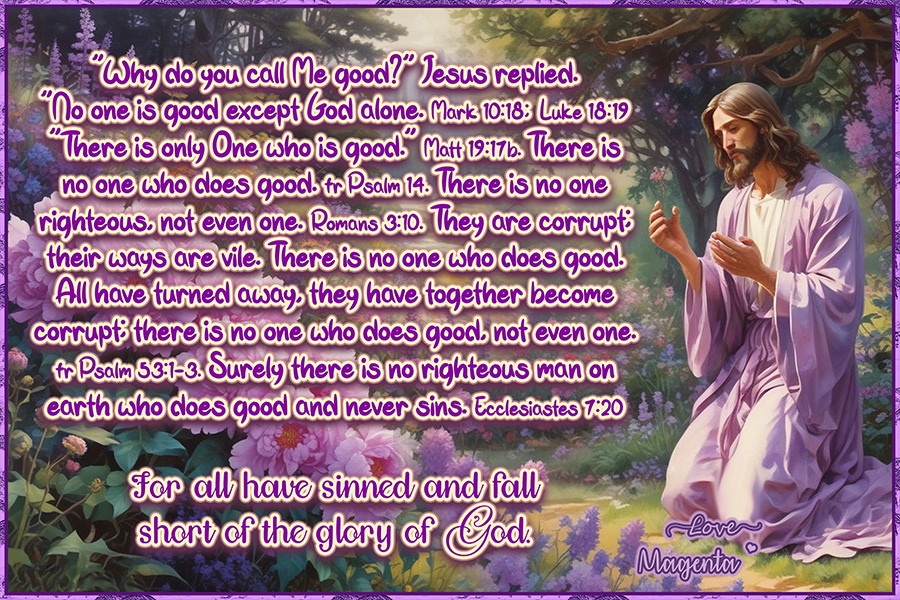
“Why do you call Me good?” Jesus replied. “No one is good except God alone. Mark ch. 10 verse 18 and Luke ch. 18 verse 19 “There is only One who is good.” Matthew ch. 19 verse 17b. There is no one who does good. fr Psalm ch. 14. There is no one righteous, not even one. Romans ch. 3 verse 10. They are corrupt; their ways are vile. There is no one who does good. All have turned away, they have together become corrupt; there is no one who does good, not even one. fr Psalm ch. 53 verses 1-3. Surely there is no righteous man on earth who does good and never sins. Ecclesiastes ch. 7 verse 20. For all have sinned and fall short of the glory of God.
 
fruituntodeath.png

Flesh serves the law of sin. For the flesh craves what is contrary to the Spirit, and the Spirit what is contrary to the flesh. They are opposed to each other. Nothing good lives in my flesh. Who can say, “I have kept my heart pure; I am clean and without sin”? Who can bring what is pure from the impure? No one! The flesh brings forth fruit unto death. Romans 7 v 25, Galatians 5 v 17, Romans 7 v 18, Proverbs 20 v 9, Job 14 v 4, Romans 7 v 5 (Romans 8 v 13 and James 1 v 15)
 
  • Like
Reactions: Cameron143
Komentaza wrote in 4040:

If someone can explain these verses and verse similar to this like Colossians 1:23 and all the warning passages and passages about falling away and all the 'if' verses I will embrace the TULIP right now.

Not a joke challenge.

Why does the Bible say 'if' so many times and have so many exhortations to
-not become apostate
-to not let any bitterness spring up in your hearts
-persevere in the faith
-many if statements.

Do the calvinists have a good response to these? I can understand and appreciate what they are saying. Glory to God alone in salvation. But what about these?

Welcome to the thread.

To answer your question as briefly as I can, I'll use the title to a classic work on the Christian life that was written by the late Francis Schaeffer (a Calvinist): "How Shall We Then Live?", as springboard. To follow up on this question, we could also reasonably ask: Who or what should inform how we live our Christian life?

We dare not compare ourselves against our fellow man since we would inevitably judge unrighteously, but even worse we don't want to fall under God's curse for going that route (Jer 17:5).

Nor do we want to place trust in ourselves or our own judgment since man's heart is utterly deceitful (Jer 17:9). All mankind is generally untrustworthy. Even our own consciences are corrupt and cannot be our infallible guide. And we can see this truth plainly in the real world, since neither civil authorities nor the private sectors throughout this fallen world operate on the honor system. Rather, the universal principle (law) that we witness is one of DISTRUST. Mankind is inherently untrustworthy! (If you're interested I wrote some on this universal law in my 2,771 on 7/14 since some here are pretty dismissive of Jer 17:9)

The only option left is to trust in God (Jer 17:7). God revealed his holy, perfect will in scripture. The Gold Standard, therefore, is God's Word. His Word is the only infallible, authoritative standard for judging ourselves. By using another standard, we would definitely fall short just on the basis of an inferior standard alone.

Therefore, all the conditional statements, sobering exhortations and chilling warnings are designed to test ourselves against God's Word. We are called to examine ourselves to see if we're in the [revealed objective] faith (1Cor 11:28; 2Cor 13:5). It's no accident that both of these exhortations are found in a church that had more than its share of spiritual problems. But there's also a lot of irony in these two passages since the Lord himself told Paul that He had "many people" in Corinth (Act 18:7-10), which is why Paul ministered there for so long.

Another reason for examining ourselves is the Sheep metaphor. Sheep aren't the brightest animals on this planet, nor are they high up on the food chain, nor are they swift of foot. And Sheep are a lot like lost human beings and can be their own worst enemy since they have this strong proclivity to stray from their shepherds and the flock (Isa 53:6). Sheep, therefore, are helpless and need to be under the constant care and watch of the Good Shepherd who will rescue a lost sheep. (For your info Freewill Theology is totally dismissive of the dire and helpless state of mankind.)

To sum up, then, all these dire warnings and conditional statements in scripture are God's gracious way to get us to examine ourselves for our own good. Both "backsliders" and pious, God-fearing saints benefit from these kinds of texts. A repentant backslider (a wayward sheep) benefits because God has put the fear of himself in that person and turned him away from his sin; likewise a godly person benefits because his heart is filled with praise and thanksgiving to the Lord for the gift of His precious, persevering grace that has kept him on the narrow path to Life. Moreover, such texts can be beneficial to someone who has been living under the delusion of biblical faith but in reality deceived himself into believing his faith was genuine. God can use such a text to get this person, too, to come to his senses, repent and believe the gospel.

In a separate post, I'll to beam up a copy of Charles Spurgeon's meditation for today which, providentially, is appropriate for this topic. If you have any questions, feel free to ask.

 
  • Like
Reactions: Komentaja
Here's the Spurgeon Devotional:

July 23rd AM


"Even thou wast as one of them."
Obadiah 1:11

Brotherly kindness was due from Edom to Israel in the time of need, but instead thereof, the men of Esau made common cause with Israel's foes. Special stress in the sentence before us is laid upon the word thou; as when Caesar cried to Brutus, "and thou Brutus"; a bad action may be all the worse, because of the person who has committed it. When we sin, who are the chosen favorites of heaven, we sin with an emphasis; ours is a crying offence, because we are so peculiarly indulged. If an angel should lay his hand upon us when we are doing evil, he need not use any other rebuke than the question, "What thou? What dost thou here?" Much forgiven, much delivered, much instructed, much enriched, much blessed, shall we dare to put forth our hand unto evil? God forbid!

A few minutes of confession may be beneficial to thee, gentle reader, this morning. Hast thou never been as the wicked? At an evening party certain men laughed at uncleanness, and the joke was not altogether offensive to thine ear, even thou wast as one of them. When hard things were spoken concerning the ways of God, thou wast bashfully silent; and so, to on-lookers, thou wast as one of them. When worldlings were bartering in the market, and driving hard bargains, wast thou not as one of them? When they were pursuing vanity with a hunter's foot, wert thou not as greedy for gain as they were? Could any difference be discerned between thee and them? Is there any difference? Here we come to close quarters. Be honest with thine own soul, and make sure that thou art a new creature in Christ Jesus; but when this is sure, walk jealously, lest any should again be able to say, "Even thou wast as one of them." Thou wouldst not desire to share their eternal doom, why then be like them here? Come not thou into their secret, lest thou come into their ruin. Side with the afflicted people of God, and not with the world.
 
  • Like
Reactions: Komentaja
Many have probably realised i don't think we can exercise free will, even think it's impossible for us to. Won't explain why i think it's an impossiblility for us yet, think it's useful for some to express why they think it exists first.

I have no doubt we have and can make choices throughout life, however, think our options are far more restricted than most realise. What do you think?

God calls us to make a choice to either believe or reject Him. He doesn't force conversion. It would be a lie of Jesus and the Apostles who called for people to believe, if in fact they had no choice.