
BTW, EV's have significant problems once you are colder than 20 degrees F.
Freezing weather leaves DOZENS of DEAD EVs stranded | MGUY Australia

BTW, EV's have significant problems once you are colder than 20 degrees F.
Freezing weather leaves DOZENS of DEAD EVs stranded | MGUY Australia
https://news.sky.com/story/human-dr...t-how-we-measure-time-study-suggests-13102985
The melting of ice in Greenland and Antarctica is said to have slowed the rotation of the Earth because it has changed where the planet's mass is concentrated.
Wednesday 27 March 2024 21:24, UK
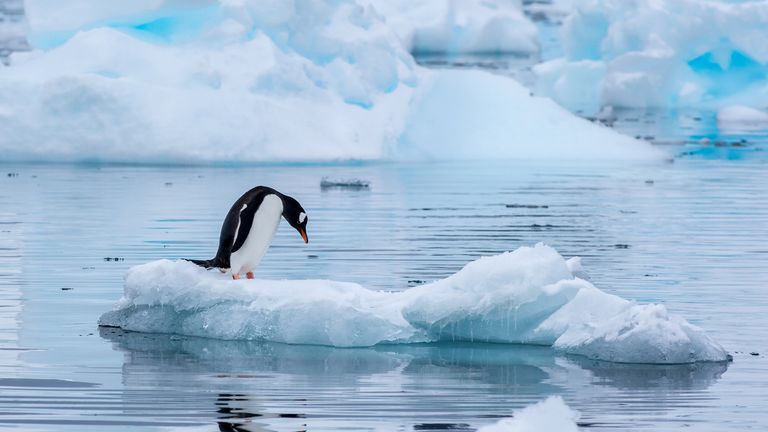
Image:Melting ice in Antarctica is said to have slowed the Earth's rotation. Pic:
Why you can trust Sky News
The melting of polar ice due to human-driven climate change has slightly slowed the Earth's rotation - and it could affect how we measure time, according to a study.
Although the disappearance of the ice has reduced the speed of the planet's rotation, the Earth is still spinning a bit faster than it used to.
The overall increase in speed means that for the first time in history, world timekeepers may have to consider subtracting a second from our clocks.
This means clocks may have to skip a second - called a "negative leap second" - around 2029 to keep universal time in sync with the Earth's rotation, according to the study published in the Nature journal.
If it wasn't for the impact of melting ice, the time change would have been needed three years earlier in 2026.
yeah the earth is rotation is slowing down.one second leap.
yeah the earth is rotation is slowing down.
It could accelerate as slow down quicker as more water melts
I care I've got a saw headone second? years away?
who cares


Wow! So since the industrial revolution in the 1800s this melting ice may have caused our clocks to lose an entire second in about 150 years! Does this mean in 2179 we may have to have another leap second? Or is it more like we have lost half a second and so the next leap second will be in 300 years?https://news.sky.com/story/human-dr...t-how-we-measure-time-study-suggests-13102985
The melting of ice in Greenland and Antarctica is said to have slowed the rotation of the Earth because it has changed where the planet's mass is concentrated.
Wednesday 27 March 2024 21:24, UK
Image:Melting ice in Antarctica is said to have slowed the Earth's rotation. Pic:
Why you can trust Sky News
The melting of polar ice due to human-driven climate change has slightly slowed the Earth's rotation - and it could affect how we measure time, according to a study.
Although the disappearance of the ice has reduced the speed of the planet's rotation, the Earth is still spinning a bit faster than it used to.
The overall increase in speed means that for the first time in history, world timekeepers may have to consider subtracting a second from our clocks.
This means clocks may have to skip a second - called a "negative leap second" - around 2029 to keep universal time in sync with the Earth's rotation, according to the study published in the Nature journal.
If it wasn't for the impact of melting ice, the time change would have been needed three years earlier in 2026.
yes I know it seems minimum, but it's still slowing down.one second? years away?
who cares
like I've just said the world is perfectly balanced, it could be something like the rotation slowing down by 1.2 seconds that tios the balance, you know about tipping points don't you, as normally the earth jumps a second forward, not fall back.Wow! So since the industrial revolution in the 1800s this melting ice may have caused our clocks to lose an entire second in about 150 years! Does this mean in 2179 we may have to have another leap second? Or is it more like we have lost half a second and so the next leap second will be in 300 years?
here you go buddyWow! So since the industrial revolution in the 1800s this melting ice may have caused our clocks to lose an entire second in about 150 years! Does this mean in 2179 we may have to have another leap second? Or is it more like we have lost half a second and so the next leap second will be in 300 years?

Don't waste my time, tell me why this would interest me.here you go buddy
This may interest you
don't waste your timeDon't waste my time, tell me why this would interest me.
BTW we have two recorded times in history of dramatic and huge changes in the time of Earth's rotation, once with Moses and once with Hezekiah. By comparison this potential 1/2 a second every 150 years appears trivial.


don't waste your time
Ok I won't
the centre of mass never changes when its surroundings are perfectly balanced in weight, do you agree that as the ice caps melt this can change the position of the centre of mass, causing a dramatic wobble effect to occur.I think Generation Z and the Millennials will quickly change the whole dialog on climate change(so don't be discouraged). From polls they've taken those who will live on the planet another 3 or 4 decades look at it completely different from those with few years left.
the centre of mass never changes when its surroundings are perfectly balanced in weight, do you agree that as the ice caps melt this can change the position of the centre of mass, causing a dramatic wobble effect to occur.
Theese where my thoughts
I'm open to be proven wrong.
So what about dramatic changes, where a dramatic balance is required.I would think it would balance it's self similar to putting balance beads in a tire same physics anyway but that's just my opinion. https://www.amazon.com/Magnum-Balan...MIgI6d0I6XhQMVI0d_AB3LAwhhEAQYASABEgIZxfD_BwE

the centre of mass never changes when its surroundings are perfectly balanced in weight, do you agree that as the ice caps melt this can change the position of the centre of mass, causing a dramatic wobble effect to occur.
Theese where my thoughts
I'm open to be proven wrong.
dramatic weight shift I was refering to where by the centre of mass would change dramatically.How is there a weight change? A pound of water as a liquid weighs the same as a pound of water as a solid or ice. A solid displaces a liquid as they can't share the same space. Such as a ship it displaces water so that it can float on water.
Water as a solid such as ice it gains more mass in a solid state since water when it freezes it expands. Why I am curious for one they think that the melting ice would raise the level of water. As the level of water would be slightly higher due to the part that is solid. Like a glass full of ice and water as the ice melts then turns into a liquid state again it just fills up the space that was displaced.
So we never have to fear if we fill a cup full of ice then water it never comes running over the side as the ice melts. So my curiosity is since in both states the weight remains the same whether a solid or liquid. How is the weight changing so that it can throw off the center of mass?
