what are you trying to say?
He is trying to say we must finish the work the Holy Spirit began in us.
I think he is from Galatia.

what are you trying to say?
He is trying to say we must finish the work the Holy Spirit began in us.
I think he is from Galatia.
If God does not change, neither will His Law. “My covenant I will not break, nor alter the word that has gone out of My lips” (Psalm 89:34). “I know that everything God does will endure forever; nothing can be added to it and nothing taken from it” (Ecclesiastes 3:14). “The works of his hands are faithful and just; all his precepts are trustworthy. They are steadfast for ever and ever, done in faithfulness and uprightness” (Psalm 111:7, 8).
God gave His Law to the Israelites at Mt. Sinai. Amid thunder and lightning, a thick cloud covered the mountain, and a trumpet blasted. Smoke billowed up as from a furnace and the whole mountain shook as the trumpet grew louder and louder. Moses led the Israelites out of their camp to meet with God, and every one of them trembled. Then God spoke (Exodus 19:16-19, 20:1). If this Law were to be changed, it would be reasonable to expect God Himself to announce it, and give reasons for its alteration, amid the same amount of ceremony. Yet there is no indication in Scripture of such an announcement.
what about verse?
Philippians 1:6
being confident of this very thing, that He who has begun a good work in you will complete it until the day of Jesus Christ;
Since when do we take our confidence off God and place it on self> And think we have to complete What God already promised he WILL COMPLETE?
true, But it still takes our eyes off JesusThinking we have to complete it is not nearly as bad as thinking we can complete it.
oh boy, how did the sabbath get introduced?In the New Testament, the seventh day of the week is called the Sabbath; it is mentioned 58 times. The first day of the week is mentioned eight times. It is simply called the first day of the week, and it is always differentiated from the Sabbath. This in itself is evidence for the continued validity of the seventh-day Sabbath.
The gospel writers record Jesus and the apostles going to the synagogue on Sabbath as their “custom” (Luke 4:16 ). Jesus said, “I have kept My Father’s commandments” (John 15:10). The women who went to anoint His body after his death “rested on the Sabbath according to the commandment” (Luke 23:56). Nearly all of the incidents reported of the apostles’ preaching occurred on the seventh-day Sabbath. Of all the accusations the Jews made against the apostles, never once did they accuse the apostles of breaking the Sabbath.
Some teach that after Christ’s death and resurrection, the Old Testament law was done away with and a new covenant took its place. But Jesus Himself said, “Do not think that I came to destroy the Law or the Prophets. I did not come to destroy but to fulfill. For assuredly, I say to you, till heaven and earth pass away, one jot or one tittle will by no means pass from the law till all is fulfilled” (Matthew 5:17, 18). The law of Moses, which foreshadowed Christ’s sacrifice, was indeed made irrelevant, but Paul maintains that the Law of God is to be kept, though we now be under grace. “Do we then make void the law through faith? God forbid; yea, we establish the law” (Romans 3:31).
How It Happened...
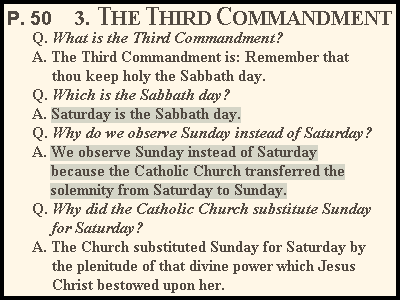
Yet for nearly 2,000 years now, millions of Christians have worshiped on Sunday. So was the Sabbath changed from the seventh to the first day of the week? Let’s look at the “yes” now.
“The Son of Man is Lord also of the Sabbath” (Luke 6:5). Here Jesus staked His claim and forbade anyone to meddle with the Sabbath. Yet He knew there would be those who would claim the power to change God’s Law. Through Daniel he warned of just such a man. Describing a “little horn power” (Daniel 7:8), Daniel says, “He will speak against the Most High and oppress his saints and try to change the set times and the laws” (Daniel 7:25). Paul made a similar prediction: “Don’t let anyone deceive you in any way, for that day will not come until the rebellion occurs and the man of lawlessness is revealed, the man doomed to destruction. He will oppose and will exalt himself over everything that is called God, or is worshiped, so that he sets himself up in God’s temple, proclaiming himself to be God” (2 Thessalonians 2:3, 4, 7).
Paul warned that this blasphemy was already at work, and that it would come not from an outside influence, but from within the church (2 Thessalonians 2:7, Acts 20:28-30). Sure enough, not long after Paul’s day, apostasy appeared in the church.
About 100 years before Christianity, Egyptian Mithraists introduced the festival of Sunday, dedicated to worshiping the sun, into the Roman Empire. Later, as Christianity grew, church leaders wished to increase the numbers of the church. In order to make the gospel more attractive to non-Christians, pagan customs were incorporated into the church’s ceremonies. The custom of Sunday worship was welcomed by Christians who desired to differentiate themselves from the Jews, whom they hated because of the Jews’ rejection of the Savior. The first day of the week began to be recognized as both a religious and civil holiday. By the end of the second century, Christians considered it sinful to work on Sunday.
The Roman emperor Constantine, a former sun-worshiper, professed conversion to Christianity, though his subsequent actions suggest the “conversion” was more of a political move than a genuine heart change. Constantine named himself Bishop of the Catholic Church and enacted the first civil law regarding Sunday observance in A.D. 321.
On the venerable day of the sun let the magistrate and people residing in cities rest, and let all workshops be closed. In the country however, persons engaged in agricultural work may freely and lawfully continue their pursuits; because it often happens that another day is not so suitable for grain growing or for vine planting; lest by neglecting the proper moment for such operations the bounty of heaven should be lost. —Schaff’s History of the Christian Church, vol. III, chap. 75.

You misunderstood me, I meant both of those were saved believers. And on judgement day one gets a greater reward for being more obedient and doing greater things for the Lord during their life time. Where as the other believer, who sinned more and done less for the Lord gets a smaller reward or position in heaven. Is that Biblical?
Here is who will receive eternal life on that Day.
- eternal life to those who by patient continuance in doing good seek for glory, honor, and immortality;
God who “will render to each one according to his deeds”: eternal life to those who by patient continuance in doing good seek for glory, honor, and immortality; but to those who are self-seeking and do not obey the truth, but obey unrighteousness—indignation and wrath, Romans 2:6-8
Again, Those who are saved do good, that is who they arePaul of course learned this from Jesus.
Do not marvel at this; for the hour is coming in which all who are in the graves will hear His voice and come forth—those who have done good, to the resurrection of life, and those who have done evil, to the resurrection of condemnation. John 5:28-29
- those who have done good, to the resurrection of life
- those who have done evil, to the resurrection of condemnation.
JPT
If God does not change, neither will His Law. “My covenant I will not break, nor alter the word that has gone out of My lips” (Psalm 89:34). “I know that everything God does will endure forever; nothing can be added to it and nothing taken from it” (Ecclesiastes 3:14). “The works of his hands are faithful and just; all his precepts are trustworthy. They are steadfast for ever and ever, done in faithfulness and uprightness” (Psalm 111:7, 8).
God gave His Law to the Israelites at Mt. Sinai. Amid thunder and lightning, a thick cloud covered the mountain, and a trumpet blasted. Smoke billowed up as from a furnace and the whole mountain shook as the trumpet grew louder and louder. Moses led the Israelites out of their camp to meet with God, and every one of them trembled. Then God spoke (Exodus 19:16-19, 20:1). If this Law were to be changed, it would be reasonable to expect God Himself to announce it, and give reasons for its alteration, amid the same amount of ceremony. Yet there is no indication in Scripture of such an announcement.

If God does not change, neither will His Law. “My covenant I will not break, nor alter the word that has gone out of My lips” (Psalm 89:34). “I know that everything God does will endure forever; nothing can be added to it and nothing taken from it” (Ecclesiastes 3:14). “The works of his hands are faithful and just; all his precepts are trustworthy. They are steadfast for ever and ever, done in faithfulness and uprightness” (Psalm 111:7, 8).
God gave His Law to the Israelites at Mt. Sinai. Amid thunder and lightning, a thick cloud covered the mountain, and a trumpet blasted. Smoke billowed up as from a furnace and the whole mountain shook as the trumpet grew louder and louder. Moses led the Israelites out of their camp to meet with God, and every one of them trembled. Then God spoke (Exodus 19:16-19, 20:1). If this Law were to be changed, it would be reasonable to expect God Himself to announce it, and give reasons for its alteration, amid the same amount of ceremony. Yet there is no indication in Scripture of such an announcement.
Do you sacrife animals for your sin?
Do you put people to death for picking up sticks of the Sabbath?
JPT
what are you trying to say?
That has been my point for months. Thank you for clearifying my point.well of course, that represents the life of those who have been saved by God,
of course, it is not WHY they are saved. That would be legalism, and place our gospel no different than the jewish gospel of works.
Again, Those who are saved do good, that is who they are
those who are not saved, do evil, that is who they are.
they were not saved BECAUSE they did good, they did good BECAUSE they are saved
You are correct TT, Jesus did bring a new covenant forward that replaced the old covenant.Jesus Christ is our new covenant as foretold by Profits of OLD
Jeremiah31:31
"The days are coming," declares the LORD, "when I will make a new covenant" with the people of Israel and with the people of Judah.
Hebrews8:6-13
6) But in fact the ministry Jesus has received is as superior to theirs as the covenant of which he is mediator is superior to the old one, since the new covenant is established on better promises.
7) For if there had been nothing wrong with that first covenant, no place would have been sought for another.
8) But God found fault with the people and said:
“The days are coming, declares the Lord,
when I will make a new covenant
with the people of Israel
and with the people of Judah.
9) It will not be like the covenant
I made with their ancestors
when I took them by the hand
to lead them out of Egypt,
because they did not remain faithful to my covenant,
and I turned away from them,
declares the Lord.
10) This is the covenant I will establish with the people of Israel
after that time, declares the Lord.
I will put my laws in their minds
and write them on their hearts.
I will be their God,
and they will be my people.
11) No longer will they teach their neighbor,
or say to one another, ‘Know the Lord,’
because they will all know me,
from the least of them to the greatest.
12) For I will forgive their wickedness
and will remember their sins no more.”c
13) By calling this covenant “new,” he has made the first one obsolete; and what is obsolete and outdated will soon disappear.
Thank you, God blessYou are correct TT, Jesus did bring a new covenant forward that replaced the old covenant.

We will all continue to sin until the day we die, Scripture is crystal clear about that. That doesn't mean we surrender to it and go with it, we fight it every moment. We still live in a corrupt body of death, so our spirit is at war with our body. We need the Holy Spirit to help us so we aren't consumed by sin, but we war against it until we die.
And as you have said, that is 90% of Christians, except for your little band of righteous followers of Jesus. Sorry that we other Christians even hope for salvation.
What verse would that be? I do not remember seeing this verse. And we have so many Christians (myself included) who live our lives every day trying to please God. But still sin. So what would make that person you spoke of any worse than me? or you or any other christian who sins? And don;t forget abraham and David, both adulterers, and both mighty men of God.
not trying to downgrade the sin, the sin is serious, and will cause serious trouble, including the chastening of God. But sin is sin, we shoudl be careful of trying to focus on certain sins, while refusing to acknowledge our own sins, which in Gods eyes, are just as damning.