
God's Sabbath Rest - Mission Impossible
- Thread starter DavidTree
- Start date
-
Christian Chat is a moderated online Christian community allowing Christians around the world to fellowship with each other in real time chat via webcam, voice, and text, with the Christian Chat app. You can also start or participate in a Bible-based discussion here in the Christian Chat Forums, where members can also share with each other their own videos, pictures, or favorite Christian music.
If you are a Christian and need encouragement and fellowship, we're here for you! If you are not a Christian but interested in knowing more about Jesus our Lord, you're also welcome! Want to know what the Bible says, and how you can apply it to your life? Join us!
To make new Christian friends now around the world, click here to join Christian Chat.
You are using an out of date browser. It may not display this or other websites correctly.
You should upgrade or use an alternative browser.
You should upgrade or use an alternative browser.


Therefore the Scripture says:
For Christ is the end of the law for righteousness to every one that believes.
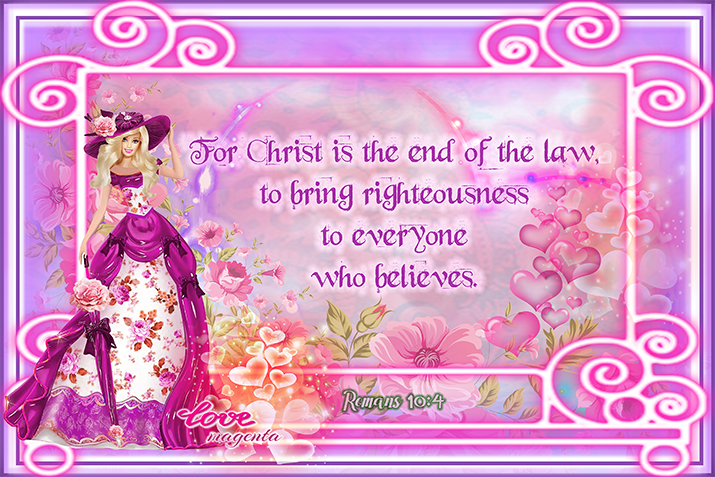
Romans 10:4


Romans 10:4
And this is why the woman in the pretty dress is SMILING..............

#190 David Tree said: So, let's get back to you finding where God placed the Ten Commandments that Moses went up the mountain to receive from the LORD.
"198
The Mercy Seat was on Top of the Ark with the Cherubim bowed in worship facing the Seat but having their heads/faces covered with their wings. Inside the Ark is where the Ten Commandments were/are kept.
The one Moses built was a shadow/copy of the TRUE Sanctuary in Heaven.
The Law was given to Moses by the LORD.
The same LORD who spoke with Moses came to earth(Isa 9:6) containing the Law in His Heart, which no man could keep.
Do you SEE this: Matthew 22:34-40
So if, the Ten Commandments were contained in the earthly Ark with Moses, what is in Heaven in the True Sanctuary???
CHRIST, the Lamb upon His Throne, and contained in Christ is the Law of God which HE alone can keep for us on our behalf.
Therefore the Scripture says:
For Christ is the end of the law for righteousness to every one that believes.
The Law of God began with the LORD on the Mountain being given to Moses until the time of HIS arrival.
The Law of God ENDED where it BEGAN with the LORD Jesus Christ who now intercedes on our behalf.
Okay, now I get the "Mission Impossible"! Re: Where are the Commandments now?
ps I still believe I need to obey all of the commandments (in love vs legalism).
"198
The Mercy Seat was on Top of the Ark with the Cherubim bowed in worship facing the Seat but having their heads/faces covered with their wings. Inside the Ark is where the Ten Commandments were/are kept.
The one Moses built was a shadow/copy of the TRUE Sanctuary in Heaven.
The Law was given to Moses by the LORD.
The same LORD who spoke with Moses came to earth(Isa 9:6) containing the Law in His Heart, which no man could keep.
Do you SEE this: Matthew 22:34-40
So if, the Ten Commandments were contained in the earthly Ark with Moses, what is in Heaven in the True Sanctuary???
CHRIST, the Lamb upon His Throne, and contained in Christ is the Law of God which HE alone can keep for us on our behalf.
Therefore the Scripture says:
For Christ is the end of the law for righteousness to every one that believes.
The Law of God began with the LORD on the Mountain being given to Moses until the time of HIS arrival.
The Law of God ENDED where it BEGAN with the LORD Jesus Christ who now intercedes on our behalf.
Okay, now I get the "Mission Impossible"! Re: Where are the Commandments now?
ps I still believe I need to obey all of the commandments (in love vs legalism).

You keep saying the all laws are ended at the cross.
I have put these verses to you many times.
A law did end at the cross but if all laws ended, the bible is contradicting itself.
The Moral law, the ten commandments, the law of liberty, are what define sin, and were here before sin.
Isa 5:24 The Law of God
Deu 4:12 spoken by God,
Deu 10:3,4, Ex 31:18, 32:16 Written by God On stone,
Deu 10:1-5, Kept inside the ark.
James 2:11 law of liberty,
James 2:12 will be judged by the law
Rom 7:14,19 Spiritual,
Ps 111:7,8 Luke 16:17, Matt 5:18 Eternal, Unchangeable
1 John 3:4 points out sin,
Ps 19:7,9,10 perfect, true
Ecc 12:13 The whole duty of man
Pro 29:18, 1 John 5:3 for our Happiness, not burdensome
Proverbs 3:1, 2 for long life and peace
Ps 119:172 Righteousness
Rom 13:10 Love
James 2:10-12 Judges all
Rom 7:12, 1 Tim 1:8, Holy, Just and Good
The Ceremonial law, the laws of Moses, The laws of sacrifices, and offerings, etc. introduced because of sin, shows the solution for sin, after sin.
Luke 2:22, The Law of Moses
Eph 2:15, contained in ordinances
Lev 1:1-3 Spoken by Moses,
2 Chro 35:12, Deut 31:9, 24 Written by Moses, written in a book,
Deut 31:26 Kept outside the ark,
Eph 2:15 Ended at the cross
Gal 3:19 Added because of Sin
Gal 5:1 Col 2:14, Yoke of bondage, against us and contrary to us
Col 2:14-16, Judges no one
Heb 7:16 Carnal, fleshly
Heb 7:12 temporary,
Lev 4:27-31, John 1:29 points to saviour,
Heb 7:19 made nothing perfect
Col 2:14 Not good
I have put these verses to you many times.
A law did end at the cross but if all laws ended, the bible is contradicting itself.
The Moral law, the ten commandments, the law of liberty, are what define sin, and were here before sin.
Isa 5:24 The Law of God
Deu 4:12 spoken by God,
Deu 10:3,4, Ex 31:18, 32:16 Written by God On stone,
Deu 10:1-5, Kept inside the ark.
James 2:11 law of liberty,
James 2:12 will be judged by the law
Rom 7:14,19 Spiritual,
Ps 111:7,8 Luke 16:17, Matt 5:18 Eternal, Unchangeable
1 John 3:4 points out sin,
Ps 19:7,9,10 perfect, true
Ecc 12:13 The whole duty of man
Pro 29:18, 1 John 5:3 for our Happiness, not burdensome
Proverbs 3:1, 2 for long life and peace
Ps 119:172 Righteousness
Rom 13:10 Love
James 2:10-12 Judges all
Rom 7:12, 1 Tim 1:8, Holy, Just and Good
The Ceremonial law, the laws of Moses, The laws of sacrifices, and offerings, etc. introduced because of sin, shows the solution for sin, after sin.
Luke 2:22, The Law of Moses
Eph 2:15, contained in ordinances
Lev 1:1-3 Spoken by Moses,
2 Chro 35:12, Deut 31:9, 24 Written by Moses, written in a book,
Deut 31:26 Kept outside the ark,
Eph 2:15 Ended at the cross
Gal 3:19 Added because of Sin
Gal 5:1 Col 2:14, Yoke of bondage, against us and contrary to us
Col 2:14-16, Judges no one
Heb 7:16 Carnal, fleshly
Heb 7:12 temporary,
Lev 4:27-31, John 1:29 points to saviour,
Heb 7:19 made nothing perfect
Col 2:14 Not good
1Jn 3:4 Whosoever committeth sin transgresseth also the law: for sin is the transgression of the law.
When Adam and Eve sinned there must have been a law.
In Noahs day there must have been a law.
Today and until the end sin will be happening.
Rev 21:7 He that overcometh shall inherit all things; and I will be his God, and he shall be my son.
Rev 21:8 But the fearful, and unbelieving, and the abominable, and murderers, and whoremongers, and sorcerers, and idolaters, and all liars, shall have their part in the lake which burneth with fire and brimstone: which is the second death.
If the laws are all gone at the cross how do we break that law today?
When Adam and Eve sinned there must have been a law.
In Noahs day there must have been a law.
Today and until the end sin will be happening.
Rev 21:7 He that overcometh shall inherit all things; and I will be his God, and he shall be my son.
Rev 21:8 But the fearful, and unbelieving, and the abominable, and murderers, and whoremongers, and sorcerers, and idolaters, and all liars, shall have their part in the lake which burneth with fire and brimstone: which is the second death.
If the laws are all gone at the cross how do we break that law today?
Ok, you don't know if you are under the Law of Moses or the New Covenant. Can't be both!
What is the new covenant....? Use the Bible to explain it clearly.
There are many who try to blend these two systems, using the texts that speak of the ceremonial law to prove that the moral law has been abolished; but this is a perversion of the Scriptures. The distinction between the two systems is broad and clear. The ceremonial system was made up of symbols pointing to Christ, to His sacrifice and His priesthood. This ritual law, with its sacrifices and ordinances, was to be performed by the Hebrews until type met antitype in the death of Christ, the Lamb of God that taketh away the sin of the world. Then all the sacrificial offerings were to cease. It is this law that Christ “took ... out of the way, nailing it to His cross.” Col 2:14 But concerning the law of Ten Commandments the psalmist declares, “Forever, O Lord, Thy word is settled in heaven.” Psa 119:89. And Christ Himself says, “Think not that I am come to destroy the law.... Verily I say unto you”—making the assertion as emphatic as possible—“Till heaven and earth pass, one jot or one tittle shall in no wise pass from the law, till all be fulfilled.” Matt 5:17,18 Here He teaches, not merely what the claims of God's law had been, and were then, but that these claims should hold as long as the heavens and the earth remain. The law of God is as immutable as His throne. It will maintain its claims upon mankind in all ages.
Clearly explain the difference between the old and new covenants.
Posts #168 , 171 , 172 , 195 , 198 , 200 , 201 , 202
Study Post # 198
So if, the Ten Commandments were contained in the earthly Ark with Moses, what is in Heaven in the True Sanctuary???
CHRIST, the Lamb upon His Throne, and contained in Christ is the Law of God which HE alone can keep for us on our behalf.
Therefore the Scripture says:
For Christ is the end of the law for righteousness to every one that believes.
Your conclusions are presumption.
If the Ark on earth was a pattern of the ark in Heaven, you can not presume that Jesus replaces the ten commandments.
The Law is in Jesus, He kept them perfectly because we can't. But that does not mean the law is void.
Christ is the end of the law for righteousness. But do we make void the law through grace? No..
Christ didn't come to end the law but to fulfil the law. Christ is the perfect example of obedience to the law.
i still haven't had anyone clearly explain the difference between the old and new covenant...
A few definitions.
a usually formal, solemn, and binding agreement,
a written agreement or promise usually under seal between two or more parties especially for the performance of some action
Heb 8:6 But now hath he obtained a more excellent ministry, by how much also he is the mediator of a better covenant, which was established upon better promises.
Heb 8:7 For if that first covenant had been faultless, then should no place have been sought for the second.
Heb 8:8 For finding fault with them, he saith, Behold, the days come, saith the Lord, when I will make a new covenant with the house of Israel and with the house of Judah:
Heb 8:9 Not according to the covenant that I made with their fathers in the day when I took them by the hand to lead them out of the land of Egypt; because they continued not in my covenant, and I regarded them not, saith the Lord.
Heb 8:10 For this is the covenant that I will make with the house of Israel after those days, saith the Lord; I will put my laws into their mind, and write them in their hearts: and I will be to them a God, and they shall be to me a people:
Heb 8:11 And they shall not teach every man his neighbour, and every man his brother, saying, Know the Lord: for all shall know me, from the least to the greatest.
Heb 8:12 For I will be merciful to their unrighteousness, and their sins and their iniquities will I remember no more.
Heb 8:13 In that he saith, A new covenant, he hath made the first old. Now that which decayeth and waxeth old is ready to vanish away.
A few definitions.
a usually formal, solemn, and binding agreement,
a written agreement or promise usually under seal between two or more parties especially for the performance of some action
Heb 8:6 But now hath he obtained a more excellent ministry, by how much also he is the mediator of a better covenant, which was established upon better promises.
Heb 8:7 For if that first covenant had been faultless, then should no place have been sought for the second.
Heb 8:8 For finding fault with them, he saith, Behold, the days come, saith the Lord, when I will make a new covenant with the house of Israel and with the house of Judah:
Heb 8:9 Not according to the covenant that I made with their fathers in the day when I took them by the hand to lead them out of the land of Egypt; because they continued not in my covenant, and I regarded them not, saith the Lord.
Heb 8:10 For this is the covenant that I will make with the house of Israel after those days, saith the Lord; I will put my laws into their mind, and write them in their hearts: and I will be to them a God, and they shall be to me a people:
Heb 8:11 And they shall not teach every man his neighbour, and every man his brother, saying, Know the Lord: for all shall know me, from the least to the greatest.
Heb 8:12 For I will be merciful to their unrighteousness, and their sins and their iniquities will I remember no more.
Heb 8:13 In that he saith, A new covenant, he hath made the first old. Now that which decayeth and waxeth old is ready to vanish away.
since no will answer the question i'll take a second to show that the old covenant is not the ten commandments.
It is just as important to understand what the Old Covenant was not, as to know what it was. we will determine by comparing scripture with scripture just what the Old Covenant was.
First of all, we notice that the Old Covenant had some poor promises in it. The New Covenant, we are told, "was established upon better promises." Heb 8:6. Tell me, has anyone ever been able to point out any poor promises in the Ten Commandments? Never. On the contrary, Paul declares that they were very good. "Children, obey your parents in the Lord: for this is right. Honour thy father and mother; which is the first commandment with promise; That it may be well with thee, and thou mayest live long on the earth." Ephesians 6:1-3.
This declaration alone is sufficient to show that the writer of Hebrews was not charging the moral law with any weak promises. The Old Covenant, whatever else it might be, could never be the Ten Commandments.
The second thing is that the Old Covenant was faulty. The Bible says, "For if that first covenant had been faultless, then should no place have been sought for the second." Hebrews 8:7. Let me ask you a question: Has any man ever been able to find a fault or a flaw in the handwriting of God? The psalmist declared, "The law of the Lord is perfect, converting the soul." Psalm 19:7. Paul wrote, "Wherefore the law is holy, and the commandment holy, and just, and good." Romans 7:12.
Does that sound like something weak and imperfect? No law could be perfect and faulty at the same time. It becomes more and more apparent that the Old Covenant could not have been the Ten Commandments.
We also read that the Old Covenant was to be abolished! "In that he saith, A new covenant, he hath made the first old. Now that which decayeth and waxeth old is ready to vanish away." Hebrews 8:13. Now we can ask a serious question that should settle every doubt on this matter. Did the great moral law of Ten Commandments vanish away? Anyone who has read the New Testament must answer, Absolutely not. Paul affirms the exact opposite about the law. He asked, "Do we then make void the law through faith? God forbid: yea, we establish the law." Romans 3:31. let us insert the words "Old Covenant" instead of the word "law" into Romans 3:31. "Do we than make void the Old Covenant through faith? God forbid: yea, we establish the Old Covenant."
That doesn't sound right at all, does it? We know that the Old Covenant had vanished away and could never be spoken of in this way. Very clearly, then, we can see that the covenant which came to an end could not have been the Ten Commandments.
Please show me how i am wrong in this reasoning.
It is just as important to understand what the Old Covenant was not, as to know what it was. we will determine by comparing scripture with scripture just what the Old Covenant was.
First of all, we notice that the Old Covenant had some poor promises in it. The New Covenant, we are told, "was established upon better promises." Heb 8:6. Tell me, has anyone ever been able to point out any poor promises in the Ten Commandments? Never. On the contrary, Paul declares that they were very good. "Children, obey your parents in the Lord: for this is right. Honour thy father and mother; which is the first commandment with promise; That it may be well with thee, and thou mayest live long on the earth." Ephesians 6:1-3.
This declaration alone is sufficient to show that the writer of Hebrews was not charging the moral law with any weak promises. The Old Covenant, whatever else it might be, could never be the Ten Commandments.
The second thing is that the Old Covenant was faulty. The Bible says, "For if that first covenant had been faultless, then should no place have been sought for the second." Hebrews 8:7. Let me ask you a question: Has any man ever been able to find a fault or a flaw in the handwriting of God? The psalmist declared, "The law of the Lord is perfect, converting the soul." Psalm 19:7. Paul wrote, "Wherefore the law is holy, and the commandment holy, and just, and good." Romans 7:12.
Does that sound like something weak and imperfect? No law could be perfect and faulty at the same time. It becomes more and more apparent that the Old Covenant could not have been the Ten Commandments.
We also read that the Old Covenant was to be abolished! "In that he saith, A new covenant, he hath made the first old. Now that which decayeth and waxeth old is ready to vanish away." Hebrews 8:13. Now we can ask a serious question that should settle every doubt on this matter. Did the great moral law of Ten Commandments vanish away? Anyone who has read the New Testament must answer, Absolutely not. Paul affirms the exact opposite about the law. He asked, "Do we then make void the law through faith? God forbid: yea, we establish the law." Romans 3:31. let us insert the words "Old Covenant" instead of the word "law" into Romans 3:31. "Do we than make void the Old Covenant through faith? God forbid: yea, we establish the Old Covenant."
That doesn't sound right at all, does it? We know that the Old Covenant had vanished away and could never be spoken of in this way. Very clearly, then, we can see that the covenant which came to an end could not have been the Ten Commandments.
Please show me how i am wrong in this reasoning.
Your conclusions are presumption.
If the Ark on earth was a pattern of the ark in Heaven, you can not presume that Jesus replaces the ten commandments.
The Law is in Jesus, He kept them perfectly because we can't. But that does not mean the law is void.
Christ is the end of the law for righteousness. But do we make void the law through grace? No..
Christ didn't come to end the law but to fulfil the law. Christ is the perfect example of obedience to the law.
You only get to choose one - i suggest you choose the One that rose from the Dead.
Tell me, you who desire to be under the law, do you not hear the law? 22For it is written that Abraham had two sons: the one by a bondwoman, the other by a freewoman. 23But he who was of the bondwoman was born according to the flesh, and he of the freewoman through promise, 24which things are symbolic. For these are [g]the two covenants: the one from Mount Sinai which gives birth to bondage, which is Hagar— 25for this Hagar is Mount Sinai in Arabia, and corresponds to Jerusalem which now is, and is in bondage with her children— 26but the Jerusalem above is free, which is the mother of us all. 27For it is written:
“Rejoice, O barren,
You who do not bear!
Break forth and shout,
You who are not in labor!
For the desolate has many more children
Than she who has a husband.”
28Now we, brethren, as Isaac was, are children of promise. 29But, as he who was born according to the flesh then persecuted him who was born according to the Spirit, even so it is now. 30Nevertheless what does the Scripture say? “Cast out the bondwoman and her son, for the son of the bondwoman shall not be heir with the son of the freewoman.” 31So then, brethren, we are not children of the bondwoman but of the free.
since no will answer the question i'll take a second to show that the old covenant is not the ten commandments.
It is just as important to understand what the Old Covenant was not, as to know what it was. we will determine by comparing scripture with scripture just what the Old Covenant was.
First of all, we notice that the Old Covenant had some poor promises in it. The New Covenant, we are told, "was established upon better promises." Heb 8:6. Tell me, has anyone ever been able to point out any poor promises in the Ten Commandments? Never. On the contrary, Paul declares that they were very good. "Children, obey your parents in the Lord: for this is right. Honour thy father and mother; which is the first commandment with promise; That it may be well with thee, and thou mayest live long on the earth." Ephesians 6:1-3.
This declaration alone is sufficient to show that the writer of Hebrews was not charging the moral law with any weak promises. The Old Covenant, whatever else it might be, could never be the Ten Commandments.
The second thing is that the Old Covenant was faulty. The Bible says, "For if that first covenant had been faultless, then should no place have been sought for the second." Hebrews 8:7. Let me ask you a question: Has any man ever been able to find a fault or a flaw in the handwriting of God? The psalmist declared, "The law of the Lord is perfect, converting the soul." Psalm 19:7. Paul wrote, "Wherefore the law is holy, and the commandment holy, and just, and good." Romans 7:12.
Does that sound like something weak and imperfect? No law could be perfect and faulty at the same time. It becomes more and more apparent that the Old Covenant could not have been the Ten Commandments.
We also read that the Old Covenant was to be abolished! "In that he saith, A new covenant, he hath made the first old. Now that which decayeth and waxeth old is ready to vanish away." Hebrews 8:13. Now we can ask a serious question that should settle every doubt on this matter. Did the great moral law of Ten Commandments vanish away? Anyone who has read the New Testament must answer, Absolutely not. Paul affirms the exact opposite about the law. He asked, "Do we then make void the law through faith? God forbid: yea, we establish the law." Romans 3:31. let us insert the words "Old Covenant" instead of the word "law" into Romans 3:31. "Do we than make void the Old Covenant through faith? God forbid: yea, we establish the Old Covenant."
That doesn't sound right at all, does it? We know that the Old Covenant had vanished away and could never be spoken of in this way. Very clearly, then, we can see that the covenant which came to an end could not have been the Ten Commandments.
Please show me how i am wrong in this reasoning.
The moral law is the Law of Christ written on our hearts and is found in the First Two Commandments.
No one, on this Thread, has even remotely said that we abandon the Holiness of God.
Therefore gird up the loins of your mind, be sober, and rest your hope fully upon the grace that is to be brought to you at the revelation of Jesus Christ; as obedient children, not conforming yourselves to the former lusts, as in your ignorance; but as He who called you is holy, you also be holy in all your conduct, because it is written, “Be holy, for I am holy.”
Since you have purified your souls in obeying the truth through the Spirit in sincere love of the brethren, love one another fervently with a pure heart, having been born again, not of corruptible seed but incorruptible, through the word of God which lives and abides forever, because
“All flesh is as grass,
And all the glory of man as the flower of the grass.
The grass withers,
And its flower falls away,
But the word of the Lord endures forever.”
Now this is the word which by the gospel was preached to you.
But the Holy Spirit also witnesses to us; for after He had said before,
“This is the covenant that I will make with them after those days, says the Lord: I will put My laws into their hearts, and in their minds I will write them,” then He adds, “Their sins and their lawless deeds I will remember no more.” Now where there is remission of these, there is no longer an offering for sin.

Jesus is my Sabbath, and He has made me free by the power of God!
1 Timothy 1:5 Now the end of the commandment is charity out of a pure heart, and of a good conscience, and of faith unfeigned:
1 Timothy 1:6 From which some having swerved have turned aside unto vain jangling;
1 Timothy 1:7 Desiring to be teachers of the law; understanding neither what they say, nor whereof they affirm.
2 Timothy 1:8 Be not thou therefore ashamed of the testimony of our Lord, nor of me his prisoner: but be thou partaker of the afflictions of the gospel according to the power of God;
2 Timothy 1:9 Who hath saved us, and called us with an holy calling, not according to our works, but according to his own purpose and grace, which was given us in Christ Jesus before the world began,
2 Timothy 1:10 But is now made manifest by the appearing of our Saviour Jesus Christ, who hath abolished death, and hath brought life and immortality to light through the gospel:
I am His, and He is mine forever!
I know the same is true for every believer that sets out to find Him, just as all His promises are true. I know in brokenness I began my walk, in what Jesus did for me with a joy and a hope I did not understand at that time leading to the death of me, yet alive in Him, that came in my brokenness for Him, decades later. I know that I am nothing, yet rejoice that it's He that has made me more than a conqueror. I know that I don't have to be heard or be right for anyone, yet I rejoice that it is He that can be made right in everyone through their own brokenness for Him.
It's all about Jesus!
1 Timothy 1:5 Now the end of the commandment is charity out of a pure heart, and of a good conscience, and of faith unfeigned:
1 Timothy 1:6 From which some having swerved have turned aside unto vain jangling;
1 Timothy 1:7 Desiring to be teachers of the law; understanding neither what they say, nor whereof they affirm.
2 Timothy 1:8 Be not thou therefore ashamed of the testimony of our Lord, nor of me his prisoner: but be thou partaker of the afflictions of the gospel according to the power of God;
2 Timothy 1:9 Who hath saved us, and called us with an holy calling, not according to our works, but according to his own purpose and grace, which was given us in Christ Jesus before the world began,
2 Timothy 1:10 But is now made manifest by the appearing of our Saviour Jesus Christ, who hath abolished death, and hath brought life and immortality to light through the gospel:
I am His, and He is mine forever!
I know the same is true for every believer that sets out to find Him, just as all His promises are true. I know in brokenness I began my walk, in what Jesus did for me with a joy and a hope I did not understand at that time leading to the death of me, yet alive in Him, that came in my brokenness for Him, decades later. I know that I am nothing, yet rejoice that it's He that has made me more than a conqueror. I know that I don't have to be heard or be right for anyone, yet I rejoice that it is He that can be made right in everyone through their own brokenness for Him.
It's all about Jesus!


I don't think you are truly listening to all that God is telling you. We are told the law is eternal, and you are saying it isn't. We are told that Christ filled every prophesy about him in the OT, and you are saying it finished these prophesies and disposed of them.Christ fulfilled the Law for us for no man was able. Christ nailed the curse of the Law to the Cross - there it died with Christ.
We are not under the Law. The 7th Day of God's REST is now, and always was, in a PERSON - His SON, the LORD Himself.
We had to wait for His Son to come and fulfill the 7th Day of Rest for us.
The law is a tool we are to use, just like a hammer is a tool. We are not to use it for our salvation. We are to use it to guide us to follow Christ within us. It defines all the sin that causes our death and curses us. We are to listen to it to learn how the kingdom of heaven operates. When we love and follow the Lord, it serves as the guard rails serve on a dangerous road. The law has many uses, we are to rightly divide them and follow the Lord.