Can We Really Exercise Free Will?

  • Christian Chat is a moderated online Christian community allowing Christians around the world to fellowship with each other in real time chat via webcam, voice, and text, with the Christian Chat app. You can also start or participate in a Bible-based discussion here in the Christian Chat Forums, where members can also share with each other their own videos, pictures, or favorite Christian music.

    If you are a Christian and need encouragement and fellowship, we're here for you! If you are not a Christian but interested in knowing more about Jesus our Lord, you're also welcome! Want to know what the Bible says, and how you can apply it to your life? Join us!

    To make new Christian friends now around the world, click here to join Christian Chat.
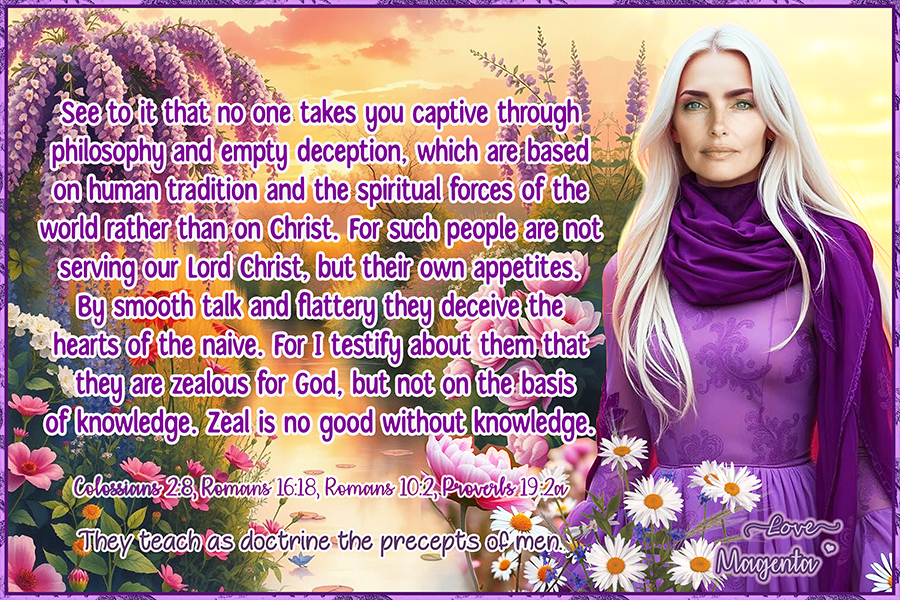
Colossians2-8-Romans16-18-Romans10-2-Proverbs19-2.png

Colossians 2 v 8, Romans 16 v 18, Romans 10 v 2, Proverbs 19 v 2a ~ See to it that no one takes you captive through philosophy and empty deception, which are based on human tradition and the spiritual forces of the world rather than on Christ. For such people are not serving our Lord Christ, but their own appetites. By smooth talk and flattery they deceive the hearts of the naive. For I testify about them that they are zealous for God, but not on the basis of knowledge. Zeal is no good without knowledge. They teach as doctrine the precepts of men.
 
Brilliant stuff, yet again, sis!! I know they don't need a lot of help, but you make these men look and sound like Idiots! So keep up the good work!!

Douglas
I'm sure it's the other way round bro, they make themselves look that way.

Just saying 😉
 
It is quality Bible centric commentary like yours that edifies many. So good that I had to bookmark this post....👍😊

Strangely, (or more likely predictably), no cogent reply nor interesting counterplay offered by the many Calvinists in the peanut gallery.

Thank you.

May the Lord Jesus get all the glory.


.....
 
And neither do I expect nor want to convince you. Whatever made you think I actually care about your opinion at all given that your expertise in the gospel is zero. I would be much, much more concerned should you ever agree with me.
Yet, you have chosen to refrain from addressing these countervailing theses, all of which are fully supported by context, hermeneutic principes and logic.

You will not because in my opinion, you cannot. And vice versa.

https://christianchat.com/threads/can-we-really-exercise-free-will.218061/post-5610217

https://christianchat.com/posts/5627431/

https://christianchat.com/posts/5629048/

Conclusion the same as always: Free-willers have the truth, facts, and scholarship on their side.
Calvinists? Not so much.
 
Is it then that in your theology those given to Jesus by God may not come to Him even though Jesus said they will come? Your temporary enablement only gives them a choice? They are not convinced which means they believe, due to God's drawing and conviction? One of our other self-exaltung free willers insisted that they became convinced and then were given a choice whether to believe what they already believed. Is that what you believe?
Please make a heartfelt attempt to educate yourself and correct your perpetual and grievous failures to rightly divide the truth of Scripture.

Here is how the ancient (biblical and 2nd-Temple period) Jewish wedding system is understood, and how it must connect it to John 6:37:

1. The Father selects and “acquires” the bride for his son (Shiddukin stage)

  • In ancient Israel, the father of the groom normally took the initiative in choosing or approving a bride for his son (see Genesis 24 with Isaac and Rebekah, Genesis 38 with Judah and Tamar, Judges 14 with Samson).
  • The father (or his representative) would negotiate with the bride’s father and pay the מֹהַר (mohar), the “bride price.”
  • Once the mohar was paid and the terms accepted, the bride legally belonged to the groom, even though they did not yet live together. She was “betrothed” (kiddushin/erusin) and considered his wife (see Deuteronomy 22:23–24, where a betrothed woman is called a “wife”).

Application to John 6:37 Many teachers say: “The Father is the one who selects and ‘purchases’ the bride’ (the Church, individual believers) for His Son by paying the ultimate bride-price—the blood of Jesus on the cross. Therefore, everyone whom the Father ‘gives’ to the Son (i.e., everyone He has chosen and purchased) will certainly come to Jesus, and Jesus will never reject or ‘cast out’ the one the Father has given Him.”

2. The bride’s consent was still required

Even though the father initiated, the young woman had to agree (see Rebekah in Genesis 24:58 – “Will you go with this man?” “I will go”). This is used to explain how divine election and human responsibility work together: the Father gives, yet the person must come (believe, respond).

3. The groom’s promise

At the betrothal ceremony the groom would say something like: “Behold, you are consecrated unto me according to the law of Moses and Israel.” He would then drink from a cup of wine and offer it to the bride. If she drank, the betrothal was sealed (the “cup of acceptance”). Jesus’ words at the Last Supper (“This cup is the new covenant in my blood…”) are seen as the moment He formally seals the betrothal with His bride.

4. The groom goes away to “prepare a place”

After betrothal, the groom returned to his father’s house to build or prepare the wedding chamber (חֻפָּה). This usually took about a year. Jesus explicitly uses this custom in John 14:2–3: “In my Father’s house are many dwelling places… I go to prepare a place for you… I will come again and receive you to myself.”

5. The groom comes “like a thief” to fetch the bride

When the father decided the preparations were complete, he would tell the son, “Go get your bride.” The groom would come unexpectedly, often at night, with shouting and trumpet blasts (the famous “shout” and “trumpet” of 1 Thessalonians 4:16–17 and the parable of the ten virgins in Matthew 25).

Summary of how John 6:37 is tied to this custom

  • “All that the Father gives Me” → The Father selects and purchases the bride for His Son (election and atonement).
  • “will come to Me” → Those who have been given inevitably respond and come (irresistible grace in Reformed theology, or the drawing power of the Spirit).
  • “and the one who comes to Me I will by no means cast out” → Once the Father has given her and she has accepted the betrothal cup, the Son will never annul the marriage contract or divorce His bride.

So while John 6:37 is not a direct quotation of a wedding formula, many Jewish and Christian teachers see the verse as reflecting the dynamics of the ancient Jewish betrothal arranged by the father, paid for with a price, and permanently binding. This imagery appears throughout the New Testament as a picture of the relationship between Christ and His people.
 
  • Like
Reactions: Kroogz
@cv5 you call it Calvinism does this it or that, and then you say Calvinism takes a person having any responsibility away From faith,

But yet you still haven't said why Calvin taught being obedient to the father ?
 
No you've got that all wrong.

Predestined = "to (yet future ) obtain a thing".

[Eph 1:11 KJV]
11 In whom also we have obtained an inheritance, being predestinated G4309 (to obtain it) according to the purpose of him who worketh all things after the counsel of his own will:

11 In whom also we have obtained an inheritance, being predestinated (the FUTURE REALIZATION yet to be revealed!) according to the purpose of him (this INHERITANCE a part of the plan of God from eternity past!) who worketh all things after the counsel of his own will:

These "THINGS" are predestined for us":

***************************************************************************

God has chosen ***THESE THINGS, namely*** blamelessness, conformation to His image, justification, adoption, obtaining an inheritance and glory ***FOR those*** who WILL believe, those who WILL CHOOSE to enter the covenant.

That's the gist of προορίζω proorizó, SG4309 .

And this term NEVER, EVER pertains to anything about God choosing any individual FOR SALVATION whatsoever and certainly nothing about "pre-birth Calvinistic selection" either.

The common error of mis-juggling the sequence and priority of terms and subjects and objects when presenting a thesis on "predestination" is really the problem.

Rom 8:29
For whom he did foreknow, he G4309 also did predestinate G4309 to be conformed to the image of his Son, that he might be the firstborn among many brethren.

Rom 8:30
Moreover whom he did predestinate, G4309 them he also called: and whom he called, them he also justified: and whom he justified, them he also glorified.


Eph 1:5
Having predestinated G4309 us unto the adoption of children by Jesus Christ to himself, according to the good pleasure of his will,


Eph 1:11
In whom also we have obtained an inheritance, being predestinated G4309 according to the purpose of him who worketh all things after the counsel of his own will:

******************************************************************************************************

Act 4:28
For to do whatsoever thy hand and thy counsel determined before G4309 to be done.
(The cross, planned from before time, but by then had already arrived at the "destination/realization").

1Co 2:7
But we speak the wisdom of God in a mystery, even the hidden wisdom, which God ordained G4309 before the world unto our glory:
1Co 2:8
Which none of the princes of this world knew: for had they known it, they would not have crucified the Lord of glory.
(The cross, planned from before time, but by then had already arrived at the "destination/realization").
Bookmarked
 
.....
John 3:8

John 3:8 KJV
“The wind bloweth where it listeth, and thou hearest the sound thereof, but canst not tell whence it cometh, and whither it goeth. So is every one that is born of the Spirit.”

Calvinist claim
Calvinists argue this means regeneration is unconditional and irresistible, because the Spirit supposedly regenerates a person without their cooperation.

Correct explanation in context
Jesus is explaining the mysterious nature, not the method, of the new birth. He is teaching Nicodemus that the new birth cannot be seen with the eyes, just as the wind cannot be seen. The point is invisibility, not irresistibility.
Jesus does not say the Spirit regenerates without faith. In the same conversation Jesus insists on belief.

John 3:16 KJV
“Whosoever believeth in him should not perish, but have everlasting life.”

John 3:18 KJV
“He that believeth on him is not condemned.”

John 3:36 KJV
“He that believeth on the Son hath everlasting life.”
The entire chapter teaches faith precedes life, not life precedes faith.

John 20:31 KJV
“…that believing ye might have life through his name.”

The wind illustration teaches that spiritual birth is invisible, not unconditional.

John 5:21
John 5:21 KJV
“For as the Father raiseth up the dead, and quickeneth them, even so the Son quickeneth whom he will.”

Calvinist claim
Calvinists claim Jesus quickens only the elect and does so irresistibly.

Correct explanation in context
The verse is referring to resurrection power, not selection of individuals to salvation. Jesus explains two kinds of quickening in this same chapter.
  1. Resurrection life in salvation
    John 5:24 KJV
    “He that heareth my word, and believeth… hath everlasting life.”
The condition is hearing and believing.
  1. Resurrection life at the last day for all
    John 5:28 to 29 KJV
    “All that are in the graves shall hear his voice, and shall come forth…”
Everyone is resurrected by His will, including the saved and the lost.

Meaning:
“Whom he will” refers to His right and authority as the divine Son to give life, not to an arbitrary selection. He gives salvation life to believers, exactly as He states.

John 5:40 KJV
“And ye will not come to me, that ye might have life.”

If they would come, they would receive life. This contradicts the Calvinist idea of irresistible regeneration.

Luke 10:22
Luke 10:22 KJV

“All things are delivered to me of my Father, and no man knoweth who the Son is, but the Father, and who the Father is, but the Son, and he to whom the Son will reveal him.”

Calvinist claim
Calvinists argue Jesus only reveals the Father to the elect.

Correct explanation in context
The passage is about divine revelation, not unconditional election.

Jesus reveals the Father to those who are humble, receptive, and childlike in faith.

Luke 10:21 KJV
“…thou hast hid these things from the wise and prudent, and hast revealed them unto babes.”

God does not hide truth arbitrarily. He hides truth from the proud and reveals it to the humble and believing. That is a moral condition, not an unconditional decree.

Compare this with:
James 4:6 KJV

“God resisteth the proud, but giveth grace unto the humble.”

Psalm 25:9 KJV
“The meek will he guide in judgment, and the meek will he teach his way.”

Jesus reveals the Father to those whose hearts respond to God’s drawing, not to an elect group predetermined without conditions.

.....



Your conclusions aove are consistently wrong

John 3:8 KJV
Wrong. True faith is given BY regeneration and only by regeneration.

[Gal 5:22 KJV] 22 But the fruit of the Spirit is love, joy, peace, longsuffering, gentleness, goodness, faith,

True belief comes only from God. He does not give it to everyone. Therefore, those who do truly believe, do so because they were chosen for it by God. Do you see the “this is the work of God that ye believe” in 6:29, and “unto you it is given in the behalf of Christ not only to believe in him” in the verses below? What do you think those mean?

[Jhn 6:29 KJV] 29 Jesus answered and said unto them, This is the work of God, that ye believe on him whom he hath sent.

[Phl 1:29 KJV] 29 For unto you it is given in the behalf of Christ, not only to believe on him, but also to suffer for his sake;

John 5:21 & Luke 10:22
Wrong. To know the mysteries of the kingdom (salvation) is only given to someone by God. He does so only to His elect. The heart of natural man is of stone and not humble. It must first be changed by God into a heart of flesh. He does so only for His elect.
The humble are those who through God, have come to the realization that they cannot save themselves but are completely dependent upon His mercy and grace through Jesus Christ. Until and unless He does so, they will remain spiritually blind and deaf and unable to change themselves.

See the below verses. They are self-explanatory.

[2Co 3:3 KJV] 3 [Forasmuch as ye are] manifestly declared to be the epistle of Christ ministered by us, written not with ink, but with the Spirit of the living God; not in tables of stone, but in fleshy tables of the heart.

[Luk 1:77 KJV] 77 To give knowledge of salvation unto his people by the remission of their sins,

[Eph 1:9 KJV] 9 Having made known unto us the mystery of his will, according to his good pleasure which he hath purposed in himself:

[Mat 13:11-13, 15-16 KJV]

11 He answered and said unto them, Because it is given unto you to know the mysteries of the kingdom of heaven, but to them it is not given.

12 For whosoever hath, to him shall be given, and he shall have more abundance: but whosoever hath not, from him shall be taken away even that he hath.

13 Therefore speak I to them in parables: because they seeing see not; and hearing they hear not, neither do they understand. ...

15 For this people's heart is waxed gross, and [their] ears are dull of hearing, and their eyes they have closed; lest at any time they should see with [their] eyes, and hear with [their] ears, and should understand with [their] heart, and should be converted, and I should heal them.

16 But blessed [are] your eyes, for they see: and your ears, for they hear.

 
  • Like
Reactions: Cameron143
John 3:8 KJV
Wrong. True faith is given BY regeneration and only by regeneration.

This verse does not support regeneration before the personal act of faith.

Christ Jesus is clearly making a descriptive statement about the Holy spirit and not ordo salutis.

In all your other proof texts which you are cherry picking to support "regeneration prior to belief" it has been clearly shown that they do not have "initial act of faith" in view but the faith of the person who has he Holy Spirit indwelling in them.


You are conflating initial faith from the faith of the person who is a believer, again these proof texts have been shown many times to not support your false soteriology.


True belief comes only from God. He does not give it to everyone.


After a post like that to claim you are not a Calvinist. o_O
 
Please make a heartfelt attempt to educate yourself and correct your perpetual and grievous failures to rightly divide the truth of Scripture.

Here is how the ancient (biblical and 2nd-Temple period) Jewish wedding system is understood, and how it must connect it to John 6:37:

1. The Father selects and “acquires” the bride for his son (Shiddukin stage)

  • In ancient Israel, the father of the groom normally took the initiative in choosing or approving a bride for his son (see Genesis 24 with Isaac and Rebekah, Genesis 38 with Judah and Tamar, Judges 14 with Samson).
  • The father (or his representative) would negotiate with the bride’s father and pay the מֹהַר (mohar), the “bride price.”
  • Once the mohar was paid and the terms accepted, the bride legally belonged to the groom, even though they did not yet live together. She was “betrothed” (kiddushin/erusin) and considered his wife (see Deuteronomy 22:23–24, where a betrothed woman is called a “wife”).

Application to John 6:37 Many teachers say: “The Father is the one who selects and ‘purchases’ the bride’ (the Church, individual believers) for His Son by paying the ultimate bride-price—the blood of Jesus on the cross. Therefore, everyone whom the Father ‘gives’ to the Son (i.e., everyone He has chosen and purchased) will certainly come to Jesus, and Jesus will never reject or ‘cast out’ the one the Father has given Him.”

2. The bride’s consent was still required

Even though the father initiated, the young woman had to agree (see Rebekah in Genesis 24:58 – “Will you go with this man?” “I will go”). This is used to explain how divine election and human responsibility work together: the Father gives, yet the person must come (believe, respond).

3. The groom’s promise

At the betrothal ceremony the groom would say something like: “Behold, you are consecrated unto me according to the law of Moses and Israel.” He would then drink from a cup of wine and offer it to the bride. If she drank, the betrothal was sealed (the “cup of acceptance”). Jesus’ words at the Last Supper (“This cup is the new covenant in my blood…”) are seen as the moment He formally seals the betrothal with His bride.

4. The groom goes away to “prepare a place”

After betrothal, the groom returned to his father’s house to build or prepare the wedding chamber (חֻפָּה). This usually took about a year. Jesus explicitly uses this custom in John 14:2–3: “In my Father’s house are many dwelling places… I go to prepare a place for you… I will come again and receive you to myself.”

5. The groom comes “like a thief” to fetch the bride

When the father decided the preparations were complete, he would tell the son, “Go get your bride.” The groom would come unexpectedly, often at night, with shouting and trumpet blasts (the famous “shout” and “trumpet” of 1 Thessalonians 4:16–17 and the parable of the ten virgins in Matthew 25).

Summary of how John 6:37 is tied to this custom

  • “All that the Father gives Me” → The Father selects and purchases the bride for His Son (election and atonement).
  • “will come to Me” → Those who have been given inevitably respond and come (irresistible grace in Reformed theology, or the drawing power of the Spirit).
  • “and the one who comes to Me I will by no means cast out” → Once the Father has given her and she has accepted the betrothal cup, the Son will never annul the marriage contract or divorce His bride.

So while John 6:37 is not a direct quotation of a wedding formula, many Jewish and Christian teachers see the verse as reflecting the dynamics of the ancient Jewish betrothal arranged by the father, paid for with a price, and permanently binding. This imagery appears throughout the New Testament as a picture of the relationship between Christ and His people.
But this item needs to be edited and corrected:
  • “will come to Me” → Those who have been given inevitably respond and come (irresistible grace in Reformed theology, or the drawing power of the Spirit).
According to consistent Biblical principles, it is only those who are WILLING to RESPOND to the wooing and appeal of the Son who be the ones that are GIVEN by the Father, as the Bride must be WILLING to accept the Husband.

Sorry for the hasty error I am multi tasking with my work presently.
 
.....
11 He answered and said unto them, Because it is given unto you to know the mysteries of the kingdom of heaven, but to them it is not given.

12 For whosoever hath, to him shall be given, and he shall have more abundance: but whosoever hath not, from him shall be taken away even that he hath.

13 Therefore speak I to them in parables: because they seeing see not; and hearing they hear not, neither do they understand. ...

15 For this people's heart is waxed gross, and [their] ears are dull of hearing, and their eyes they have closed; lest at any time they should see with [their] eyes, and hear with [their] ears, and should understand with [their] heart, and should be converted, and I should heal them.

16 But blessed [are] your eyes, for they see: and your ears, for they hear.
Nope. Wrong as usual. A shameful yet perpetual feature of the Calvinist.
The Isaiah 6 context is readily available.....if you care to actually do the bare minimum study required.
Such as backing up a chapter and discovering and understanding the dynamics, rather than regurgitating dumbed-down Calvinist dogma.

Israel CHOSE to abandon/ignore/deny God and His statues, laws and principles, WILLFULLY breaking the covenant. Consequences followed.

[Isa 5:5 KJV]
And now go to; I will tell you what I will do to my vineyard: I will take away the hedge thereof, and it shall be eaten up; [and] break down the wall thereof, and it shall be trodden down:

[Isa 5:6 KJV]
And I will lay it waste: it shall not be pruned, nor digged; but there shall come up briers and thorns: I will also command the clouds that they rain no rain upon it.

[Isa 5:7 KJV]
For the vineyard of the LORD of hosts [is] the house of Israel, and the men of Judah his pleasant plant: and he looked for judgment, but behold oppression; for righteousness, but behold a cry.

[Isa 5:13 KJV]
Therefore my people are gone into captivity, because [they have] no knowledge: and their honourable men [are] famished, and their multitude dried up with thirst.

[Isa 5:14 KJV]
Therefore hell hath enlarged herself, and opened her mouth without measure: and their glory, and their multitude, and their pomp, and he that rejoiceth, shall descend into it.

[Isa 5:24 KJV]
Therefore as the fire devoureth the stubble, and the flame consumeth the chaff, [so] their root shall be as rottenness, and their blossom shall go up as dust: because they have cast away the law of the LORD of hosts, and despised the word of the Holy One of Israel.

[Isa 5:25 KJV]
Therefore is the anger of the LORD kindled against his people, and he hath stretched forth his hand against them, and hath smitten them: and the hills did tremble, and their carcases [were] torn in the midst of the streets. For all this his anger is not turned away, but his hand [is] stretched out still.
 
After a post like that to claim you are not a Calvinist. o_O

My claim is in my allegiance is to the Bible. While not a Calvinist in that I am a follower of his nor of any other man's teachings, nevertheless, all of his teachings that I'm familiar with I believe to be correct and consistent with Scripture. That doesn't make me a Calvinist it makes me a Biblist, and in my opinion, it makes him one too.
 
My claim is in my allegiance is to the Bible. While not a Calvinist in that I am a follower of his nor of any other man's teachings, nevertheless, all of his teachings that I'm familiar with I believe to be correct and consistent with Scripture. That doesn't make me a Calvinist it makes me a Biblist, and in my opinion, it makes him one too.
But.....your super-determinist views have been proven wrong, conclusively, time after time, without exception.
Yet.....you cling to them and disseminate false doctrine and "another gospel" regardless.
 
Nope. Wrong as usual. A shameful yet perpetual feature of the Calvinist.
The Isaiah 6 context is readily available.....if you care to actually do the bare minimum study required.
Such as backing up a chapter and discovering and understanding the dynamics, rather than regurgitating dumbed-down Calvinist dogma.

Israel CHOSE to abandon/ignore/deny God and His statues, laws and principles, WILLFULLY breaking the covenant. Consequences followed.

[Isa 5:5 KJV]
And now go to; I will tell you what I will do to my vineyard: I will take away the hedge thereof, and it shall be eaten up; [and] break down the wall thereof, and it shall be trodden down:

[Isa 5:6 KJV]
And I will lay it waste: it shall not be pruned, nor digged; but there shall come up briers and thorns: I will also command the clouds that they rain no rain upon it.

[Isa 5:7 KJV]
For the vineyard of the LORD of hosts [is] the house of Israel, and the men of Judah his pleasant plant: and he looked for judgment, but behold oppression; for righteousness, but behold a cry.

[Isa 5:13 KJV]
Therefore my people are gone into captivity, because [they have] no knowledge: and their honourable men [are] famished, and their multitude dried up with thirst.

[Isa 5:14 KJV]
Therefore hell hath enlarged herself, and opened her mouth without measure: and their glory, and their multitude, and their pomp, and he that rejoiceth, shall descend into it.

[Isa 5:24 KJV]
Therefore as the fire devoureth the stubble, and the flame consumeth the chaff, [so] their root shall be as rottenness, and their blossom shall go up as dust: because they have cast away the law of the LORD of hosts, and despised the word of the Holy One of Israel.

[Isa 5:25 KJV]
Therefore is the anger of the LORD kindled against his people, and he hath stretched forth his hand against them, and hath smitten them: and the hills did tremble, and their carcases [were] torn in the midst of the streets. For all this his anger is not turned away, but his hand [is] stretched out still.
So I ask you @rogerg : why will you not hear?

[Isa 30:9 KJV]
That this [is] a rebellious people, lying children, children [that] will not hear the law of the LORD:

[Jer 13:17 KJV]
But if ye will not hear it, my soul shall weep in secret places for [your] pride; and mine eye shall weep sore, and run down with tears, because the LORD'S flock is carried away captive.

[Jer 22:5 KJV]
But if ye will not hear these words, I swear by myself, saith the LORD, that this house shall become a desolation.

[Jer 22:21 KJV]
I spake unto thee in thy prosperity; [but] thou saidst, I will not hear. This [hath been] thy manner from thy youth, that thou obeyedst not my voice.

[Mal 2:2 KJV]
If ye will not hear, and if ye will not lay [it] to heart, to give glory unto my name, saith the LORD of hosts, ***(THEN)*** I will even send a curse upon you, and I will curse your blessings: yea, I have cursed them already, because ye do not lay [it] to heart.
 
  • Like
Reactions: Kroogz and HeIsHere
This verse does not support regeneration before the personal act of faith.

Christ Jesus is clearly making a descriptive statement about the Holy spirit and not ordo salutis.

In all your other proof texts which you are cherry picking to support "regeneration prior to belief" it has been clearly shown that they do not have "initial act of faith" in view but the faith of the person who has he Holy Spirit indwelling in them.

You are conflating initial faith from the faith of the person who is a believer, again these proof texts have been shown many times to not support your false soteriology.
After a post like that to claim you are not a Calvinist. o_O
Ironically, it seems obvious that the Calvinists are contaminated with the very affliction declared in the very passages that they utterly fail to comprehend, thereby fulfilling them upon themselves. Quite a shock huh? No, not really.....:cautious:

[Mat 13:15 KJV]
For this people's heart is waxed gross, and [their] ears are dull of hearing, and their eyes they have closed; lest at any time they should see with [their] eyes, and hear with [their] ears, and should understand with [their] heart, and should be converted, and I should heal them.

[Act 28:27 KJV]
For the heart of this people is waxed gross, and their ears are dull of hearing, and their eyes have they closed; lest they should see with [their] eyes, and hear with [their] ears, and understand with [their] heart, and should be converted, and I should heal them.