Romans 10:17, a courtroom haearing?

  • Christian Chat is a moderated online Christian community allowing Christians around the world to fellowship with each other in real time chat via webcam, voice, and text, with the Christian Chat app. You can also start or participate in a Bible-based discussion here in the Christian Chat Forums, where members can also share with each other their own videos, pictures, or favorite Christian music.

    If you are a Christian and need encouragement and fellowship, we're here for you! If you are not a Christian but interested in knowing more about Jesus our Lord, you're also welcome! Want to know what the Bible says, and how you can apply it to your life? Join us!

    To make new Christian friends now around the world, click here to join Christian Chat.
I believe that I was saved simply because at a point in my life the Spirit changed my heart and placed me into Christ. Why, I will never fully understand, but I assure you it was due to nothing good in me.
Now I trust that Christ's righteousness belongs to me. Even though I do not fellowship with the Father as I should, Christ does. And, it is credited to me. He has forgiven my every sin, past, present and future. This He has done this for all God's elect.
As far as faith goes, I do not believe fallen man can achieve perfection in the area of faith/trust/belief in this life. If we could, would we not be as Christ is right this minute?
We continue to be sanctified more fully, but never reach perfection in this life. We should therefore be ever thankful that we are given Christ's perfect faith.
 
Your line of reasoning would preclude any reasonable understanding of Ephesians 2:8 because if it is wrong to assign faith to the subjects of salvation, it is equally wrong to assign "faith" to the one who saves. However, the verse demands that we ascribe faith to people and not to the Lord who saves, not only because of context (see 1:13 and 1:15 for example), but also because the one who saves does not need faith to save people from His wrath.
I'm not assigning faith. I'm pointing out its genesis. Faith isn't simply the product of audibly hearing the word of God. Faith comes by hearing, and hearing comes by the word of God:

...the word of God produces hearing
...hearing produces faith

Hearing biblically doesn't merely mean audibly hearing, but it also means understanding. This understanding is given or communicated to the one who hears. Matthew 13:9-17.
 
I'm not assigning faith. I'm pointing out its genesis. Faith isn't simply the product of audibly hearing the word of God. Faith comes by hearing, and hearing comes by the word of God:

...the word of God produces hearing
...hearing produces faith

Hearing biblically doesn't merely mean audibly hearing, but it also means understanding. This understanding is given or communicated to the one who hears. Matthew 13:9-17.
The battle lines keep changing.

First Front: "My point was "our" isn't in the verse. It was placed into the verse. This causes a reading of scripture that isn't present in the word of God."

Second Front: CRFTD: "I did so purposely because it is our faith." C143: "Sure, but it's also Christ's faith."

Third Front: "I'm not assigning faith. I'm pointing out its genesis."

I've addressed one and two (which are contradictory by the way). The third one seems to be one of the arguments that some people use to support the idea that faith is gifted to some people (and not to others) so that He can save the ones who believe. If it is, there is little point in addressing other issues before this one is resolved.
 
The battle lines keep changing.

First Front: "My point was "our" isn't in the verse. It was placed into the verse. This causes a reading of scripture that isn't present in the word of God."

Second Front: CRFTD: "I did so purposely because it is our faith." C143: "Sure, but it's also Christ's faith."

Third Front: "I'm not assigning faith. I'm pointing out its genesis."

I've addressed one and two (which are contradictory by the way). The third one seems to be one of the arguments that some people use to support the idea that faith is gifted to some people (and not to others) so that He can save the ones who believe. If it is, there is little point in addressing other issues before this one is resolved.
Front 3 is the explanation of front 1. The explanation isn't to show that faith is gifted. Rather, it is an explanation of what God's word actually teaches.
 
Now you're adding the word produces. It doesn't say that. It says hearing comes through the word of God and faith comes out of that hearing.
When something comes by another thing, it is because the thing produced it.

I sweated by exercising. The exercising produced the sweat.
 
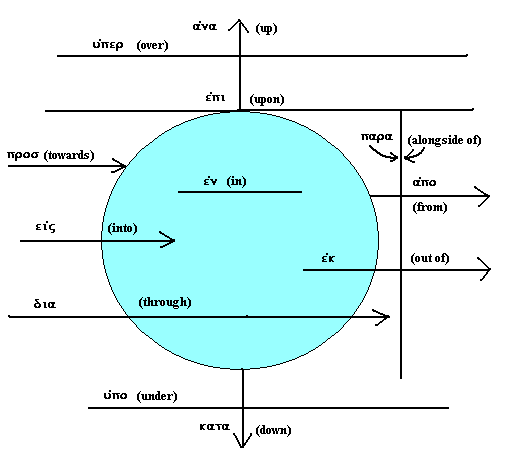
Where do you find through in Romans 10:17?

It's what the Greek says. A literal translation:

So faith out of (ἐκ) hearing, and hearing through (διά) the utterance of God. Romans 10:17
G1537 ἐκ ek (ek) prep.
ἐξ ex (ex)
1. out (of a place, time, or cause).
2. from out (of the point whence action or motion proceeds), forth.

G1223 διά dia (d̮iy-a') prep.
δι- di- (d̮iy-) [shortened prefix]
1. through.
 
It's what the Greek says. A literal translation:

So faith out of (ἐκ) hearing, and hearing through (διά) the utterance of God. Romans 10:17
G1537 ἐκ ek (ek) prep.
ἐξ ex (ex)
1. out (of a place, time, or cause).
2. from out (of the point whence action or motion proceeds), forth.

G1223 διά dia (d̮iy-a') prep.
δι- di- (d̮iy-) [shortened prefix]
1. through.
Why didn't you give all the definitions of those words? They also mean by or by means of. Those who translated the KJV thought these were the appropriate translation.
 
Why didn't you give all the definitions of those words? They also mean by or by means of. Those who translated the KJV thought these were the appropriate translation.

No they don't. Greek is a very technical language. The KJV translators took liberties they shouldn't have

propos.GIF
 
Front 3 is the explanation of front 1. The explanation isn't to show that faith is gifted. Rather, it is an explanation of what God's word actually teaches.
My view is that God Himself does the teaching. And to learn, a person must trust the things God teaches. As do other Scriptures, Romans 10:17 points us to God to trust Him and learn from Him. In other words, it doesn't tell us where trust comes from. It tells us the object of well-placed faith.

But faith is not just about learning because God is more than our teacher. He also leads us, guides us, directs us, corrects us, and comforts us. He does all these things from the intimacy of our own hearts. The key to living a successful Christian life is to trust Him in all these things. Those who are led by the Spirit of God are His children (Rom 8:14). If we live in the Spirit, then we should walk in lock step with the Spirit (Gal 5:25).
 
My view is that God Himself does the teaching. And to learn, a person must trust the things God teaches. As do other Scriptures, Romans 10:17 points us to God to trust Him and learn from Him. In other words, it doesn't tell us where trust comes from. It tells us the object of well-placed faith.

But faith is not just about learning because God is more than our teacher. He also leads us, guides us, directs us, corrects us, and comforts us. He does all these things from the intimacy of our own hearts. The key to living a successful Christian life is to trust Him in all these things. Those who are led by the Spirit of God are His children (Rom 8:14). If we live in the Spirit, then we should walk in lock step with the Spirit (Gal 5:25).
Romans 10:17 clearly teaches the genesis of faith.
 
Romans 10:17 clearly teaches the genesis of faith.
Romans 10:17 clearly sits near the end of a lengthy discussion of faith's role in a person's salvation (i.e., Romans 10:1-21). The passage is clear that God draws people to Christ with a message of reconciliation in Christ Jesus. Some people hear the message, believe the message, and call on Christ to save them. Jesus saves everyone who calls on Him. But other people hear the message and refuse to believe so they are not saved.

There is a theoretical third group of people that never hear the message. But Romans 10:18 closes the door to that possibility in that it is a reference to Psalm 19 which starts with this:

The heavens declare the glory of God;​
And the firmament shows His handiwork.​
2 Day unto day utters speech,​
And night unto night reveals knowledge.​
3 There is no speech nor language​
Where their voice is not heard.​
4 Their line has gone out through all the earth,​
And their words to the end of the world. (Ps 19:1–4)​
Nobody will be able to claim ignorance as an excuse because God sends out His message in many different ways that cannot be avoided by people. In fact, He personally reveals the message to people so that everyone who rejects it will be without excuse (Rom 1:19-20).

Believing the gospel message is dependent on hearing the gospel message and hearing the gospel message is dependent on God sending out the gospel message (Rom 10:14-15, 17). But faith is not the end of the stream, nor is it a gift that some people possess and others do not. A person who believes goes to Jesus for salvation, and Jesus saves everyone who goes to Him. To read this passage otherwise is to ignore its message.
 
Romans 10:17 clearly sits near the end of a lengthy discussion of faith's role in a person's salvation (i.e., Romans 10:1-21). The passage is clear that God draws people to Christ with a message of reconciliation in Christ Jesus. Some people hear the message, believe the message, and call on Christ to save them. Jesus saves everyone who calls on Him. But other people hear the message and refuse to believe so they are not saved.

There is a theoretical third group of people that never hear the message. But Romans 10:18 closes the door to that possibility in that it is a reference to Psalm 19 which starts with this:

The heavens declare the glory of God;​
And the firmament shows His handiwork.​
2 Day unto day utters speech,​
And night unto night reveals knowledge.​
3 There is no speech nor language​
Where their voice is not heard.​
4 Their line has gone out through all the earth,​
And their words to the end of the world. (Ps 19:1–4)​
Nobody will be able to claim ignorance as an excuse because God sends out His message in many different ways that cannot be avoided by people. In fact, He personally reveals the message to people so that everyone who rejects it will be without excuse (Rom 1:19-20).

Believing the gospel message is dependent on hearing the gospel message and hearing the gospel message is dependent on God sending out the gospel message (Rom 10:14-15, 17). But faith is not the end of the stream, nor is it a gift that some people possess and others do not. A person who believes goes to Jesus for salvation, and Jesus saves everyone who goes to Him. To read this passage otherwise is to ignore its message.

T
THE GREEK DID NOT USE THE WORD EUAGGELION FOR GOSPEL IN ROM. 10:17!

THEY USED THE WORD RHEMA, WHICH MEANS A DIVINE MESSAGE!
 
  • Like
Reactions: Cameron143
The Word of God mixed with faith. That is, the word of God is spoken, the 'hearee' is presented with the Truth and, with it, is given the opportunity to consider, "Is this truth?" Even being given the opportunity is gracious. There is no difference in the revelation between those that say, "Yes, it is possible" and those that say, "No, it is impossible." Both are an expression of faith in one form or another. However, the former is 'good faith' or living faith and the latter is dead faith.
 
T
THE GREEK DID NOT USE THE WORD EUAGGELION FOR GOSPEL IN ROM. 10:17!

THEY USED THE WORD RHEMA, WHICH MEANS A DIVINE MESSAGE!
So what? Salvation in Christ is the subject or Romans 10. It speaks of God as sending out the message. It speaks of people hearing the message. It speaks of some who reject the message and some who receive the message. And it speaks of Jesus saving everyone who responds favorably to the message.

Certainly, especially for the saved, God does not limit His messages to the subject of salvation. He is interested in more than that. When He provides a way of escape from temptation (1 Cor 10:13), for instance, or when He corrects us when we disobey (Heb 12), His message is plain and clear. We hear it and act on it by trusting what He communicates and doing accordingly or not. The general statement of Romans 10:12 applies to all the communications of God with man, including His specific communication to individuals concerning salvation.
 
The Word of God mixed with faith. That is, the word of God is spoken, the 'hearee' is presented with the Truth and, with it, is given the opportunity to consider, "Is this truth?" Even being given the opportunity is gracious. There is no difference in the revelation between those that say, "Yes, it is possible" and those that say, "No, it is impossible." Both are an expression of faith in one form or another. However, the former is 'good faith' or living faith and the latter is dead faith.
These are good points. I would just tweek the final statement a bit to say that the one who rejects the message refuses to believe.
 
  • Like
Reactions: Mem
These are good points. I would just tweek the final statement a bit to say that the one who rejects the message refuses to believe.

This is what dead faith effectively amounts to, yes. Disbelief comes in many forms, broad is that way, but the path of belief is narrow, as its parameters are strictly confined to the truth.
 
  • Like
Reactions: 2ndTimeIsTheCharm