Loss of salvation???

  • Christian Chat is a moderated online Christian community allowing Christians around the world to fellowship with each other in real time chat via webcam, voice, and text, with the Christian Chat app. You can also start or participate in a Bible-based discussion here in the Christian Chat Forums, where members can also share with each other their own videos, pictures, or favorite Christian music.

    If you are a Christian and need encouragement and fellowship, we're here for you! If you are not a Christian but interested in knowing more about Jesus our Lord, you're also welcome! Want to know what the Bible says, and how you can apply it to your life? Join us!

    To make new Christian friends now around the world, click here to join Christian Chat.
Typically, those who become close enough to know God don't do as I have mentioned but in everything there has to be at least one example.

Says who, may I ask? So many people talk volumes about adverse cases of people walking away from their faith and allegedly losing it and yet can't point out one example that fits their hypothetical. Why would any of us care about people we don't know nor will ever encounter in this life who allegedly walked away from their faith and lost it? How would anyone prove such a case? How does anyone prove loss of salvation in others or even themselves? What's the acid test that's not tied to some subjective measure made up in someone's inferior imaginations?

Please understand that I'm simply trying to help you to think more critically about those questions you're asking because, for a question to have merit, it needs something of substance behind its asking. Most point to answers that are found to be rooted more in feelings and emotions than for them to think on a higher plane, which is the basis for what scripture actually says in contrast to what one WANTS to believe. Reason and rationalization of hypotheticals that have no real substantial backing only muddy the waters and serve as distractions away from simply accepting what scripture teaches us.

MM
 
Can a once truly saved believer backslide too much and lose the gift of salvation? If so do they need to repent and ask for forgiveness through Christ again? Thoughts are welcome and scripture too!
Hello! How are you doing today? I hope you had a peaceful night. It's nice to meet you, and I would love for us to get to know each other better. If you don't mind sharing, I would love to hear more about yourself.
 
Hello! How are you doing today? I hope you had a peaceful night. It's nice to meet you, and I would love for us to get to know each other better. If you don't mind sharing, I would love to hear more about yourself.

Is this a dating site too? I had no idea...

MM
 
Please explain how losing, versus cannot lose, salvation is a false dichotomy. If your splitting the hair for there to be a third option, and that being that one can vacate their salvation, that option too is as empty for supporting scripture as the loss position. That's pretty straightforward and logical. Pointing to the silence also serves a good purpose for highlighting the additions to the text things that aren't there.

Your original dichotomy was OSAS or works-salvation. Rejecting that false dichotomy, I answered that Scripture presents responsive, cooperative, obedient faith that is not meritorious “works.” So I did not claim that losing vs. not losing salvation is a false dichotomy - you did, by ignoring how I addressed your original binary.
 
Says who, may I ask? So many people talk volumes about adverse cases of people walking away from their faith and allegedly losing it and yet can't point out one example that fits their hypothetical. Why would any of us care about people we don't know nor will ever encounter in this life who allegedly walked away from their faith and lost it? How would anyone prove such a case? How does anyone prove loss of salvation in others or even themselves? What's the acid test that's not tied to some subjective measure made up in someone's inferior imaginations?

Please understand that I'm simply trying to help you to think more critically about those questions you're asking because, for a question to have merit, it needs something of substance behind its asking. Most point to answers that are found to be rooted more in feelings and emotions than for them to think on a higher plane, which is the basis for what scripture actually says in contrast to what one WANTS to believe. Reason and rationalization of hypotheticals that have no real substantial backing only muddy the waters and serve as distractions away from simply accepting what scripture teaches us.

MM
We do have a current example who was a pastor turned scholar but now claims not to believe or follow God. Is he still good with God?
 
As to the 2 Timothy 2 section:

2 Timothy 2:10-13 — Therefore I endure all things for the elect's sakes, that they may also obtain the salvation which is in Christ Jesus with eternal glory. It is a faithful saying: For if we be dead with him, we shall also live with him: If we suffer, we shall also reign with him: if we deny him, he also will deny us: If we believe not, yet he abideth faithful: he cannot deny himself.

Attempting to keep this simple and not needing to respond to the personal rhetoric:
  • Treating this part and other parts of Scripture objectively, there are several different interpretations of it.
  • Here's a view of the simple grammar and parallelism of what many believe was a hymn:
    • Died with Him -> live with Him
    • Endure -> Reign with Him
    • Deny Him -> He will deny us [the 2 previous "with Him" outcomes]
      • This third line is a negative mirror of the first two.
      • Jesus uses the same wording for denial of men before the Father (Matt10:33 as your use of Thayer's notes)
    • The final clauses are two-fold:
      • If we are faithless (but not denying Him in finality) He remains faithful - reason: He cannot deny Himself
        • This applies to all He's said above
          • Died together -> will live together
          • Endure -> will reign together
          • Deny Him -> will deny us those 2 positive "together" outcomes of our actions
  • Although it's understood how you use this to distinguish between salvation vs. rewards, agreement is not universal.
  • You've really just continued to try to use 2Tim2:13 as proof of OSAS. Again, agreement with you is not universal.
There is simply nothing here that is unambiguously creating a life vs. rewards distinction.

You're importing OSAS into 2Tim2:13.
 
Magenta, have you ever read 1 Corinthians 11

14 Doth not even nature itself teach you, that, if a man have long hair, it is a shame unto him?

15 But if a woman have long hair, it is a glory to her: for her hair is given her for a covering.

I fully understand why Jesus Christ is always shown as a long haired effeminate, that comes from the god of this world Satan.

Plus it directly violated the Commandment of no idols

4 Thou shalt not make unto thee any graven image, or any likeness of any thing that is in heaven above, or that is in the earth beneath, or that is in the water under the earth:

here is a statement directly by Jesus Christ that is never in sermons.

Luke 19

27 But those mine enemies, which would not that I should reign over them, bring hither, and slay them before me.
Are you still under the law? My condolences.

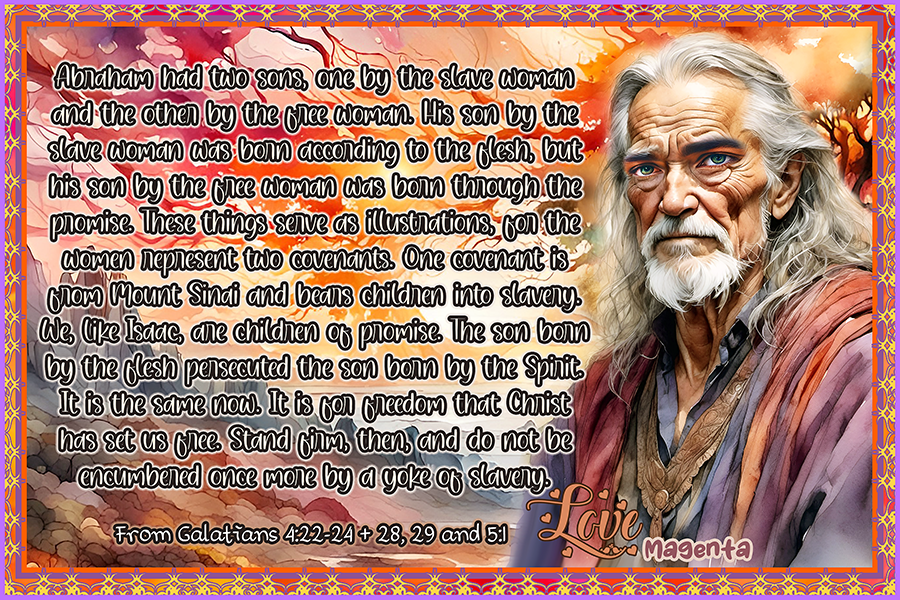
From-Galatians4-22-24plus28-29and5-1.png

From Galatians 4 v 22-24 plus 28-29 and 5 v 1 Abraham had two sons, one by the slave woman and the other by the free woman. His son by the slave woman was born according to the flesh, but his son by the free woman was born through the promise. These things serve as illustrations, for the women represent two covenants. One covenant is from Mount Sinai and bears children into slavery. We, like Isaac, are children of promise. The son born by the flesh persecuted the son born by the Spirit. It is the same now. It is for freedom that Christ has set us free. Stand firm, then, and do not be encumbered once more by a yoke of slavery.
 
Matt 5:17 Do not think that I have come to abolish the Law or the Prophets. I have not come to abolish them, but to fulfill them.


Until end of time – Matt 5:18 - For I tell you truly, until heaven and earth pass away, not a single jot, not a stroke of a pen, will disappear from the Law until everything is accomplished.


Rev 12:17 - And the dragon was enraged at the woman and went to make war with the rest of her children, who keep the commandments of God and hold to the testimony of Jesus. And the dragon stood on the shore of the sea.


Rev 14:12 - Here is a call for the perseverance of the saints, who keep the commandments of God and the faith of Jesus.
 
Catch my transition from OC to NC commands?

Your unwillingness to answer simply yes or no questions tells the story...at least where assumption is concerned. You leave us no other choice but to assume you believe in loss of salvation, which is works-based salvation no matter how one slices and dices it up into pieces.

MM
 
Your original dichotomy was OSAS or works-salvation. Rejecting that false dichotomy, I answered that Scripture presents responsive, cooperative, obedient faith that is not meritorious “works.” So I did not claim that losing vs. not losing salvation is a false dichotomy - you did, by ignoring how I addressed your original binary.

Yeah, yeah. You talk much about an alleged "false dichotomy" on my part under the guise of OC vs NC and some other straw men arguments, but your dodging about with the short chirp posts, not willing to explain and actually back up your claim of falsehood on my part with something of substance only shows how weak and pathetic your case really is. You can al least admit that, can't you? Why else do you persist in refusing to type out enough evidence and quotes from scripture to back your own words?

Come on! Let's converse.

MM
 
You leave us no other choice but to assume you believe in loss of salvation, which is works-based salvation no matter how one slices and dices it up into pieces.

What's the fallacy called that tries to establish relevance by speaking for all people rather than just one's self?
 
Matt 5:17 Do not think that I have come to abolish the Law or the Prophets. I have not come to abolish them, but to fulfill them.


Until end of time – Matt 5:18 - For I tell you truly, until heaven and earth pass away, not a single jot, not a stroke of a pen, will disappear from the Law until everything is accomplished.


Rev 12:17 - And the dragon was enraged at the woman and went to make war with the rest of her children, who keep the commandments of God and hold to the testimony of Jesus. And the dragon stood on the shore of the sea.


Rev 14:12 - Here is a call for the perseverance of the saints, who keep the commandments of God and the faith of Jesus.

Yes, all good stuff spoken and written to Israel before and after the dispensation of grace for the body of Christ. Lots of people out there are failing to rightly divide the word of truth, trying to mash together things that don't apply to us today.

Thanks for the post.

MM
 
Attempting to keep this simple and not needing to respond to the personal rhetoric:
  • Treating this part and other parts of Scripture objectively, there are several different interpretations of it.
  • Here's a view of the simple grammar and parallelism of what many believe was a hymn:
    • Died with Him -> live with Him
    • Endure -> Reign with Him
    • Deny Him -> He will deny us [the 2 previous "with Him" outcomes]
      • This third line is a negative mirror of the first two.
      • Jesus uses the same wording for denial of men before the Father (Matt10:33 as your use of Thayer's notes)
    • The final clauses are two-fold:
      • If we are faithless (but not denying Him in finality) He remains faithful - reason: He cannot deny Himself
        • This applies to all He's said above
          • Died together -> will live together
          • Endure -> will reign together
          • Deny Him -> will deny us those 2 positive "together" outcomes of our actions
  • Although it's understood how you use this to distinguish between salvation vs. rewards, agreement is not universal.
  • You've really just continued to try to use 2Tim2:13 as proof of OSAS. Again, agreement with you is not universal.
There is simply nothing here that is unambiguously creating a life vs. rewards distinction.

You're importing OSAS into 2Tim2:13.

Yes, I understand all this as things other people believe, but what the various bandwagons believe is of no consequence to the absolute, objective truth of scripture for what it says. I'm somewhat disappointed that you would appeal to such a weak, subjective foundation for support...

Never have you even tried to tackle the idea that "denial" automatically leads to the allegedly ONLY understanding of it meaning loss of salvation. You and others you side with who eisegete that into the textual meaning, I had expected better of you than this. Bandwagon support is really no support at all.

MM
 
What's the fallacy called that tries to establish relevance by speaking for all people rather than just one's self?

"The fallacy is called the "appeal to the common man," which occurs when someone assumes that their perspective or authority represents the views of all people, often disregarding the diversity of opinions within a group. "
 
I'm somewhat disappointed that you would appeal to such a weak, subjective foundation for support...

I had expected better of you than this. Bandwagon support is really no support at all.


This is an example of an "ad hominem" fallacy, where the focus is on attacking the opponent's character or expressing disappointment in them rather than addressing the argument itself. This type of argument diverts attention from the actual issue being discussed
 
Your unwillingness to answer simply yes or no questions tells the story...at least where assumption is concerned. You leave us no other choice but to assume you believe in loss of salvation, which is works-based salvation no matter how one slices and dices it up into pieces.

MM

For someone who lectures others on critical-thinking skills, you might want to look in the mirror.

I made a straightforward biblical point: God saves those who obey His New-Covenant command to believe in His Son (1 John3:23, et.al.).

Your reply:
  • misrepresents that as works-salvation,
  • keeps forcing a false dichotomy (either/or - OSAS or works-salvation)
  • closes discussion because I won’t buy into to your false framing.
In short, you’re refusing to deal with the Scripture I actually cited and your responses typically contain multiple fallacies in reasoning (straw-man, false dichotomy, circularity, etc.)
 
We do have a current example who was a pastor turned scholar but now claims not to believe or follow God. Is he still good with God?

This question does have an answer in scripture that many today refuse to accept. If you're asking me to judge that man on the basis of that short sentence, nobody but the Lord can answer that apart from that man.

The pertinent question to ask THAT man is if he ever truly believed in the death, burial and resurrection on the third day of Christ Jesus.

So, when it comes to everything else along this line, there's no right answers to the wrong questions.

If he says "yes," and that answer is honest and true, then he is still saved, yes. That's not you or me judging him, but rather reliance upon the scriptures I have shared with you. Given those scriptures, do you accept them for what they say?

To help you with this, please answer some questions:

* Do you believe the seal of Holy Spirit is removed from a man who later claims disbelief?
* Do you believe Christ re-casts a man's sins back upon him from Himself on the basis of sin and unbelief?
* Do you believe Christ exercises unfaithfulness toward us on the basis of unbelief later in life for whatever reason(s)?
* Do you believe Christ falls into self-denial on the basis of our unbelief?

If you can find scripture that supports those things, then scripture is inconsistent and we ALL have a serious problem, for our salvation is then ALWAYS in question. None of us could know for sure if we're saved, and yet some choose to live in that state of mind and heart in this life, and that's sad.

2 Timothy 2:13 If we believe not, yet he abideth faithful: he cannot deny himself.

Paul either meant what he said, or we transliterate his words into something else that more aligns with our chosen beliefs. That's the choice we all face when reading scripture and deciding as to if we want to believe what it says or make it say what we want it to say. I'm not saying you do that, but some do, and the tendency is very strong for that.

Group-think, for some, is not easy to resist. Riding the largest bandwagon has its lure, but those bandwagons are generally driven by Satan and his false doctrines he has so successfully served as the mastermind behind so much of it. Scripture is our weapon against him and his schemes.

MM
 
For someone who lectures others on critical-thinking skills, you might want to look in the mirror.

I made a straightforward biblical point: God saves those who obey His New-Covenant command to believe in His Son (1 John3:23, et.al.).

Your reply:
  • misrepresents that as works-salvation,
  • keeps forcing a false dichotomy (either/or - OSAS or works-salvation)
  • closes discussion because I won’t buy into to your false framing.
In short, you’re refusing to deal with the Scripture I actually cited and your responses typically contain multiple fallacies in reasoning (straw-man, false dichotomy, circularity, etc.)

You are the closer since you refuse to quote scripture and explain why you believe they are saying what you think they teach.

So, let's make this simple enough:

How is a requirement to retain salvation NOT a works-based salvation? How do you know that you're applying enough resistance against sin and in keeping those commands of Christ enough to say that you're absolutely saved? What's the barometer for that? Can you at least answer that? If not, then even you should question your salvation when you can't even define that line between salvation and salvation lost. A bark with no bite is nothing to fear nor respect.

MM
 
Yeah, yeah. You talk much about an alleged "false dichotomy" on my part under the guise of OC vs NC and some other straw men arguments, but your dodging about with the short chirp posts, not willing to explain and actually back up your claim of falsehood on my part with something of substance only shows how weak and pathetic your case really is. You can al least admit that, can't you? Why else do you persist in refusing to type out enough evidence and quotes from scripture to back your own words?

Come on! Let's converse.

MM

So many games to try to support a system of theology.

You originally presented a strict either/or - a false dichotomy: OSAS or works-salvation. I rejected that false dichotomy and described responsive, cooperative, obedient, non-meritorious faith instead. You've never actually engaged that description or the verses I cited (1John3:23, etc.).

What you've done is straw-man my position, shift the goalposts, project your own dodging onto me, and resort to insults and mockery - all classic fallacies - under the guise of ‘let’s converse’.

It’s ironic to be decrying the condition of reasoning in our day and to be reproving others for lacking critical-thinking skills while repeatedly using fallacies, caricatures, and bullying tactics yourself.