Refuting the Calvinist’s Denial of Free Will

  • Christian Chat is a moderated online Christian community allowing Christians around the world to fellowship with each other in real time chat via webcam, voice, and text, with the Christian Chat app. You can also start or participate in a Bible-based discussion here in the Christian Chat Forums, where members can also share with each other their own videos, pictures, or favorite Christian music.

    If you are a Christian and need encouragement and fellowship, we're here for you! If you are not a Christian but interested in knowing more about Jesus our Lord, you're also welcome! Want to know what the Bible says, and how you can apply it to your life? Join us!

    To make new Christian friends now around the world, click here to join Christian Chat.

Jon777

Active member
Sep 16, 2025
119
44
28
Virginia
In supporting man’s free will, is there stronger direct support for free will than in the following verses?

V13 The Lord hates all abominations, and they are not loved by those who fear him.
V14 It was he who created man in the beginning, and he left him in the power of his own inclination.
V15 If you will, you can keep the commandments, and to act faithfully is a matter of your own choice.
 
  • Like
Reactions: homwardbound
In supporting man’s free will, is there stronger direct support for free will than in the following verses?

V13 The Lord hates all abominations, and they are not loved by those who fear him.
V14 It was he who created man in the beginning, and he left him in the power of his own inclination.
V15 If you will, you can keep the commandments, and to act faithfully is a matter of your own choice.
By trust to the risen Son unto Father as the gift to see new from Father's Spirit and Truth for all to stand in thankfully
Col 1:21-23
 
The question does not involve in which book and chapter the verses are found. The question is, are there more clear, direct verses to support free will than these I posted?
I shake my head.

You didn’t think that through. You claim there are no more clear, direct verses to support free will, but you won’t or can’t provide the reference for those verses. I see no reason to go hunting in a concordance for the verses you cited.

If you can’t demonstrate that those verses are in the Bible, you should not have implied that they are.

So, once again, book and chapter?
 
  • Like
Reactions: rogerg
In supporting man’s free will, is there stronger direct support for free will than in the following verses?

V13 The Lord hates all abominations, and they are not loved by those who fear him.
V14 It was he who created man in the beginning, and he left him in the power of his own inclination.
V15 If you will, you can keep the commandments, and to act faithfully is a matter of your own choice.
Taken captive to do the will of the devil is defined as being free by those who promote free will.

Meanwhile Scripture also says that the man of flesh cannot please, submit to, or obey God.
The man of flesh being him who is not regenerated, nor indwelt by the Holy Spirit of God.


But promoters of free will contradict and deny such explicitly articulated verses and also rewrite
others they do not like, such as 1 Corinthians 2:14. Lots of Pelagian heretics here. They believe
flesh can please God by choosing to believe with their incurably wicked heart what is foolishness
to him as a lover of darkness and slave to sin opposed to the spiritual things of God.


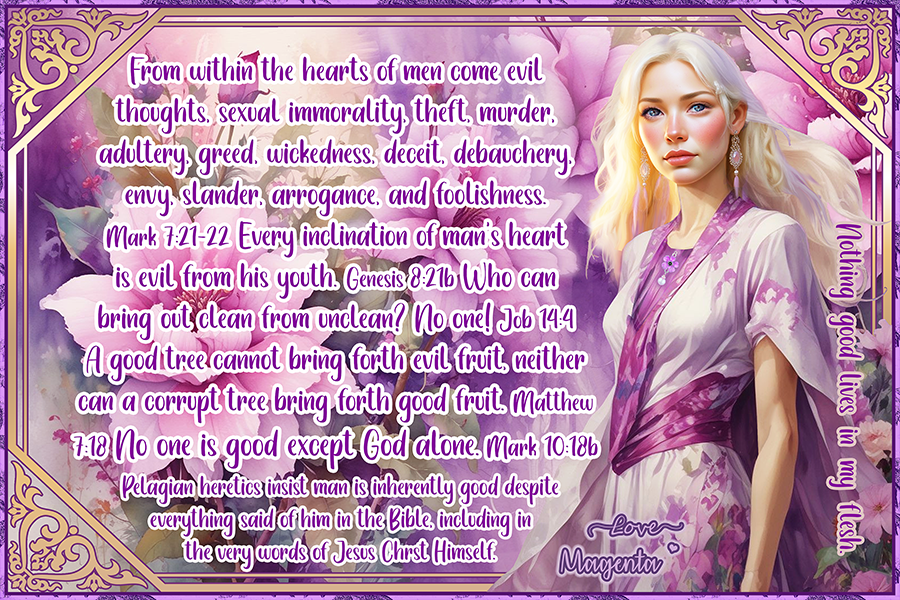
Pelagianheretics.png

Pelagian heretics insist man is inherently good. From within the hearts of men come evil thoughts, sexual immorality, theft, murder, adultery, greed, wickedness, deceit, debauchery, envy, slander, arrogance, and foolishness. Mark 7 verses 21-22 Every inclination of man's heart is evil from his youth. Genesis 8 verse 21b Who can bring out clean from unclean? No one! Job 14 verse 4 A good tree cannot bring forth evil fruit, neither can a corrupt tree bring forth good fruit. Matthew 7 verse 18
 
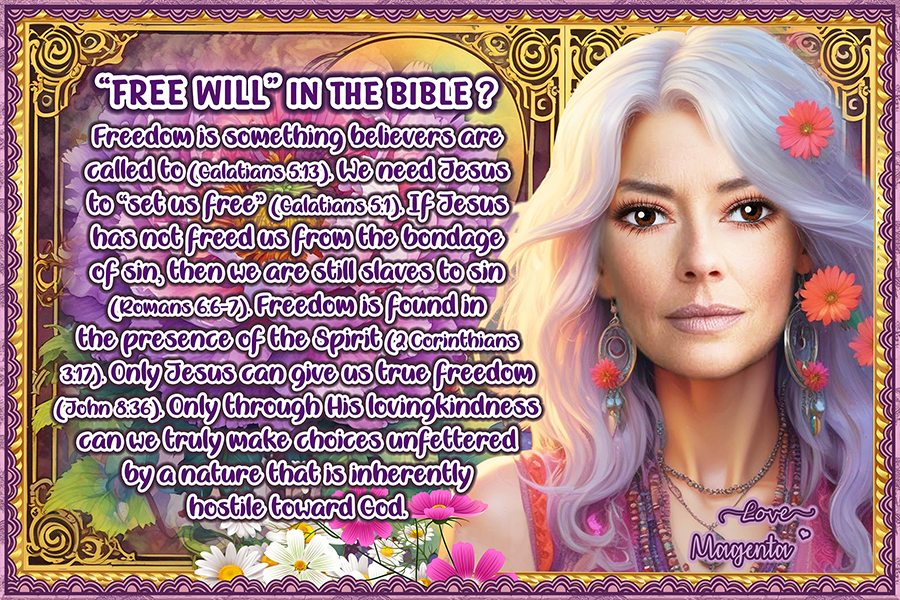
Freewill.png

"Free will" in the Bible? ~ Freedom is something believers are called to (Galatians 5 verse 13). We need Jesus to “set us free” (Galatians 5 verse 1). If Jesus has not freed us from the bondage of sin, then we are still slaves to sin (Romans 6 verses 6-7). Freedom is found in the presence of the Spirit (2 Corinthians 3 verse 17). Only Jesus can give us true freedom (John 8 verse 36). Only through His lovingkindness can we truly make choices unfettered by a nature that is inherently hostile toward God.
 
Taken captive to do the will of the devil is defined as being free by those who promote free will.

Meanwhile Scripture also says that the man of flesh cannot please, submit to, or obey God.
The man of flesh being him who is not regenerated, nor indwelt by the Holy Spirit of God.


But promoters of free will contradict and deny such explicitly articulated verses and also rewrite
others they do not like, such as 1 Corinthians 2:14. Lots of Pelagian heretics here. They believe
flesh can please God by choosing to believe with their incurably wicked heart what is foolishness
to him as a lover of darkness and slave to sin opposed to the spiritual things of God.


Pelagianheretics.png

Pelagian heretics insist man is inherently good. From within the hearts of men come evil thoughts, sexual immorality, theft, murder, adultery, greed, wickedness, deceit, debauchery, envy, slander, arrogance, and foolishness. Mark 7 verses 21-22 Every inclination of man's heart is evil from his youth. Genesis 8 verse 21b Who can bring out clean from unclean? No one! Job 14 verse 4 A good tree cannot bring forth evil fruit, neither can a corrupt tree bring forth good fruit. Matthew 7 verse 18
Therefore ask God willingly for the new heart offered us all in Ezekiel 36:26 speaks of the risen Son fro us, seek, trust to do good by God's lead, not the self anymore Phil 3:1-20
yet, all that takes willing to believe God loves you completely first, when anyone does that between God and themselves, God seals them to see new and learn new from mistakes made afterwards, having past sins forgiven through the cross of Son for them, gets revealed from Father to them
Amazing, believe, receive and see and grow daily into maturity from God in humility, that begins Eph 1:13 for anyone that chooses to beleive God and stick to that as if are glued to it. One will then grow new unto maturity, and I am not saying I got it, I get it, thank you Father and Son as Won (One) for us all
Wow, woe is me Isaiah 6:1-7
 
In supporting man’s free will, is there stronger direct support for free will than in the following verses?

V13 The Lord hates all abominations, and they are not loved by those who fear him.
V14 It was he who created man in the beginning, and he left him in the power of his own inclination.
V15 If you will, you can keep the commandments, and to act faithfully is a matter of your own choice.

Willing = equals free will to choose to be willing for Father to lead, and one then loves all over the few, flesh first birth only knows how to only love those that love them back
Exodus 25:2
Speak unto the children of Israel, that they bring me an offering: of every man that giveth it willingly with his heart ye shall take my offering.
Exodus 35:5
Take ye from among you an offering unto the Lord: whosoever is of a willing heart, let him bring it, an offering of the Lord; gold, and silver, and brass,
Exodus 35:21
And they came, every one whose heart stirred him up, and every one whom his spirit made willing, and they brought the Lord's offering to the work of the tabernacle of the congregation, and for all his service, and for the holy garments.
Exodus 35:29
The children of Israel brought a willingoffering unto the Lord, every man and woman, whose heart made them willing to bring for all manner of work, which the Lordhad commanded to be made by the hand of Moses.
Judges 5:2
Praise ye the Lord for the avenging of Israel, when the people willingly offered themselves.
Judges 5:9
My heart is toward the governors of Israel, that offered themselves willingly among the people. Bless ye the Lord.
1 Chronicles 28:9
And thou, Solomon my son, know thou the God of thy father, and serve him with a perfect heart and with a willing mind: for the Lord searcheth all hearts, and understandeth all the imaginations of the thoughts: if thou seek him, he will be found of thee; but if thou forsake him, he will cast thee off for ever.
1 Chronicles 28:21
And, behold, the courses of the priests and the Levites, even they shall be with thee for all the service of the house of God: and there shall be with thee for all manner of workmanship every willing skilful man, for any manner of service: also the princes and all the people will be wholly at thy commandment.
1 Chronicles 29:5
The gold for things of gold, and the silver for things of silver, and for all manner of work to be made by the hands of artificers. And who then is willing to consecrate his service this day unto the Lord?
1 Chronicles 29:6
Then the chief of the fathers and princes of the tribes of Israel and the captains of thousands and of hundreds, with the rulers of the king's work, offered willingly,

Are we getting it, Father seeks those willing to serve God. Are you, I and others seeing to be willing
Matthew 26:39
And he went a little farther, and fell on his face, and prayed, saying, O my Father, if it be possible, let this cup pass from me: nevertheless not as I will, but as thou wilt.

Willing is the free choice given to all to choose to be willing to Father to trust Father to do Father's will in love and mercy to all, you think? I trust thank you

 
I'm surprised no one seemed to be curious enough about the verses I quoted to do an online search to see where they came from. Out of 8 of the search engines I use, 7 stated clearly from where the verses come from.

The Catholic Study Bible, The New American Bible, Revised Edition, ©2011

The Wisdom of Ben Sira (Ecclesiasticus or Sirach) 175 BC
“Though not included in the Jewish Bible after the first century A.D., nor, therefore, accepted by Protestants, the Wisdom of Ben Sira has been recognized by the Catholic Church as inspired and canonical.” From the Introduction to the book.

The Reading Guide to Sirach
“Sirach belongs to the collection called deuterocanonical by Roman Catholics or apocryphal by Protestants… the Jews did not accept Sirach as canonical…its absence from the Jewish list explains its exclusion from the Protestant canon.” Page 277

Roman Catholic Study Bible Annotation on Sirach 15:11-20, including the verses I quoted in the OP
“Here Ben Sira links freedom of the will with human responsibility. God, who sees everything, is neither the cause nor the occasion of sin. We have power to choose our behavior and we are responsible for both the good and the evil we do (vv15-17)”

The Council of Trent was the 19th ecumenical council of the Roman Catholic Church, held in three sessions between 1545 and 1563 in the city of Trent (now Trento, Italy). The Council of Trent was convened in response to the Protestant Reformation…the Council of Trent helped shape modern Roman Catholicism and solidified its theological stance for centuries to come. Statements from that official council -
“…since all men lost their innocence in the apostasy of Adam, so that . . . they are servants of sin, under the power of the devil and of death . . . nevertheless in them free will is by no means extinct although it is weakened as to its strength and biased.”
—"If any one shall say that the free will of man has been lost and extinguished in consequence of the sin of Adam. . . . anathema sit.”

Robert Bellarmine(1542-1621), Counter-Reformation Leader: Bellarmine was one of the most prominent Catholic defenders against Protestant doctrines during the Reformation. He wrote extensively to explain and defend Catholic teachings.

Statements by Bellarmine:
Amiss. Gratia, " 3. 1.—"The penalty which properly stands over against the first sin, is the loss of original righteousness and of the supernatural gifts with which God had furnished our nature. " DeGratia primi hom., 1.—"They (the Catholics) teach that, through the sin of Adam the whole man was truly deteriorated, but that he has not lost free will nor any other of the dona naturalia, but only the donasupernaturalia."

The Roman Catholic Church taught (and still teaches) that humans retain free will, even after the Fall. While original sin wounded human nature, it did not destroy free will. Grace is necessary for salvation, but humans must freely cooperate with God’s grace — this cooperation is part of salvation. This synergy (cooperation between God and man) is essential in Catholic soteriology. This "cooperation" is where the works salvation comes in!
 
I'm surprised no one seemed to be curious enough about the verses I quoted to do an online search to see where they came from. Out of 8 of the search engines I use, 7 stated clearly from where the verses come from.

The Catholic Study Bible, The New American Bible, Revised Edition, ©2011

The Wisdom of Ben Sira (Ecclesiasticus or Sirach) 175 BC
“Though not included in the Jewish Bible after the first century A.D., nor, therefore, accepted by Protestants, the Wisdom of Ben Sira has been recognized by the Catholic Church as inspired and canonical.” From the Introduction to the book.

The Reading Guide to Sirach
“Sirach belongs to the collection called deuterocanonical by Roman Catholics or apocryphal by Protestants… the Jews did not accept Sirach as canonical…its absence from the Jewish list explains its exclusion from the Protestant canon.” Page 277

Roman Catholic Study Bible Annotation on Sirach 15:11-20, including the verses I quoted in the OP
“Here Ben Sira links freedom of the will with human responsibility. God, who sees everything, is neither the cause nor the occasion of sin. We have power to choose our behavior and we are responsible for both the good and the evil we do (vv15-17)”

The Council of Trent was the 19th ecumenical council of the Roman Catholic Church, held in three sessions between 1545 and 1563 in the city of Trent (now Trento, Italy). The Council of Trent was convened in response to the Protestant Reformation…the Council of Trent helped shape modern Roman Catholicism and solidified its theological stance for centuries to come. Statements from that official council -
“…since all men lost their innocence in the apostasy of Adam, so that . . . they are servants of sin, under the power of the devil and of death . . . nevertheless in them free will is by no means extinct although it is weakened as to its strength and biased.”
—"If any one shall say that the free will of man has been lost and extinguished in consequence of the sin of Adam. . . . anathema sit.”

Robert Bellarmine(1542-1621), Counter-Reformation Leader: Bellarmine was one of the most prominent Catholic defenders against Protestant doctrines during the Reformation. He wrote extensively to explain and defend Catholic teachings.

Statements by Bellarmine:
Amiss. Gratia, " 3. 1.—"The penalty which properly stands over against the first sin, is the loss of original righteousness and of the supernatural gifts with which God had furnished our nature. " DeGratia primi hom., 1.—"They (the Catholics) teach that, through the sin of Adam the whole man was truly deteriorated, but that he has not lost free will nor any other of the dona naturalia, but only the donasupernaturalia."

The Roman Catholic Church taught (and still teaches) that humans retain free will, even after the Fall. While original sin wounded human nature, it did not destroy free will. Grace is necessary for salvation, but humans must freely cooperate with God’s grace — this cooperation is part of salvation. This synergy (cooperation between God and man) is essential in Catholic soteriology. This "cooperation" is where the works salvation comes in!
I can't tell yet if you're being sarcastic, or just promoting Catholic heresies.

Surely you must know those Books are not considered as a part of the Holy Bible.
 
In supporting man’s free will, is there stronger direct support for free will than in the following verses?

V13 The Lord hates all abominations, and they are not loved by those who fear him.
V14 It was he who created man in the beginning, and he left him in the power of his own inclination.
V15 If you will, you can keep the commandments, and to act faithfully is a matter of your own choice.

Well, in the OT we have Deuteronomy 30:19 and in the NT there is Matthew 23:37.
 
I can't tell yet if you're being sarcastic, or just promoting Catholic heresies.

Surely you must know those Books are not considered as a part of the Holy Bible.
I can't tell yet if you're being sarcastic, or just promoting Catholic heresies.

Surely you must know those Books are not considered as a part of the Holy Bible.

I'm not being sarcastic, and I'm not promoting Roman Catholic doctrine. The quotes I gave show the Roman Catholic Study Bible itself clearly stating that Protestants do not consider Sirach canonical and why. I've quoted the official Roman Catholic teaching of "free will" and it is what I read on this Forum consistently by those who oppose Roman Catholicism. Most have no idea what Roman Catholic doctrine is, and many consistently attack Luther and Calvin, as they have misrepresented those Reformers. Those embracing free will are parroting the official Roman Catholic teaching on the topic.
 
Well, in the OT we have Deuteronomy 30:19 and in the NT there is Matthew 23:37.

Quoting Dt 30:19 alone gives just half of the sentence, which makes it a dangerous half-truth. It was choosing to obey God in order to keep the promised land. This is not choosing eternal life.

“I call heaven and earth to witness against you this day, that I have set before you life and death, blessing and curse; therefore choose life, that you and your descendants may live, loving the LORD your God, obeying his voice, and cleaving to him; for that means life to you and length of days, that you may dwell in the land which the LORD swore to your fathers, to Abraham, to Isaac, and to Jacob, to give them.” (Deut 30:19-20)

“O Jerusalem, Jerusalem, thou that killest the prophets, and stonest them which are sent unto thee, how often would I have gathered thy children together, even as a hen gathereth her chickens under her wings, and ye would not!” (Matt 23:37)

Looks like Matt. 23:37 is a clear example of man’s will being in bondage to his sinful nature.

Jesus answered them, “I told you, and you do not believe. The works that I do in my Father’s name, they bear witness to me; but you do not believe, because you do not belong to my sheep. (John 10:25-26)

“What then? Are we Jews any better off? No, not at all; for I have already charged that all men, both Jews and Greeks, are under the power of sin, as it is written: “None is righteous, no, not one; no one understands, no one seeks for God. All have turned aside, together they have gone wrong; no one does good, not even one.” “Their throat is an open grave, they use their tongues to deceive.” “The venom of asps is under their lips.” “Their mouth is full of curses and bitterness.” “Their feet are swift to shed blood, in their paths are ruin and misery, and the way of peace they do not know.” “There is no fear of God before their eyes.” (Rom 3:9-18)
 
I'm not being sarcastic, and I'm not promoting Roman Catholic doctrine. The quotes I gave show the Roman Catholic Study Bible itself clearly stating that Protestants do not consider Sirach canonical and why. I've quoted the official Roman Catholic teaching of "free will" and it is what I read on this Forum consistently by those who oppose Roman Catholicism. Most have no idea what Roman Catholic doctrine is, and many consistently attack Luther and Calvin, as they have misrepresented those Reformers. Those embracing free will are parroting the official Roman Catholic teaching on the topic.
OK
 
I have [{(NEVER)}] heard or read in the Free Will "Doctrine" that man can save himself.

I have read in Acts 17 that God created man with the ability to seek God but that man does not.

My understanding of the Free Will "Doctrine" is that God initiates\manifests Himself to a person [like hearing the Gospel preached] where man begins to understand that he needs God to be saved.

The Free Will portion of what I just wrote ^ is man can accept or reject God and His offer of Salvation.

I have never heard or read man could save himself and that's what Free Will is.
 
  • Like
Reactions: wattie
I'm surprised no one seemed to be curious enough about the verses I quoted to do an online search to see where they came from. Out of 8 of the search engines I use, 7 stated clearly from where the verses come from.

The Catholic Study Bible, The New American Bible, Revised Edition, ©2011

The Wisdom of Ben Sira (Ecclesiasticus or Sirach) 175 BC
“Though not included in the Jewish Bible after the first century A.D., nor, therefore, accepted by Protestants, the Wisdom of Ben Sira has been recognized by the Catholic Church as inspired and canonical.” From the Introduction to the book.

The Reading Guide to Sirach
“Sirach belongs to the collection called deuterocanonical by Roman Catholics or apocryphal by Protestants… the Jews did not accept Sirach as canonical…its absence from the Jewish list explains its exclusion from the Protestant canon.” Page 277

Roman Catholic Study Bible Annotation on Sirach 15:11-20, including the verses I quoted in the OP
“Here Ben Sira links freedom of the will with human responsibility. God, who sees everything, is neither the cause nor the occasion of sin. We have power to choose our behavior and we are responsible for both the good and the evil we do (vv15-17)”

The Council of Trent was the 19th ecumenical council of the Roman Catholic Church, held in three sessions between 1545 and 1563 in the city of Trent (now Trento, Italy). The Council of Trent was convened in response to the Protestant Reformation…the Council of Trent helped shape modern Roman Catholicism and solidified its theological stance for centuries to come. Statements from that official council -
“…since all men lost their innocence in the apostasy of Adam, so that . . . they are servants of sin, under the power of the devil and of death . . . nevertheless in them free will is by no means extinct although it is weakened as to its strength and biased.”
—"If any one shall say that the free will of man has been lost and extinguished in consequence of the sin of Adam. . . . anathema sit.”

Robert Bellarmine(1542-1621), Counter-Reformation Leader: Bellarmine was one of the most prominent Catholic defenders against Protestant doctrines during the Reformation. He wrote extensively to explain and defend Catholic teachings.

Statements by Bellarmine:
Amiss. Gratia, " 3. 1.—"The penalty which properly stands over against the first sin, is the loss of original righteousness and of the supernatural gifts with which God had furnished our nature. " DeGratia primi hom., 1.—"They (the Catholics) teach that, through the sin of Adam the whole man was truly deteriorated, but that he has not lost free will nor any other of the dona naturalia, but only the donasupernaturalia."

The Roman Catholic Church taught (and still teaches) that humans retain free will, even after the Fall. While original sin wounded human nature, it did not destroy free will. Grace is necessary for salvation, but humans must freely cooperate with God’s grace — this cooperation is part of salvation. This synergy (cooperation between God and man) is essential in Catholic soteriology. This "cooperation" is where the works salvation comes in!
While I appreciate that you provided the source, doing so in your initial post would have been appropriate. The quotation is not from the Bible, and as this is a Bible discussion forum, there’s nothing further to discuss.