Can We Really Exercise Free Will?

  • Christian Chat is a moderated online Christian community allowing Christians around the world to fellowship with each other in real time chat via webcam, voice, and text, with the Christian Chat app. You can also start or participate in a Bible-based discussion here in the Christian Chat Forums, where members can also share with each other their own videos, pictures, or favorite Christian music.

    If you are a Christian and need encouragement and fellowship, we're here for you! If you are not a Christian but interested in knowing more about Jesus our Lord, you're also welcome! Want to know what the Bible says, and how you can apply it to your life? Join us!

    To make new Christian friends now around the world, click here to join Christian Chat.
No, not necessarily since salvation is a process of sanctification/regeneration. You're operating under the assumption that God's grace is ineffectual in this process. Don't forget: That miracle also bears witness to the truth that Jesus gives Life to whomever HE WISHES! And that's exactly what took place with that blind man. Jesus sought him out because the Father had given him to Jesus in eternity. Monogerism does not negate human response to God's grace/power.

You're again alleging you understand how I view grace and that it's incorrect. Same allegations.

Does monergism say men work with God in the salvation process like you have in your explanation of that verse?

Synergism includes human response to God's grace/power. So, if monergism does also, then what's the point of all your allegations? And since monos ergon means "alone work" or "the work of one" then it sounds like you're confusing the 2 contrasting words and concepts of alone vs. together.

Jesus wishes to give life to those who choose to believe in and follow Him. This is pretty simple. and very clear in Scripture.
 
  • Like
Reactions: Roughsoul1991
I agree. I just simply see that God does everything He can to save the sinner and provides many opportunities to change and move them towards belief. He moves first or else we would stay very content in our natural state.
Yes, Scripture does say it is God's will and desire not man's... People don't decide to believe what is foolishness to them.

1-Corinthians4-7b-John3-27-Romans9-15-16s.png

1 Corinthians 4 verse 7b; John 3 verse 27; Romans 9 verses 15-16 ~ What do you have that you did not receive? And if you did also receive it, why do you boast as not having received it? John replied, "A man can receive only that which is given him from heaven." "I will have mercy on whom I have mercy, and I will have compassion on whom I have compassion." So then, it does not depend on man's desire or effort, but on God's mercy.
:)
 
Jesus wishes to give life to those who choose to believe in and follow Him. This is pretty simple. and very clear in Scripture.
Very clear also that God moves first, those given will come and obviously? Not all are given.
 
I cited the passage in my 4468: Eph 5:8!

Maybe you can spin that text to make it say that "you were formerly twilight"? :rolleyes: Or maybe they were simply children of the night, taking after their former father the Prince of Darkness whose seed they used be? How's that for a "novel" idea?

Thanks for stating the verse. I knew where it was because it's the only one I know of that makes that statement.

You're making the point and using that verse. Why does Paul say they were darkness? Please explain what you think he means. Maybe begin in close context and go from there. Why is Paul personifying them as having been darkness?

Does Jesus the Light of the world, or God who is Light, or does Paul's treatment of the Light of the Gospel of Christ's Glory have any ability to deal with darkness?
 
Romans8-6-7s.png

Romans 8:6-7 The mind of the flesh is death, but the mind of the Spirit is life and peace, because the mind of the flesh is hostile to God: It does not submit to God’s law, nor can it do so.
 
Romans8-5s.png

Romans 8:5 Those who live according to the flesh set their minds on the things of the flesh; but those who live according to the Spirit set their minds on the things of the Spirit.
 
John8-43and47-Acts13-48-Romans8-8.png

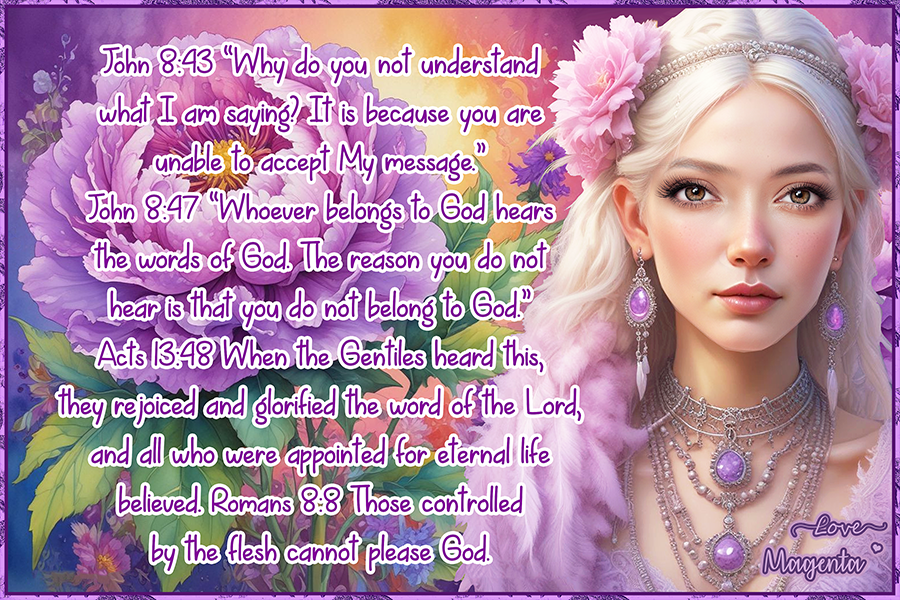
John 8 verses 43, 47, Acts 13 verse 48, Romans 8 verse 8, John 8 verse 43 “Why do you not understand what I am saying? It is because you are unable to accept My message.” “Whoever belongs to God hears the words of God. The reason you do not hear is that you do not belong to God.” When the Gentiles heard this, they rejoiced and glorified the word of the Lord, and all who were appointed for eternal life believed. Those controlled by the flesh cannot please God.
 
In summary, John 9 teaches many spiritual lessons. The only difference between the blind man at birth and the vast majority of the rest of humanity is that most of us come into this world physically sighted, thanks to God's grace. But like the blind man at birth, we all come into this world born spiritually blind. No exceptions! But FWers don't really believe this for a nanosecond. Man is NOT helpless -- certainly not helplessly blind! It only takes a natural act of man's "freewill" to see (understand) Christ, his kingdom and his gospel. So, listen to what the Savior said who allegedly desires that all mankind w/o exception be saved
The blind man did not come to faith in Christ at the time he was healed of blindness. When the pharisees asked him what he knew about Christ, the man answered "a prophet" (John 9:17). The man also told the pharisees he believed Jesus was "a worshipper of God, and doeth His will" (John 9:31) and Jesus was a "man of God" (John 9:33).

After Jesus took him aside and revealed Himself as Messiah (John 9:35-37), then the man worshipped Him.

So, this chapter in Scripture confirms what I and others have been telling you ... God reaches out to mankind and mankind either believes or rejects ...

If a person believes, he or she receives the blessing promised.

If a person does not believe, he or she receives the consequence of rejecting.
.
 
  • Like
Reactions: sawdust
Eph 2:1-9 Do you not have ears?
Providing a way to be Saved is not being forced to be saved.

Those verses show what God has done and it was all God who provided this way for us to be Saved. But nowhere do those verses say we were just Saved and God forced it upon us.
 
  • Like
Reactions: studier
The unregenerated live according to the flesh.

fruituntodeath.png

Flesh serves the law of sin. For the flesh craves what is contrary to the Spirit, and the Spirit what is contrary to the flesh. They are opposed to each other. Nothing good lives in my flesh. Who can say, “I have kept my heart pure; I am clean and without sin”? Who can bring what is pure from the impure? No one! The flesh brings forth fruit unto death. Romans 7 v 25, Galatians 5 v 17, Romans 7 v 18, Proverbs 20 v 9, Job 14 v 4, Romans 7 v 5 (Romans 8 v 13 and James 1 v 15)
 
I agree! If salvation is a gift by grace thru faith, then it must be received as a gift rather than earned.

“But without faith it is impossible to please him:

for he that cometh to God must believe that he is,

and that he is a rewarder of them that diligently seek him.”
‭‭Hebrews‬ ‭11:6‬ ‭KJV‬‬

“But seek ye first the kingdom of God, and his righteousness; and all these things shall be added unto you.”
‭‭Matthew‬ ‭6:33‬ ‭KJV‬‬

“Now after that John was put in prison, Jesus came into Galilee, preaching the gospel of the kingdom of God, and saying, The time is fulfilled, and the kingdom of God is at hand: repent ye, and believe the gospel.”
‭‭Mark‬ ‭1:14-15‬ ‭KJV‬‬

“And he said unto them, Go ye into all the world, and preach the gospel to every creature. He that believeth and is baptized shall be saved;

but he that believeth not shall be damned.”
‭‭Mark‬ ‭16:15-16‬ ‭
 
Providing a way to be Saved is not being forced to be saved.

Those verses show what God has done and it was all God who provided this way for us to be Saved. But nowhere do those verses say we were just Saved and God forced it upon us.
Amen exactly

“For this is good and acceptable in the sight of God our Saviour; who will have all men to be saved, and to come unto the knowledge of the truth.”
‭‭1 Timothy‬ ‭2:3-4‬ ‭KJV‬‬

So he provided a way for them all to be saved

“And he said unto them, Go ye into all the world, and preach the gospel to every creature. He that believeth and is baptized shall be saved;

but he that believeth not shall be damned.”
‭‭Mark‬ ‭16:15-

That covers everyone and it doesn’t say “ those god chooses will be saved and those God rejects will be damned ….it doesn’t say “ whoever is i saved will believe and whoever is damned will not believe …..

it says he sent out the message of Jesus Christ and salvation to all creation and whoever believes that message shall be saved whoever doesn’t believe that message shall be damned . “Strangely “the bible is really consistent about that and never contradicts itself regarding it
 
Romans9plus-Johnandtitus.png

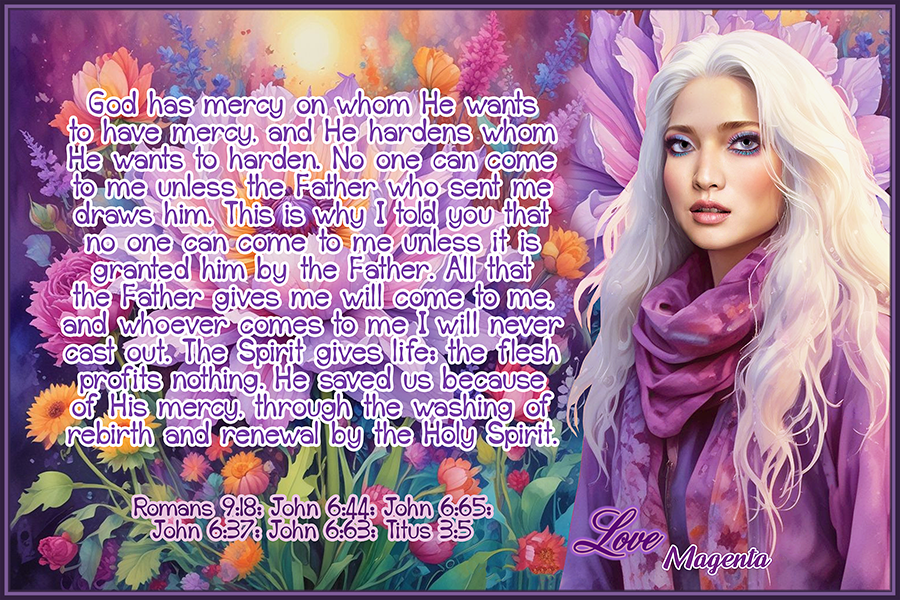
Romans 9 verse 18; John 6 verse 44; John 6 verse 65; John 6 verse 37; John 6 verse63; Titus 3 verse5 ~ God has mercy on whom He wants to have mercy, and He hardens whom He wants to harden. No one can come to me unless the Father who sent me draws him. This is why I told you that no one can come to me unless it is granted him by the Father. All that the Father gives me will come to me, and whoever comes to me I will never cast out. The Spirit gives life; the flesh profits nothing. He saved us because of His mercy, through the washing of rebirth and renewal by the Holy Spirit.
 
Thanks for the addition.

My understanding of your interpretation I think is again stated here and goes something like this:
  • Faith = having faith in/from God's Truth
  • Belief = believing things other than God's truth
Maybe you'd state this in simplicity otherwise and/or better.

This issue I have is that pistis means faith and belief and... So, the terms are interchangeable. And we don't call believers "faithers" simply because it doesn't sound right at this point. And linguistically there's really not much difference going through the Text and replacing "believe" with "have faith" so "faith from news" (Gospel) could just as easily be translated "belief from news". As long as we know what the content of belief or faith is being discussed, it's not an issue which word we use.

On that note, for example, I recall years ago working in Hebrews and specifically on Heb11. For instance Heb11:6:

Without pistis impossible to be pleasing, to clarify, to pisteuō is necessary for the man who comes to God​
Without belief impossible to be pleasing, to clarify, to believe is necessary for the man who comes to God​
Without faith impossible to be pleasing, to clarify, to exercise faith is necessary for the man who comes to God​
Without trust impossible to be pleasing, to clarify, to trust is necessary for the man who comes to God​

As I worked through a lot of such things it just became clear that no matter what word(s) we like or don't like for whatever reasons, the main thing that's necessary is that we just always keep in mind that the object is God or whatever related to Him He is identifying and having us focus on in the context.

As I again work through the Eph verses @reneweddaybyday brought up re: trust, my sense and recall are that those verses do not specify that trust comes before belief.

Trying to define things down to exacting details can get difficult. Language has it's limitations. :)

Let me say this. I separate believing and faith not because they are two distinct actions, but because they have two separate origins. Biblical saving faith comes from the word, our believing is an act of our will, it doesn't save us but it acknowledges that which is true as revealed by God in His grace. Our believing then acts in accordance with that truth, we may not even (at times) have an absolute confidence that it's true but we act accordingly anyway (a I believe, help my unbelief scenario).

I believe, at the point of salvation, it is Christ's faith we are given. We are given His life ergo, I see it is His perfect faith in us that pleases God. By God's grace through this faith we are saved which is why it is called a gift. (yes I am saying both the grace and the faith of Eph.2:8 is a gift) We do not manufacture/produce this faith from within ourselves.

Our growth in salvation, ie sanctification, is that faith of Christ being transferred into our "bank account" (so to speak) so that His faith becomes our faith. That occurs as we apply the same principle we did in the first instance by acknowledging the truth (believing), resting in the faith we already possess ie the Gospel and applying what we believe to be true. As we do that, the faith of Christ we already possess (by grace) continues to become our faith. This is why I say faith is the word at work in us.

As we continue to learn and come to know Christ better, the faith found in the elemental doctrines are added to the Gospel and if we persevere, the faith found in the meat of the word is added on top of these things so that, ultimately we reach the full stature of Christ having full transferrance of His faith to us. Of course, we have to persevere and if it was guranteed as some insist, there would be no need to tell us to persevere for it would happen automatically.

Whether reaching the full stature does happen in one's lifetime or even can happen, I don't know. I only know I'm still learning, still walking but I am not what I was and like Paul, I have found a contentment that surpasses anything that at one time I thought possible.

I hope that makes sense. I'm not always the best when it comes to explaining stuff. :)
 
  • Like
Reactions: studier
Trying to define things down to exacting details can get difficult. Language has it's limitations. :)

Let me say this. I separate believing and faith not because they are two distinct actions, but because they have two separate origins. Biblical saving faith comes from the word, our believing is an act of our will, it doesn't save us but it acknowledges that which is true as revealed by God in His grace. Our believing then acts in accordance with that truth, we may not even (at times) have an absolute confidence that it's true but we act accordingly anyway (a I believe, help my unbelief scenario).

I believe, at the point of salvation, it is Christ's faith we are given. We are given His life ergo, I see it is His perfect faith in us that pleases God. By God's grace through this faith we are saved which is why it is called a gift. (yes I am saying both the grace and the faith of Eph.2:8 is a gift) We do not manufacture/produce this faith from within ourselves.

Our growth in salvation, ie sanctification, is that faith of Christ being transferred into our "bank account" (so to speak) so that His faith becomes our faith. That occurs as we apply the same principle we did in the first instance by acknowledging the truth (believing), resting in the faith we already possess ie the Gospel and applying what we believe to be true. As we do that, the faith of Christ we already possess (by grace) continues to become our faith. This is why I say faith is the word at work in us.

As we continue to learn and come to know Christ better, the faith found in the elemental doctrines are added to the Gospel and if we persevere, the faith found in the meat of the word is added on top of these things so that, ultimately we reach the full stature of Christ having full transferrance of His faith to us. Of course, we have to persevere and if it was guranteed as some insist, there would be no need to tell us to persevere for it would happen automatically.

Whether reaching the full stature does happen in one's lifetime or even can happen, I don't know. I only know I'm still learning, still walking but I am not what I was and like Paul, I have found a contentment that surpasses anything that at one time I thought possible.

I hope that makes sense. I'm not always the best when it comes to explaining stuff. :)

Actually, I think you both explained it well and did break it down to some very exacting details, so thank you for the effort and perseverance.

I think what I appreciate most in what you did here is dealt with the "faith OF Christ" that more have been working on in the Text and considering as you have.

I'm not suggesting to be explaining anything to you here, rather I'm just seeing if we are on the same page and explaining for anyone else who might care about such things.

The problem with this phrase "faith OF Christ" is that it's mostly being translated as "faith IN Christ" which is a perfectly legitimate translation, but IMO overdone in some translations. In topically studying "faith" I began to think the phrase was more often speaking about His Faith. Then I look into some scholarship and saw I wasn't alone. Articles like this explain it well. There is also a footnote in the NET Bible translation about the increasing scholarship agreeing with it and we can see this translation agreeing with the scholarship (but using "faithfulness" vs. "faith") vs. the ESV that remained with "IN":

NET Romans 3:22 namely, the righteousness of God through the faithfulness of Jesus Christ for all who believe. For there is no distinction,

ESV Romans 3:22 the righteousness of God through faith in Jesus Christ for all who believe. For there is no distinction:

Interestingly not only the very literal YLT identifies the actual language, but so did Darby in the 1800's:

YLT Romans 3:22 and the righteousness of God is through the faith of Jesus Christ to all, and upon all those believing, -- for there is no difference,

DBY Romans 3:22 righteousness of God by faith of Jesus Christ towards all, and upon all those who believe: for there is no difference;

What I found interesting in my studies about this is how this single 2 letter word changes the focus from us to Jesus - it's not our belief or faith in Him but His perfect faith or belief or faithfulness that is in view, which for me gives even more appreciation for Him and how He lived in relationship with our Father, but also for what He's passed on to us and lives in us.

By believing or having faith in Him we have His belief or faith or faithfulness in us and I think what you've picked up is that this provides insight for what's being developed in us - His perfect faithfulness. And once we get into this understanding of how important this word is -"faithfulness" - we're tapping into what faith is all about - an increasingly faithful relationship with perfectly faithful God until we reach perfection which Paul sees not only as spiritual maturity, but further the high call of God in Christ Jesus and arriving at the resurrection per Phil3.

And one more note, when we understand Paul's mindset about this, when he says in Rom1:5 and bookends Romans with the same phrase in Rom16:26 - "obedience OF faith" - as his God mandated mission to the nations, this phrase can be translated as "obedience meaning faith" or simply "faith obedience" or "faithful obedience". If we focus on this and reason with it, IMO I came to see it as ultimately meaning "faithfulness". God desire for the nations is to have the perfect faithfulness of His Son and thereby become perfectly faithful sons just like Him. With a little more work in the Text, we're ultimately speaking also of Love.

Thanks for explaining your thinking. Honestly, IMO it's this type of detail we should be discussing here rather than the repetitive surface-level nonsense that keeps hijacking and side-tracking us.

Thanks again!

 
  • Like
Reactions: sawdust
At least you got this part ^ right.

gospelfoolishness.png

The gospel is foolishness to the natural man, since he can neither accept nor comprehend the spiritual things of God. It is impossible for his incurably wicked heart to grow the seed of God’s Word into the good fruit of faith while he is captive to the will of the devil. Along with the rest of the world who does not know God, he is blinded to the truth and under the power and influence of Satan, rendered incapable of submitting to or obeying God, with Whom he is inherently hostile toward in his mind, for he craves what is contrary to the Spirit. He suppresses the truth in unrighteousness, refusing to come into the light because he is a slave to sin, a lover of darkness, defined as darkness itself, and his deeds are evil.

GRFS per Paul and Silas was this: “Believe in the Lord Jesus.” (ACTS 16:31) This is GRFS in a nutshell. Jesus Himself expressed GRFS even more succinctly using three, four and five letter words: “Ask… seek… knock…” (MT 7:7). This indicates that God graces every sinful soul with the ability or opportunity to seek salvation (MT 7:7, cf. 1TM 2:3-4, EZK 33:11), which might be called “seeking grace” (TIT 2:11). As Hebrews 11:6 states: “he [God] rewards those who earnestly seek him” (cf. IS 45:19). Seeking God is the beginning of saving faith, and not seeking God or rejecting His salvation in Christ is the essence of evil atheism or faith in I-dolatry (RM 3:11, 1:18-23). All humans sin, but every sinner has the opportunity to repent/have saving faith (per RM 1:20, 2:7, 3:21-22, 4:16 & 5:8-19).

Thus, sinful humanity retains the image of God or moral free will, so every normal adult soul is able by faith to choose to seek salvation–or not (cf. Deut. 30:19). That is why Paul went “every Sabbath to the synagogue, trying to persuade Jews and Greeks” (Acts 18:4)! “He witnessed to them from morning till evening, explaining about the kingdom of God, and from the Law of Moses and from the Prophets he tried to persuade them about Jesus.” (Acts 28:23b) “Some were convinced by what he said, but others would not believe.” (Acts 28:24) “They disagreed among themselves and began to leave after Paul made this final statement: The Holy Spirit spoke the truth to your ancestors when he said through Isaiah the prophet, ‘You will be ever hearing but never understanding; you will be ever seeing but never perceiving, for this people’s heart has become calloused.'” (Acts 28:25-27a, cf. 2Tim. 3:7)

Regarding the human heart, we can see that it is “deceitful… and beyond cure” (Jer. 17:9) when it becomes calloused (cf. Matt. 23:37), but the uncalloused heart is enabled to seek salvation and find God (per Matt. 7:7 & Heb. 11:6). God’s enabling of seeking is not irresistible, it does not pry open a hardened heart, and it does not continue forever (Rom. 10:10-13, Heb. 3:12-19). When a heart becomes calloused, the soul is totally depraved.
 
Yes, Scripture does say it is God's will and desire not man's... People don't decide to believe what is foolishness to them.

1-Corinthians4-7b-John3-27-Romans9-15-16s.png

1 Corinthians 4 verse 7b; John 3 verse 27; Romans 9 verses 15-16 ~ What do you have that you did not receive? And if you did also receive it, why do you boast as not having received it? John replied, "A man can receive only that which is given him from heaven." "I will have mercy on whom I have mercy, and I will have compassion on whom I have compassion." So then, it does not depend on man's desire or effort, but on God's mercy.
:)

Scripture indicates that God graces every sinful soul with the ability or opportunity to seek salvation (Matt. 7:7, cf. 1Tim. 2:3-4, Ezek. 33:11), which might be called “seeking grace” (Tit. 2:11). As Hebrews 11:6 states: “he [God] rewards those who earnestly seek him” (cf. Isa. 45:19). Seeking God is the beginning of saving faith, and not seeking God or rejecting His salvation in Christ is the essence of evil atheism or faith in I-dolatry (Rom. 3:11, 1:18-23).

All humans sin, but every sinner has the opportunity to repent/have saving faith (per Rom. 1:20, 2:7, 3:21-22, 4:16 & 5:8-19). Thus, sinful humanity retains the image of God or moral free will, so every normal adult soul is able by faith to choose to seek salvation–or not (cf. Deut. 30:19).
 
  • Like
Reactions: 2ndTimeIsTheCharm
that is the sequence I see in those verses:

Ephesians 1:

12 That we should be to the praise of his glory, who first trusted in Christ.

first trusted ... which translated from the Greek word proelpizō ... from pro = before and elpizō = hope. It is more than just wishful thinking. It is a confidence in something (Something) in which there is a future realization of fulfillment.


13 In whom ye also [trusted], after that ye heard the word of truth, the gospel of your salvation: in whom also after that ye believed, ye were sealed with that holy Spirit of promise

We trusted after we heard the word of truth ... we believed after we trusted ... we were sealed with the Holy Spirit of promise after we believed.

I have read commentaries wherein it is stated that the "who first trusted in Christ" refers to the Jewish believers ... the Jews hoped before the coming of Christ in His earthly ministry and I am not opposed to this understanding ... especially when contrasting the "we" of vs 11 to the "ye" of vs 12.

However, I have also considered how we came to be born again and I think of the times someone heard the gospel before he or she actually believed the gospel. How many of us believed the gospel the first time we heard it? The first time we hear the gospel we might consider it ... then the next time, we think about it a little more ... the next time we start to hope ... the next time ... the next time ... until that trust (hope) gives way to belief ... at which point God increases that faith and births the new creation within.

Each and every time we believe the truth, God brings increase and strengthens our faith ... that is what I believe concerning faith. I do not understand why that is so far-fetched. We can increase our knowledge or intellect ... we can increase our physical strength ... we can increase whatever God-given talents we have been blessed with (singing, athletic ability, artistic ability, etc., etc.). If we want to increase faith, go to God's Word, read it, study it (Ezra 7:10; Acts 17:11; Col 3:16; 2 Tim 2:15), consume it (Job 23:12; Psalm 119:103; Jer 15:16), breathe it ... believe it ... God will bring increase.

When we increase our knowledge ... or our physical strength ... or our artistic abilities ... is that us increasing ourselves? ... or is that increasing something God designed when He created, formed, made mankind? Those who are blessed with inherent abilities should thank God above ... and a lot of folks who are recipients of certain awards thank God first and foremost for the talents He has blessed them with ... why is it that faith absolutely must not be one of those inherent abilities ??? ... just sayin'

I've gone back through these Ephesians verses, translated them myself, then looked again at newer translations than the KJV. In translating I agree with the more recent works and disagree with the KJV for a few reasons.

Here again are a few translations to consider. Mine is very literal and including some options. I'm happy to post it for you if you'd like, but it'll be easier to use these published ones:

KJV Ephesians 1:13 In whom ye also trusted, after that ye heard the word of truth, the gospel of your salvation: in whom also after that ye believed, ye were sealed with that holy Spirit of promise,​
NET Ephesians 1:13 And when you heard the word of truth (the gospel of your salvation)– when you believed in Christ– you were marked with the seal of the promised Holy Spirit,​
ESV Ephesians 1:13 In him you also, when you heard the word of truth, the gospel of your salvation, and believed in him, were sealed with the promised Holy Spirit,​
NAS Ephesians 1:13 In Him, you also, after listening to the message of truth, the gospel of your salvation-- having also believed, you were sealed in Him with the Holy Spirit of promise,​

Discussion points:
  1. The KJV is inserting "trusted" carrying it forward from Eph1:12. This is interpretive. It's not in the original Text. IMO and in the view of these other translators, it's not a proper insertion. I can't speak for them, but my reasoning is as follows:
    1. "trusted" is not the word I'd use. Nor is it the word these other translators used. The word primarily means "hope". I know some - at least one - instills this word with the meaning of "confidence" which I'm OK with, but don't see it as necessity. Nor do others translate it that way. Hope simply denotes it's not here yet, but future (and yes, we don't hope it will come in the sense that we're uncertain, so, yes, we are certain in will come because God promised it). But "trust" is in the primary range of the word pisteuō (believe) and the word here is rooted in elpizō which primarily means "to hope". So, I and seemingly other translators don't see it appropriate to cross and confuse the two words.
    2. In Eph1:12 I see Paul as referring himself and other Jews who were hoping (awaiting, expecting) the arrival of Messiah. When we're reading Paul as I showed in Eph3, he's ultimately speaking of the Jewish disciples and Apostles, et.al. who were "first hoped" in Messiah (and believed Jesus was Messiah). So, Paul is in effect distinguishing between Jews who knew of Messiah and were hoping for His coming, from Gentiles and whoever did not know of Him. So, Paul will transition in Eph1:13 into New Covenant, post-resurrection era Gospel hearing and believing, etc. IOW Paul is not carrying forward this Jewish hope and there's no need to here.
  2. Then in Eph1:13 there are some grammatical markers that need to be interpreted and interestingly the NET, ESV, and NAS each interpret this a little bit different one another. To explain:
    1. The main aorist verb in Eph1:13 is "sealed"
    2. The two aorist participles "hearing" and "believing" are describing what was involved in the sealing and there are a few ways to interpret them as can be seen in these 3 translations:
      1. The NET looks to be making the hearing, believing, sealing all contemporaneous using and repeating "when".
      2. The ESV seems to be leaving more room for a logical flow between hearing and believing, but once heard and believed, sealing takes place.
      3. The NAS is clarifying the logical flow of the sealing taking place "after" hearing and believing but muddying the distinction between hearing and believing.
    3. My take is that there is a logical flow between all 3 - hearing, believing, sealing - even though the timing is in God's purview and thus the logical flow could seem less pronounced in other Scriptures. The flow is this:
      1. The Jewish believers had been hoping in the arrival of their foretold Messiah. Their belief in Him is discussed elsewhere. The first-hoped is distinguishing the Jewish and Gentile akin to the Jew first then the Gentile.
      2. The flow in both the language, basic and temporal logic, and from other Scriptures is hear > believe > seal.
        1. Faith/Belief [in Jesus Christ] [results] from news (the Good News - the Gospel) Rom10:17
        2. Sealed being the primary aorist verb in Eph1:13 has the 2 attached aorist participles which structure although can denote contemporaneous commonly defaults to being sequential especially having multiple participles. This is the way I read the grammar here as I showed just above.
Given all of this, I do not see any sequence here of trust > believe in Eph1:13. It may well be discussion in Eph1:12 but IMO not Eph1:13. I think Paul is distinguishing Jews who first hoped in Messiah's coming [then believed Jesus is Messiah] and Gentiles who hear the Gospel > believe Jesus is Christ > are sealed by the promised Holy Spirit.

I'll also say that this fits with how I view Paul's evangelism. He had to be informing many if not most Gentiles who had not been somewhat schooled in synagogues as "God-Fearers" or proselytes about who and what "Messiah/Christ" is.

When we read Paul's actual evangelizing of Jews and Gentiles in Acts13, he makes it a point to attach and reference Psalm2, which may be one of the most succinct pieces of OC Scripture explaining who and what YHWH's Anointed/Messiah/Christ is = YWHW's KING of kings who inherits the earth and to whom all on the earth including its kings had best revere and submit to lest He be angry!