Way to avoid the point. So whatever you want to call this made- up language, it is still not the language God spoke.
Is Greek the language that God speaks? Latin? Hebrew?

Way to avoid the point. So whatever you want to call this made- up language, it is still not the language God spoke.
This was Early Modern English.

Let's just scuttle everything you said here:Is Greek the language that God speaks? Latin? Hebrew?
There is an important piece of information that you must understand when it comes to biblical inspiration.
It was the WORDS that were inspired, not the men! God worked through men by His Holy Spirit with the result
of the WORDS being inspired. The words are what God breathed life into, not the men. The words of God are living!

All you have done is shown DIFFERENCES between verses in the KJV and various modern translations.
the language KJB was written is not that of the original Scriptures

Maan, what chew talkin bout? Wee can still tawk good? Right!In it's most purest form, not like the modern, watered down, slang English of today.

Note: With Grammarly that I just installed, I do see three grammar errors in your paragraph.Take it up with Merriam Webster.
This is not evidence for a translation into the English language becoming 'the one' instead of the Bible in the actual languages it was written in. SMH.Do pictures come up on your screen?
If so, then you are not looking at the screen cap I provided correctly.
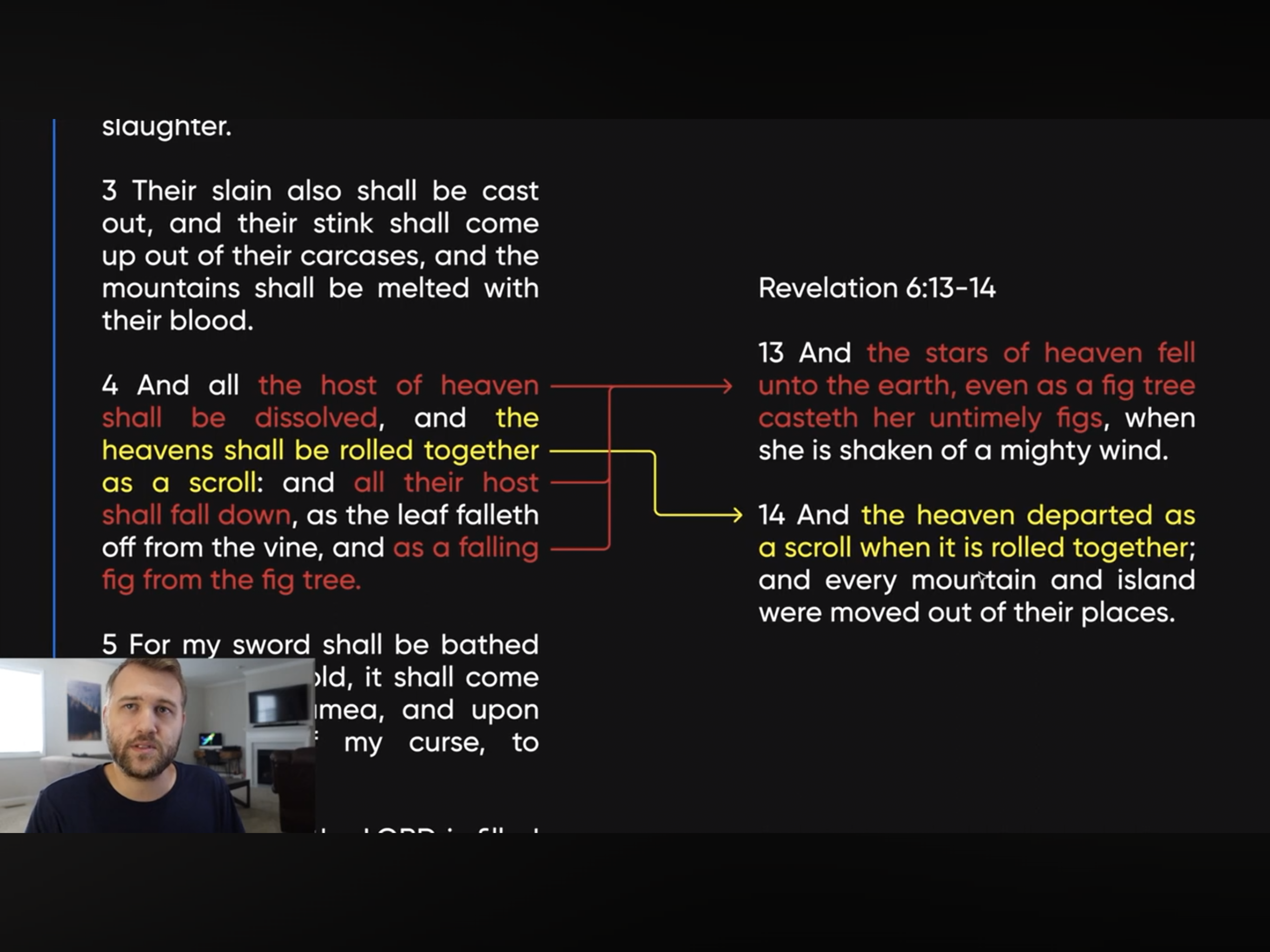
Look again at the picture above. It’s not hard to see. The words colored in red in Isaiah 34:4 line up with the words in red in Revelation 6:13. The words in yellow in Isaiah 34:4 line up with the words in yellow in Revelation 6:14.
Connect the dots now.
That's mainly just unconventional spelling right there, rather than slang.Maan, what chew talkin bout? Wee can still tawk good? Right!

Difference alone does not demonstrate "corruption". As you know, there are different ways to say the same thing without having corrupted the message.At the very least it show how different the KJV is from the modern versions. Either the KJV is corrupt or the modern versions. They all cannot be the word of God.
As I understand it, the primary goal of modern textual criticism is to determine what the original authors wrote. Period. What is the harm in that?This is because these two things go back to the Garden of Eden [where] the The serpent said to Eve, “Yea, hath God said…?” (Genesis 3:1).
This was about questioning God’s Word, which is at the heart of Textual Criticism.
These footnotes rightly explain that there are uncertainties about the validity of these passages. If something had been added to Scripture, wouldn't you want to know?I mean, you got footnotes in your Bible questioning the ending of Mark, and the story of the woman caught in the act of adultery.
For 1611, perhaps. Often incorrect for now.Just correct English...
Maan, what chew talkin bout? Wee can still tawk good? Right!

What Bible translation are you using?
You said:Revelation 6:13-14
King James Version
13 And the stars of heaven fell unto the earth, even as a fig tree casteth her untimely figs, when she is shaken of a mighty wind.
14 And the heaven departed as a scroll when it is rolled together; and every mountain and island were moved out of their places.
You said:That verse doesn't support KJV-onlyism if we read it in the KJV.
You said:If you discuss KJV-onlyism with KJV-onlyists, arguments for it just keep getting weaker and weaker and weirder and weirder.
You said:Do you think the Greek text of the book of Revelation got uninspired after the King James as released?
Bible Higlighter said:Note: With Grammarly that I just installed, I do see three grammar errors in your paragraph.
Take it up with Merriam Webster.
This is not evidence for a translation into the English language becoming 'the one' instead of the Bible in the actual languages it was written in. SMH.

I don't care. My quote came from them. If you have a problem with it, take it up with them.You don’t know what grammar points I discovered. I did not list them.
As I understand it, the primary goal of modern textual criticism is to determine what the original authors wrote. Period. What is the harm in that?
You said:These footnotes rightly explain that there are uncertainties about the validity of these passages. If something had been added to Scripture, wouldn't you want to know?
