
Lady.......I just mopped the floor with your annihilation heresy. It wasn't even close.
As it should be.....
Okay, I was gonna put a sample of a God complex, but you just did that for me CV5.


Lady.......I just mopped the floor with your annihilation heresy. It wasn't even close.
As it should be.....
Lady.......I just mopped the floor with your annihilation heresy. It wasn't even close.
As it should be.....

I feel like I'm in a Ferrari and you're on your tricycle, saying
"Bite my dust!" Pshh...


You offer more useless vain human philosophy. Nevertheless the Scriptures are perfectly consistent and perfectly clear. When Paul says eternal punishment he means eternal punishment.I call that type of empty declaration as the false declaration of victory fallacy.
Proof by declaring victory is one of the many smokescreens that are used to cover the fact that the reasoning is based on one of the three fallacies of Agrippa's trilemma. Whenever a logical fallacy is committed, the fallacy has its roots in Agrippa's trilemma. All human thought (without Divine revelation) is based on one of three unhappy possibilities. These three possibilities are infinite regression, circular reasoning, or axiomatic thinking. This problem is known as Agrippa's trilemma. Some have claimed that only logic and math can be known without Divine revelation; however, that is not true. Without Divine revelation, neither logic nor math can be known. Science is also limited to the pragmatic because of the weakness on human reasoning, which is known as Agrippa's trilemma.
The logical fallacy of proof by false declaration of victory occurs when an announcement of victory is substituted for rational thought. This is very similar in effect to summary dismissal. This is often coupled with a straw man fallacy.
He likes to just announce that somehow Annihilation was disproven when it wasn't, and ET was thoroughly proven "boilerplate" doctrine when that didn't happen either.
You offer more useless vain human philosophy. Nevertheless the Scriptures are perfectly consistent and perfectly clear. When Paul says eternal punishment he means eternal punishment.
Say what? You are disputing Paul's veracity? That seems to be a very common problem on this thread. Glad it's not my problem.This is exactly the type of post that I was talking about.
I call that type of empty declaration as the false declaration of victory fallacy.
Proof by declaring victory is one of the many smokescreens that are used to cover the fact that the reasoning is based on one of the three fallacies of Agrippa's trilemma. Whenever a logical fallacy is committed, the fallacy has its roots in Agrippa's trilemma. All human thought (without Divine revelation) is based on one of three unhappy possibilities. These three possibilities are infinite regression, circular reasoning, or axiomatic thinking. This problem is known as Agrippa's trilemma. Some have claimed that only logic and math can be known without Divine revelation; however, that is not true. Without Divine revelation, neither logic nor math can be known. Science is also limited to the pragmatic because of the weakness on human reasoning, which is known as Agrippa's trilemma.
The logical fallacy of proof by false declaration of victory occurs when an announcement of victory is substituted for rational thought. This is very similar in effect to summary dismissal. This is often coupled with a straw man fallacy.
He likes to just announce that somehow Annihilation was disproven when it wasn't, and ET was thoroughly proven "boilerplate" doctrine when that didn't happen either.

Say what? You are disputing Paul's veracity? That seems to be a very common problem on this thread. Glad it's not my problem.

It reminds me of rapture theory. I can't claim to be correct but my opinion is,,, she makes sense to me. I wondered for a while. If everyone in the next kingdom is saved, spirit filled and faithful. Who will Satan tempt when he get's a furlough from prison after the coming 1000 year reign of Christ?Consider that in the traditional view, the wicked are not being punished to learn something. There’s nothing remedial about their torment. Rather, God keeps them in existence for the sole purpose of having them experience pain. And this pain is without hope of ever being terminated or relieved. After twenty trillion trillion years of torment, the damned are no closer to completing their dire sentence than they were their first moment of horror. Is this view really compatible with a God whose heart was expressed in Jesus’ dying prayer, “Father, forgive them, they know not what they do” (Lk 23:34)? If agents get to the point where they are indeed hopelessly locked in their resistance to God, it seems more reasonable, just, and Biblical, to believe God would put them out of their misery.
From the annihilationist perspective, God’s justice and mercy unite in condemning the wicked to extinction. He justly punishes their sin and forbids them a place within the Kingdom, mercifully annihilating them precisely so they will not endlessly endure what the traditional view says they endure. source The lie of Satan is alive and repeatedly iterated to this day: "Thou shalt not surely die."

That's the point. Paul used what is called a "contrastive parallelism", which started in verse 12, "just as through one man, sin entered the world". The contrastive nature of the parallelism is clear in vs 15, "But the gift is not like the trespass. What Christ “gives” contrasts with what Adam did, his “trespass”... and in vs 16, "I can surely see how Adam and Christ are compared, albeit as opposites...one brought in death, the other brought in life.
I think I covered that thoroughly enough in post# 1154, but in addition to this chapter, 1 Cor 15 confirms that Adam is a type of Christ:But how exactly is Adam the "figure" of Him to come?
Two last quick comments about this verse.Rom 5:14 Nevertheless death reigned from Adam to Moses, even over them that had not sinned after the similitude of Adam's transgression, who is the figure of him that was to come.
"The gift is not like that which came through the one who sinned" (the same principle, expanded)
I think I covered that thoroughly enough in post# 1154, but in addition to this chapter, 1 Cor 15 confirms that Adam is a type of Christ:
“But now Christ has been raised from the dead, the first fruits of those who are asleep. For since by a man came death, by a man also came the resurrection of the dead. For as in Adam all die, so also in Christ all will be made alive.” (1 Corinthians 15:20–22)
“So also it is written, “The first man, Adam, became a living soul.” The last Adam became a life-giving spirit. However, the spiritual
is not first, but the natural; then the spiritual. The first man is from the earth, made of dust; the second man is from heaven.” (1 Corinthians 15:45–47)
The fact that Adam foreshadows Jesus is clear, Biblically, theologically, and linguistically.

Paul said we should do as He did, and how many times in all his books (28% of the NT) did he preach eternal conscious torment via hellfire damnation? Did he ever even use the word hell? No, he did not. Paul, who claimed he was caught up into heaven and given the Gospel directly by Jesus, that all men would be judged according to his gospel, that he had declared to people the whole counsel of God, that he kept back nothing profitable from the people he taught, and that he was the apostle to the gentiles... never once used the word hell. Paul uses the Greek word "Hades" in 1 Corinthians 15:55, where it is translated "grave." (KJV) O death, where is thy sting? O grave, where is thy victory? In Galatians 1:8, he says: But though we, or an angel from heaven, preach any other gospel unto you than that which we have preached unto you, let him be accursed. So what does that make you?Say what? You are disputing Paul's veracity? That seems to be a very common problem on this thread. Glad it's not my problem.
Those are not examples of Adam being a type of Christ. Clearly that is showing he is opposite.
Adam is a contrastive parallel figure, not a comparative parallel figure. You haven't retained my comment (below)"like unto me"
Moses declares that Jesus would be "like unto me" meaning Jesus would be like Moses!
See? The foreshadowing is contrastive in nature, not comparative. The foreshadowing is contrastive throughout the entire chapter:The contrastive nature of the parallelism is clear in vs 15, "But the gift is not like the trespass. What Christ “gives” contrasts with what Adam did, his “trespass”... and in vs 16, "
"The gift is not like that which came through the one who sinned" (the same principle, expand
You still haven't been able to tell me the meaning of "death reigned from Adam until Moses". If you learn what that means, then you'll understand why Moses is mentioned.Moses as well as God are saying the Messiah would be like Moses and then fast forward to the NT and we have Moses mentioned in the same sentence where *someone* had been a figure of Christ in his life.
Which part isn't correct?...the English syntax, or the Greek parsing?In no sense is any of that correct.
Here...Paul said we should do as He did, and how many times in all his books (28% of the NT) did he preach eternal conscious torment via hellfire damnation? Did he ever even use the word hell? No, he did not. Paul, who claimed he was caught up into heaven and given the Gospel directly by Jesus, that all men would be judged according to his gospel, that he had declared to people the whole counsel of God, that he kept back nothing profitable from the people he taught, and that he was the apostle to the gentiles... never once used the word hell. Paul uses the Greek word "Hades" in 1 Corinthians 15:55, where it is translated "grave." (KJV) O death, where is thy sting? O grave, where is thy victory? In Galatians 1:8, he says: But though we, or an angel from heaven, preach any other gospel unto you than that which we have preached unto you, let him be accursed. So what does that make you?
Adam is a contrastive parallel figure, not a comparative parallel figure.
You still haven't been able to tell me the meaning of "death reigned from Adam until Moses". If you learn what that means, then you'll understand why Moses is mentioned.
Which part isn't correct?...the English syntax, or the Greek parsing?
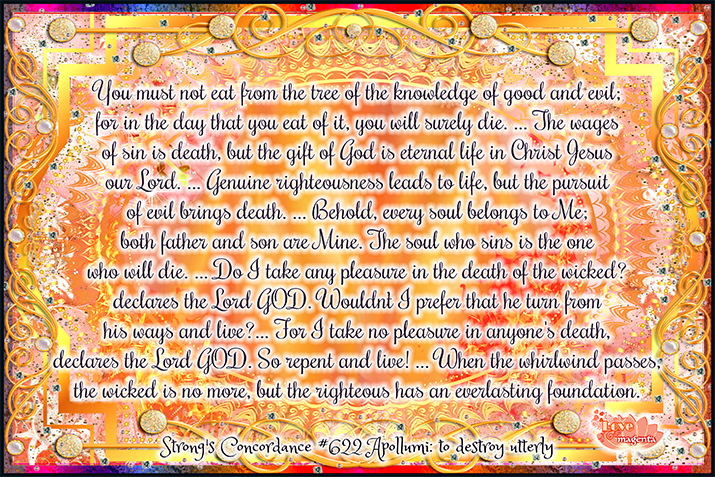
Paul often used words indicating destruction (ἀπόλλυμι, ὄλεθρος, ἀπώλεια) as synonyms for Gehenna:Paul said we should do as He did, and how many times in all his books (28% of the NT) did he preach eternal conscious torment via hellfire damnation? Did he ever even use the word hell? No, he did not. Paul, who claimed he was caught up into heaven and given the Gospel directly by Jesus, that all men would be judged according to his gospel, that he had declared to people the whole counsel of God, that he kept back nothing profitable from the people he taught, and that he was the apostle to the gentiles... never once used the word hell. Paul uses the Greek word "Hades" in 1 Corinthians 15:55, where it is translated "grave." (KJV) O death, where is thy sting? O grave, where is thy victory? In Galatians 1:8, he says: But though we, or an angel from heaven, preach any other gospel unto you than that which we have preached unto you, let him be accursed. So what does that make you?
How and why you choose to IGNORE the clear unmistakable intentional use of Ghenna by our Lord simply beggars the imagination. There is NO excuse for such folly.Paul said we should do as He did, and how many times in all his books (28% of the NT) did he preach eternal conscious torment via hellfire damnation? Did he ever even use the word hell? No, he did not. Paul, who claimed he was caught up into heaven and given the Gospel directly by Jesus, that all men would be judged according to his gospel, that he had declared to people the whole counsel of God, that he kept back nothing profitable from the people he taught, and that he was the apostle to the gentiles... never once used the word hell. Paul uses the Greek word "Hades" in 1 Corinthians 15:55, where it is translated "grave." (KJV) O death, where is thy sting? O grave, where is thy victory? In Galatians 1:8, he says: But though we, or an angel from heaven, preach any other gospel unto you than that which we have preached unto you, let him be accursed. So what does that make you?
It seems you think Jesus would idly warn us about the destruction of body and soul, and that we should instead believe that the soul is immortal, even though that is not taught in the Bible. In fact Scripture directly and articulately says that God alone is immortal. I cannot find the word Ghenna in any Bible. According to you, God must have made a mistake when He repeatedly said the wages of sin is death.How and why you choose to IGNORE the clear unmistakable intentional use of Ghenna by our Lord simply beggars the imagination. There is NO excuse for such folly.
Gal 1:8 But though we, or an angel from heaven, preach any other gospel unto you than that which we have preached unto you, let him be accursed.Here...
"But even if we (or an angel from heaven) should preach a gospel contrary to the one we preached to you, let him be condemned to HELL! As we have said before, and now I say again, if any one is preaching to you a gospel contrary to what you received, let him be condemned to HELL!" (Galatians 1:8-9 NET).
More....MUCH more tomorrow.

