
Hebrew the first language?
- Thread starter Victor1999
- Start date
-
Christian Chat is a moderated online Christian community allowing Christians around the world to fellowship with each other in real time chat via webcam, voice, and text, with the Christian Chat app. You can also start or participate in a Bible-based discussion here in the Christian Chat Forums, where members can also share with each other their own videos, pictures, or favorite Christian music.
If you are a Christian and need encouragement and fellowship, we're here for you! If you are not a Christian but interested in knowing more about Jesus our Lord, you're also welcome! Want to know what the Bible says, and how you can apply it to your life? Join us!
To make new Christian friends now around the world, click here to join Christian Chat.
You are using an out of date browser. It may not display this or other websites correctly.
You should upgrade or use an alternative browser.
You should upgrade or use an alternative browser.


Adam means dirt. It also means man, but it was dirt before it was man. The dirt is red dirt, very common around the world.
Dam, taken from adam, means red and it means blood. Dam dam means dark rad. I find muich comfort in the results of my past meditations on these meanings relating to our Lor and Savior.
Dam, taken from adam, means red and it means blood. Dam dam means dark rad. I find muich comfort in the results of my past meditations on these meanings relating to our Lor and Savior.

A Short History of the Hebrew Language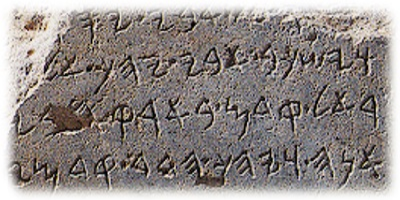
By Jeff A. Benner
From the Creation to the Flood
Hebrew is classified as a Semitic (or Shemitic, from Shem, the son of Noah) language. Was Hebrew just one of the many Semitic languages such as Canaanite, Aramaic, Phoenician, Akkadian, etc., that evolved out of a more ancient unknown language? Or, was Hebrew, and the Semitic family of languages, the original language of man?
According to the Bible all people spoke one language (Genesis 11:1) until the construction of the Tower of Babel, in southern Mesopotamia which occurred sometime around 4000 BC (Merrill F. Unger, "Tower of Babel," Unger's Bible Dictionary, 1977 ed.: 115). During the construction of the Tower, God confused the language of man and scattered the nations (Genesis 11:7,8).
It is at this time that the Sumerians (from the land of Sumer, known as Shinar in the Bible - Genesis 10:10), speaking a non-Semitic language, appear in southern Mesopotamia (J.I. Packer, Merril C. Tenney, William White, Jr., Nelson's Illustrated Encyclopedia of Bible Facts (Nashville: Thomas Nelson, 1995) 337.). It is believed that the Sumerians are related to the people living between the Black and Caspian Seas (Madelene S. Miller and J. Lane Miller, "Sumer," Harper's Bible Dictionary, 1973 ed.: 710) known as the Scythians, descendents of Noah's son Japheth (Merrill F. Unger, "Scythian," Unger's Bible Dictionary, 1977 ed.: 987).
At approximately the same time the Sumerians appeared in Mesopotamia, another civilization emerges in the South, the Egyptians. The original language of the Egyptians is Hamitic (From Ham, the second son of Noah) and is also unrelated to the Semitic languages (Merrill F. Unger, " Egypt," Unger's Bible Dictionary, 1977 ed.: 288).
During the time of the Sumerians and the Egyptians, the Semitic peoples lived in Sumeria and traveled west into the land of Canaan.
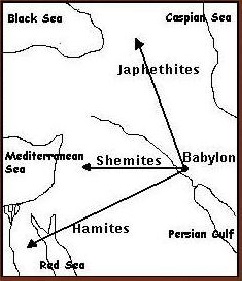
The descendants of Noah
It would appear that after the Tower of Babel, the descendants of Japheth traveled north with their language, the descendants of Ham traveled southwest with their language and the Semites traveled west with their language.
"That is why it was called Babel - because there the LORD confused the language of the whole world. From there the LORD scattered them over the face of the whole earth"(Genesis 11.9).
What was the one language spoken prior to the Tower of Babel? When God created Adam he spoke to him (Genesis 2:16) indicating that God gave Adam a language and this language came from God himself, not through the evolution of grunts and groans of cave men. When we look at all the names of Adam's descendent we find that all the names from Adam to Noah and his children are Hebrew names, meaning that their name has a meaning in Hebrew. For instance, Methuselah (Genesis 5:21) is Hebrew for "his death brings" (The flood occurred the year that he died). It is not until we come to Noah's grandchildren that we find names that are of a language other than Hebrew. For instance, the name Nimrod (Genesis 11:18), who was from Babylon/Sumer/Shinar and possibly the Tower of Babel, is a non-Hebrew name. According to the Biblical record of names, Adam and his descendants spoke Hebrew.
In addition, Jewish tradition as well as some Christian Scholars, believed that Hebrew was the original language of man (William Smith, "Hebrew Language," Smith's Bible Dictionary, 1948 ed.: 238).
I’m not a fan of Jeff Benner. He claims there are hidden messages in the Hebrew text and that you need to convert the letters to Paleo Hebrew to understand them. Too much like Bible Code stuff.
He is an engineer and not a linguist.

Not sure what resurrected language is. Was the Hebrew ever a dead language?
Men might of spoken in other languages but Hebrews is the language inspired from God .First written by Moses a Hebrew. If the first author moved to do that will was German than it would of been German .
Yes, Hebrew was a dead language for a while before it got revived. I'll explain,
"Dead language" in linguistics means that it stopped being the mother tongue to people, or a language that was exclusively used daily. It was just written and maybe used for prayer and such, but was not used in daily conversation and was not taught as mother tongue. When this happens to a language, it's called dead, and such language never comes back to be mother tongue again. There is no case in history that it happened. Ancient Latin is an example of a dead language. Even though it still has some purposes. It will never become a living language again.
Hebrew met that fate during history. The Jews actually stopped speaking Hebrew.
Hebrew was resurrected though, and did get restored to a living language. They speak the language today.
Thought it was pretty amazing.

I’m not a fan of Jeff Benner. He claims there are hidden messages in the Hebrew text and that you need to convert the letters to Paleo Hebrew to understand them. Too much like Bible Code stuff.
He is an engineer and not a linguist.
Nice to know that! I don't like the Bible Code either, IMO it's ridiculous.
Yes, Hebrew was a dead language for a while before it got revived. I'll explain,
"Dead language" in linguistics means that it stopped being the mother tongue to people, or a language that was exclusively used daily. It was just written and maybe used for prayer and such, but was not used in daily conversation and was not taught as mother tongue. When this happens to a language, it's called dead, and such language never comes back to be mother tongue again. There is no case in history that it happened. Ancient Latin is an example of a dead language. Even though it still has some purposes. It will never become a living language again.
Hebrew met that fate during history. The Jews actually stopped speaking Hebrew.
Hebrew was resurrected though, and did get restored to a living language. They speak the language today.
Thought it was pretty amazing.
Thanks for that. I am aware somewhat of the Latin in that way . It is used more of a way of holding on to a oral tradition to a time period of history when it was a golden time for some .and chanting was more popular. (before the reformation) They still use it I think for the purpose to draw people and say we are a old church in a hope of saying its a continuation of what you see in the bible (men following men) .
Carrying a dead language in a hope it could win some. I have not heard that of the Hebrew . How long was it considered dead and what was the least amount of time when it was used, was allowed?
Thanks for that. I am aware somewhat of the Latin in that way . It is used more of a way of holding on to a oral tradition to a time period of history when it was a golden time for some .and chanting was more popular. (before the reformation) They still use it I think for the purpose to draw people and say we are a old church in a hope of saying its a continuation of what you see in the bible (men following men) .
Carrying a dead language in a hope it could win some. I have not heard that of the Hebrew . How long was it considered dead and what was the least amount of time when it was used, was allowed?
I believe this video sums it up really nicely and concisely. It was linguistically dead for about a milennium and a half.
She says it wasn't dead because it was being used in literature, however, not being used as a mother tongue is precisely what qualifies it for being dead.
Furthermore Arabic got a bit included into the revival, they did take up some Arabic elements, which makes this even more amazing (reflecting on how the Gentiles/Ishmael got grafted in). Like the language also testifies to what happened in the New testament.

That is entirely possible. After all it is the language of the Tanakh (OT). Indeed the rabbis have some rather interesting ideas about how each letter of the Hebrew alphabet relates to creation. Then we have the Bible Code discovered within the Torah.
"For 3,000 years a secret code in The Bible has remained hidden. Now it has been unlocked by computer - and it may reveal our future. The code was broken by a distinguished mathematician, and later corroborated by world-famous academics. It foretells events that happened thousands of years after it was incorporated in The Old Testament - from World War 2 to the Gulf War. Now an extraordinary new book presents what best-selling author Michael Drosnin believes is irrefutable proof of the existence of God in "The Bible Code". It was one murderous deed that finally convinced him it was for real..."
http://www.jahtruth.net/bibcode.htm
I thought the bible code was disproved?
I seem to recall the initial fervor and then skepticism...it is possible that he was on to something I suppose, but it seems silly that a human being could "unlock" the "code" through knowledge alone.
I liked the idea that there is more to language than meets the eye but beyond that I don't believe we will ever fully understand the word until faith is sight.
I think that when the bible code II came out it was a good indicator of it's original support.

To echo what others have stated - in Linguistics a "dead language" means no one speaks it as their mother tongue or first language, nor is it the language of a given community. Even though Latin, for example, is still used both in the academic and liturgical worlds, no one speaks it as their mother tongue/first language. It is not the native language of any given place, i.e. it's a dead language.

As far as I know it was confirmed by mathematicians and statisticians. It may have some merit for unbelievers. We know that there is a great deal about the structure of the Bible that we do not really know.I thought the bible code was disproved?


As Adam was not the first human to live on the Earth Hebrew was obviously not the first language in the world.
Unless all the hunter gatherers of the pre-Adamic stone age had one common language … possible.
The Tower of Babel disruption of languages and the dispersal of peoples from the Middle East to distant lands throws a
spanner in the work of the study of languages.
Unless all the hunter gatherers of the pre-Adamic stone age had one common language … possible.
The Tower of Babel disruption of languages and the dispersal of peoples from the Middle East to distant lands throws a
spanner in the work of the study of languages.
I believe this video sums it up really nicely and concisely. It was linguistically dead for about a milennium and a half.
She says it wasn't dead because it was being used in literature, however, not being used as a mother tongue is precisely what qualifies it for being dead.
Furthermore Arabic got a bit included into the revival, they did take up some Arabic elements, which makes this even more amazing (reflecting on how the Gentiles/Ishmael got grafted in). Like the language also testifies to what happened in the New testament.
Thanks for that .It would seem it was the language from approx. 1O00 BC or so. It would seem that Hebrew was used up until faithless Israel demanded a king in Israel because of their jealously of the surrounding pagan nations . Mocking God by taking on the oral traditions of men. (Isaiah28) making the word without effect.
The promise he would mock those who refuse to hear him. He spoke in all the tongues of all the nations as spoken of in Joel . It awoke the whole world and the Hebrew language became necessary for sorting out the traditions of men in Acts 2.
The unbelieving Jew it would seem jumped on the Hebrew wagon. . . falsely identifying them selves as God's people according to the flesh.
The Hebrew language can be there but that does not mean God has spoken today . They lost that privilege as being identified by the tongue of God, Hebrew, in the Old Testament .
As Adam was not the first human to live on the Earth Hebrew was obviously not the first language in the world.
Unless all the hunter gatherers of the pre-Adamic stone age had one common language … possible.
The Tower of Babel disruption of languages and the dispersal of peoples from the Middle East to distant lands throws a
spanner in the work of the study of languages.
pre-Adamic stone age?
Seven days he finished all the work of creating to include angels as messengers . Seven is the number assigned. Not a unknown . He could of performed it in the twinkling of the eye. Why try and remove the 7 days and make it into a unknown wonderment? How could that benefit the gospel, us hearing God...It would confuse the whole matter.
Genesis 2 King James Version (KJV) Thus the heavens and the earth were finished, and all the host of them.And on the seventh day God ended his work which he had made; and he rested on the seventh day from all his work which he had made. And God blessed the seventh day, and sanctified it: because that in it he had rested from all his work which God created and made.
Not a unknown remnant but rather...7, 24 hours of day and night. 12+12=24
That statement contradicts the Bible.As Adam was not the first human to live on the Earth Hebrew was obviously not the first language in the world.
For as in Adam all die, even so in Christ shall all be made alive... The first man is of the earth, earthy: the second man is the Lord from heaven. (1 Cor 15:22,47)
Hmm, I do think the Lord can revive a "dead language" and or teach it to individuals. It's just that I think people have a sort of mysticism (maybe not anyone here but I have at times and I'm probably not alone) about original languages. Perfect form if you will.
I don't see how you could speak an ancient language from the flesh. Ancient Greek is different from modern Greek. Language evolves over time. Thus the transition from old English to middle English and modern English...it is incredibly different. Makes for an interesting study.
Even studying a dead language and attempting to speak it without having it spoken to you it would be impossible to speak accurately since it cannot be heard from a native speaker. It's been 12 years since I took Latin but I think that was the reason.
I've daydreamed about the Tower of Babel event and what a unified language would have been like in the past. It would have been super convenient for sure. I often wonder if sticking to English and perfecting it is doing a disservice to myself vs learning as many languages as I can. I would like to learn some in the future but then I would have to reallocate lingual resources
I have some used for Spanish but I wouldn't say I'm fluent.
Thinking about language puts up this frustrating wall of the limitations of humanity that I do think about often. I feel almost hemmed in by English.
In the end I think words fail. THE WORD does not.
I don't see how you could speak an ancient language from the flesh. Ancient Greek is different from modern Greek. Language evolves over time. Thus the transition from old English to middle English and modern English...it is incredibly different. Makes for an interesting study.
Even studying a dead language and attempting to speak it without having it spoken to you it would be impossible to speak accurately since it cannot be heard from a native speaker. It's been 12 years since I took Latin but I think that was the reason.
I've daydreamed about the Tower of Babel event and what a unified language would have been like in the past. It would have been super convenient for sure. I often wonder if sticking to English and perfecting it is doing a disservice to myself vs learning as many languages as I can. I would like to learn some in the future but then I would have to reallocate lingual resources
I have some used for Spanish but I wouldn't say I'm fluent.
Thinking about language puts up this frustrating wall of the limitations of humanity that I do think about often. I feel almost hemmed in by English.
In the end I think words fail. THE WORD does not.

From the Flood to the Babylonian Captivity
The first mention of a Hebrew is in Genesis 14:13 where Abraham is identified as a "Hebrew" (Eevriy in Hebrew). In Exodus 2:6 Moses is identified as one of the "Hebrews" (Eevriym in Hebrew) and throughout the Hebrew Bible the children of Israel are often identified as "Hebrews." A "Hebrew" is anyone who is descended from "Eber" (Ever in Hebrew), an ancestor of Abraham and Moses (See Genesis 10:24).
The language used by the descendants of "Eber" is called "Hebrew" (Eevriyt in Hebrew), but is never called "Hebrew" in the Hebrew Bible, but is instead referred to as the "Language of Canaan" (Isaiah 19:18) and the "Language of Judah" (II Kings 18:28, Isaiah 36:11, 13, Nehemiah 13:24, II Chronicles 32:18). While the Hebrew Bible may not refer to the language of the Hebrews as "Hebrew," we do know that their language was in fact "Hebrew," as attested to in the many inscriptions discovered in the land of Israel from this period of time.
From the Babylonian Captivity to the Bar Kockba Revolt
After the time of King David, the nation of Israel split into two kingdoms, Israel in the north and Judah in the south. The northern Kingdom of Israel was taken into captivity by the Assyrians around 740 BC and the southern Kingdom of Judah was taken into Babylonian captivity about 570 BC.
During their captivity in Babylon, the Hebrews continued to speak the Hebrew language, but instead of writing the language with the Hebrew script (often referred to as Paleo-Hebrew), they adopted the Aramaic square script to write the Hebrew language and the Hebrew script was used on a very limited basis such as a few Biblical scrolls and coins.
When the Hebrews returned to the land of Israel, around 500 BC, it was believed that the Hebrews had abandoned the Hebrew language and instead spoke the Aramaic language, the language of their captors in Babylon. The Oxford Dictionary of the Christian Church, in its first edition in 1958, stated; "[Hebrew] ceased to be a spoken language around the fourth century B.C." However, much textual and archeological evidence has been discovered over recent years, which has revised this long established theory.
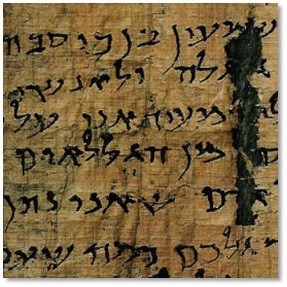
Bar Kochba letter from 135 A.D.
One of the most compelling evidences for the continued use of Hebrew into the 2nd Century A.D. is a letter from the Jewish General Simon Bar Kockba (Shimon ben Kosva, as the first line of the letter states in the above picture), which is dated at 135 A.D., which he wrote during the second Jewish revolt against Rome. This letter, along with many others, was written in Hebrew, establishing the fact that Hebrew was still the language of the Jewish people, even into the second century AD.
Because of the overwhelming evidence of Hebrews continued use, the Oxford Dictionary of the Christian Church, in its third edition in 1997 now, states; "[Hebrew] continued to be used as a spoken and written language in the New Testament period."
From the Bar Kockba Revolt to Today
When the Jews, led by Simon Bar Kockba, were defeated in the revolt of 135 AD the Jews were expulsed from the land and dispersed around the world initiating the Diaspora. At this point most Jews adopted the language of the country they resided in, but Hebrew continued to be spoken in the synagogues and Yeshivas (religious schools) for the teaching and studying of the Torah and the Talmud.
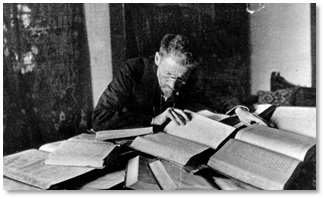
Eliezer Ben-Yehuda, c. 1912
In the late 19th Century Eliezer Ben-Yehuda began a revival of the Hebrew language as a living language for the Jewish people in Israel and when the state of Israel was established as an independent nation in 1948, Hebrew became the official language and, once again, Hebrew became the native language of the Hebrew people.
Have you read anything from James Harris i.e. names of God? if not you might see it interesting...
Hmm, I do think the Lord can revive a "dead language" and or teach it to individuals. It's just that I think people have a sort of mysticism (maybe not anyone here but I have at times and I'm probably not alone) about original languages. Perfect form if you will.
I don't see how you could speak an ancient language from the flesh. Ancient Greek is different from modern Greek. Language evolves over time. Thus the transition from old English to middle English and modern English...it is incredibly different. Makes for an interesting study.
Even studying a dead language and attempting to speak it without having it spoken to you it would be impossible to speak accurately since it cannot be heard from a native speaker. It's been 12 years since I took Latin but I think that was the reason.
I've daydreamed about the Tower of Babel event and what a unified language would have been like in the past. It would have been super convenient for sure. I often wonder if sticking to English and perfecting it is doing a disservice to myself vs learning as many languages as I can. I would like to learn some in the future but then I would have to reallocate lingual resources
I have some used for Spanish but I wouldn't say I'm fluent.
Thinking about language puts up this frustrating wall of the limitations of humanity that I do think about often. I feel almost hemmed in by English.
In the end I think words fail. THE WORD does not.
For me language study is just that. Having read the Word in Hebrew...some in Aramaic---I feel not much more informed thanthan before reading. Many things I felt or knew by the infilling of the Holy Spirit were simply confirmed or given more light.. Most who are familiar with the evolution of Hebrew are quite aware that many words in the original text are unknown today, that is as per definitionns.
It does help a lot though when readig and understanding the prophecies and teachings of our Father by means of His prophets. I have posted many "full translations" of wosrds that thave only been transliterated up u8ntil now, but they do not seem to stimulate others as they have me... It must not be mine to share.
Anyone who has received the Holy Spirit should know as much or more than I without knowing languages. Our Father is just always. All love in Jesus, Yesua, j
Just as language that are current have passed through evolutions to arrive to their present sstates, so it is, as mentioned already in the quosted post, with Hebrew, otherwis would nto have needed to study biblical Hebrew. Modern Hebrew is way different than the Biblical.

The angels have Hebrew names and people before the baby tower incident also have Hebrew names. I think it makes sense that Adam spoke to God in Hebrew and not in tongues as some suggest (he wouldn't understand what he was saying if he did that). That means that Hebrew is the language originally intended for the entire world and we would all be speaking Hebrew right now if we didn't try to build a baby tower. It might even be the only God-made language today, if none of the other ancient languages are still in use. All other languages after that incident were invented by men but we have one like Hebrew that was taught to Adam by God... Not that it really matters, but it is an interesting thought.
Therefore its name was called Babel, because there the Lord confused the language of the whole earth
(Hebrews 11:9)
i think it would say He confused the language of the whole earth '*except for the Hebrews' if this were the case.
We can go back quite a ways with language. Hebrew is Semitic, but the Semitic languages come from Proto-Semitic, just one break off from Proto-Afro-Asiatic. PAA comprises most of the languages of what is today the Middle East (excluding Indo-European languages) and northern Africa. I'm kind of going of on a few tangents here, but....
PAA is just a branch from a reconstructed phylum of a macro family called "Nostratic"; to which belong the Afro-Asiatic, Indo-European, Dravidian (many of the non-I-E languages of India), and Turkic-Altaic (languages extending form Turkey to Central Asia) languages. Some also include Uralic, Kartvelian (Georgia and the Caucuses region), and Eskimo-Aleut in the mix. It is estimated that Proto-Nostratic was spoken between about 15,000 to 12,000 BCE.
An example of a reconstructed Proto-Nostratic word is */k'o/ or */q'o/ - "who". The asterisk just indicates a constructed or hypothetical or unattested form, the // indicate what's between them is a phonetic transcription. Variations and modern developments of this root word is the word for "who" in virtually all languages in these language families. By reconstructing a common vocabulary/lexicon, particularly from more recent proto-languages (Proto Indo-European is a great example), we can get an idea of where these people originated from and what their culture would have included, just from the common root words that can be constructed. We know that the Indo-Europeans, for example, lived in an area that included Beech trees, but not certain other types of trees (as there is no common root word for them).
Some have even proposed that Nostratic itself is a branch of an even older language macro family which includes many Amerindian languages as well as several other language groups. You just keep going further and further back in time.
If you extract the religious allegory in the Babel narrative, it represents a pretty good picture of what happened historically with at least Proto-Semitic (the "common language" of the Babel narrative). Speakers of Proto-Semitic migrated towards the west and as they migrated and became isolated nations, groups, etc., their languages eventually splintered off into what would have been at first just dialects of P-Semitic, but over time, separate but a very closely related group of languages (a “confounding” of languages from one parent tongue). The narrative is a fascinating account of how people, even in ancient times, realized the concept of the relationship between sister languages and the recognition that they must have come from some parent, "common" language.
Many people gloss over a few things about the Babel narrative:
While the Babel account does indicate a common original language, it does not claim that said language was Hebrew (as many people think/assume).
There is also zero indication in the narrative that God necessarily used a supernatural process in ‘confounding’ the languages (though obviously, He certainly could have).
Further, and perhaps most importantly, though most people interpret and assume it as such, the account does not claim that this diversification of languages was an immediate event.
One might imagine that the Babel narrative was woven combining history (as it was understood back then) and religion into a powerful story.
One final thought....the notion commonly assumed is that God used the confounding of languages to scatter the people, however, it may be argued, as Dallin Oaks states in his article “The Tower of Babel: A Linguistic Consideration”, that “God scattered the people to cause a confusion (read, the eventual development of individual, related) of languages”. An interesting take on the narrative as it fits more closely with what actually happened historically (from a historical linguistic perspective).
PAA is just a branch from a reconstructed phylum of a macro family called "Nostratic"; to which belong the Afro-Asiatic, Indo-European, Dravidian (many of the non-I-E languages of India), and Turkic-Altaic (languages extending form Turkey to Central Asia) languages. Some also include Uralic, Kartvelian (Georgia and the Caucuses region), and Eskimo-Aleut in the mix. It is estimated that Proto-Nostratic was spoken between about 15,000 to 12,000 BCE.
An example of a reconstructed Proto-Nostratic word is */k'o/ or */q'o/ - "who". The asterisk just indicates a constructed or hypothetical or unattested form, the // indicate what's between them is a phonetic transcription. Variations and modern developments of this root word is the word for "who" in virtually all languages in these language families. By reconstructing a common vocabulary/lexicon, particularly from more recent proto-languages (Proto Indo-European is a great example), we can get an idea of where these people originated from and what their culture would have included, just from the common root words that can be constructed. We know that the Indo-Europeans, for example, lived in an area that included Beech trees, but not certain other types of trees (as there is no common root word for them).
Some have even proposed that Nostratic itself is a branch of an even older language macro family which includes many Amerindian languages as well as several other language groups. You just keep going further and further back in time.
If you extract the religious allegory in the Babel narrative, it represents a pretty good picture of what happened historically with at least Proto-Semitic (the "common language" of the Babel narrative). Speakers of Proto-Semitic migrated towards the west and as they migrated and became isolated nations, groups, etc., their languages eventually splintered off into what would have been at first just dialects of P-Semitic, but over time, separate but a very closely related group of languages (a “confounding” of languages from one parent tongue). The narrative is a fascinating account of how people, even in ancient times, realized the concept of the relationship between sister languages and the recognition that they must have come from some parent, "common" language.
Many people gloss over a few things about the Babel narrative:
While the Babel account does indicate a common original language, it does not claim that said language was Hebrew (as many people think/assume).
There is also zero indication in the narrative that God necessarily used a supernatural process in ‘confounding’ the languages (though obviously, He certainly could have).
Further, and perhaps most importantly, though most people interpret and assume it as such, the account does not claim that this diversification of languages was an immediate event.
One might imagine that the Babel narrative was woven combining history (as it was understood back then) and religion into a powerful story.
One final thought....the notion commonly assumed is that God used the confounding of languages to scatter the people, however, it may be argued, as Dallin Oaks states in his article “The Tower of Babel: A Linguistic Consideration”, that “God scattered the people to cause a confusion (read, the eventual development of individual, related) of languages”. An interesting take on the narrative as it fits more closely with what actually happened historically (from a historical linguistic perspective).
Therefore its name was called Babel, because there the Lord confused the language of the whole earth (Hebrews 11:9) i think it would say He confused the language of the whole earth '*except for the Hebrews' if this were the case.
A new beginning with Noah. Like in Genesis out of the place used to represent the temporal kingdom of God called out of the East. East used in representing Christ . . .4 water courses rivers that came out represent the gospel going out into all the nations as four heads
It accredits Eber meaning "the region beyond," (not seen as a faith principle) as the father of the Hebrew people In Luke 3:35 he is called Heber.
Shem the first born of Noah His son Eber uses two sons, pelag and Joktan to make a points of the division of nations .
Genesis 10:2 Eber was the father of two sons. One son was named pelag .. He was given this name because the earth was divided during his life. The other son was named Joktan.
The name Joktan means diminished
Eber or Heber = "the region beyond" Traditionally from an ancestral name Eber, but probably literally "one from the other side," perhaps in reference to the River Euphrates, or perhaps simply signifying "immigrant;" from 'ebher "region on the other or opposite side."
Genesis 10:21Shem was Japheth’s older brother. One of Shem’s descendants was Eber, the father of all the Hebrew people.
A picture of Proverbs 21
Proverbs 21 King James Version (KJV) The king's heart is in the hand of the Lord, as the rivers of water: he turneth it whithersoever he will.