
Were by nature the children of wrath! I'm not sure that I fully understand all aspects of human nature as taught in Scripture. Does this mean that our very nature must undergo a change? Does our nature contain that which leads to sin?Everything after its kind...Genesis 1:24-25.

Can We Really Exercise Free Will?
- Thread starter LifelongLearner
- Start date
-
Christian Chat is a moderated online Christian community allowing Christians around the world to fellowship with each other in real time chat via webcam, voice, and text, with the Christian Chat app. You can also start or participate in a Bible-based discussion here in the Christian Chat Forums, where members can also share with each other their own videos, pictures, or favorite Christian music.
If you are a Christian and need encouragement and fellowship, we're here for you! If you are not a Christian but interested in knowing more about Jesus our Lord, you're also welcome! Want to know what the Bible says, and how you can apply it to your life? Join us!
To make new Christian friends now around the world, click here to join Christian Chat.
You are using an out of date browser. It may not display this or other websites correctly.
You should upgrade or use an alternative browser.
You should upgrade or use an alternative browser.

Those verses in no way support regeneration before belief, cause ultimately it all boils down to this one erroneous doctrine.
[Act 18:27 KJV] 27 And when he was disposed to pass into Achaia, the brethren wrote, exhorting the disciples to receive him: who, when he was come, helped them much which had believed through grace:
[Luk 1:77 KJV] 77 To give knowledge of salvation unto his people by the remission of their sins,
[2Pe 1:1 KJV] 1 Simon Peter, a servant and an apostle of Jesus Christ, to them that have obtained like precious faith with us through the righteousness of God and our Saviour Jesus Christ:

Sure. We all were until God quickened us.Unless you were saved in early childhood?
You were at one time such a natural man.
Spiritual things were at one time foolishness to you.
That was how I was until I became saved.
Actually, we receive a new nature, or become partakers of the divine nature. Our old nature remains but can be subjugated to the new. This can be quite the struggle at times as I'm sure you are aware.Were by nature the children of wrath! I'm not sure that I fully understand all aspects of human nature as taught in Scripture. Does this mean that our very nature must undergo a change? Does our nature contain that which leads to sin?
The new nature is portrayed as a new heart, and this, along with the Spirit indwelling us, is what allows us to put on the new man and walk in the guidance of the Spirit.

These Pelagian heretics simply do not like what God's revealed written Word says of man/human nature.Were by nature the children of wrath! I'm not sure that I fully understand all aspects of human nature as taught in Scripture.
Does this mean that our very nature must undergo a change? Does our nature contain that which leads to sin?
So they are going to twist and turn in the wind to distort just about anything having to do with it.
Their whole free will shtick is built on such a faulty premise: that man can do in the flesh what Scripture says he cannot.
Actually, we receive a new nature, or become partakers of the divine nature. Our old nature remains but can be subjugated to the new. This can be quite the struggle at times as I'm sure you are aware.
The new nature is portrayed as a new heart, and this, along with the Spirit indwelling us, is what allows us to put on the new man and walk in the guidance of the Spirit.
Jer 13:23
Can the Ethiopian change his skin or the leopard its spots? Then may you also do good who are accustomed to do evil.
These are things within us that we are unable to change. They are part of our nature. Only God has the power to change our nature.
The mind of the flesh is death, but the mind of the Spirit is life and peace, because the mind of the flesh is hostile to God: It does not submit to God’s law, nor can it do so. Those controlled by the flesh cannot please God. Romans 8 v 6-8 This is what we speak, not in words taught us by human wisdom but in words taught by the Spirit, explaining spiritual realities with Spirit-taught words. The person without the Spirit does not accept the things that come from the Spirit of God but considers them foolishness, and cannot understand them because they are discerned only through the Spirit. 1 Corinthians 2 v 13-14
Jer 13:23
Can the Ethiopian change his skin or the leopard its spots? Then may you also do good who are accustomed to do evil. These
are things within us that we are unable to change. They are part of our nature. Only God has the power to change our nature.
Romans 7 v 14, John 8 v 34, Jeremiah 13 v 23, Romans 3 v 10 ~ We know that the law is spiritual; but
I am unspiritual, sold as a slave to sin. Jesus replied, “Truly, truly, I tell you, everyone who sins is a slave to sin.” Can the Ethiopian change his skin, or the leopard his spots? Neither are you able to do good - you who are accustomed to doing evil. There is no one righteous, not even one.
Thank you for the welcome... since it's been a few days...sorry for the delay what is your understanding for " 4 Yet the LORD hath not given you an heart to perceive, and eyes to see, and ears to hear, unto this day ", in relation to God not changing and the New not contradicting the Old and/or what are you pointing to that I might not be 'seeing' here?P.S. Welcome to the 'hood!
Were by nature the children of wrath! I'm not sure that I fully understand all aspects of human nature as taught in Scripture.
Does this mean that our very nature must undergo a change? Does our nature contain that which leads to sin?
From: John 8 verse 34; 2 Peter 2 verse 19a; Galatians 4 verse 8; Romans 7 verse 14; Ephesians 2 verse 3b; Romans 6 verse 6 ~ “Truly, truly, I say to you, everyone who commits sin is a slave to sin.” They are slaves of corruption. When you did not know God, you were enslaved to those that by nature are not gods. You were of the flesh, sold under sin. We were by nature children of wrath, like the rest of mankind. Our old self was crucified so that we would no longer be enslaved to sin.
Romans 5 verse 12 Ephesians 2 verse 3 Just as sin entered the world through one man, and death through sin, so also death was passed on to all men, because all sinned. We were by nature children of wrath.
.

Thanks! I think I needed an extra boost along these lines of thinking today. And all my friends came to my rescue. . . .
From: John 8 verse 34; 2 Peter 2 verse 19a; Galatians 4 verse 8; Romans 7 verse 14; Ephesians 2 verse 3b; Romans 6 verse 6 ~ “Truly, truly, I say to you, everyone who commits sin is a slave to sin.” They are slaves of corruption. When you did not know God, you were enslaved to those that by nature are not gods. You were of the flesh, sold under sin. We were by nature children of wrath, like the rest of mankind. Our old self was crucified so that we would no longer be enslaved to sin.
I was very happy to see you when you made your appearance yesterday, as it seemed to me you had been absent for a while, and I also wanted to apologize to you for any misunderstanding if you felt included when I have denounced Hebrew Roots for all the mixing in of uninspired texts as they have a propensity to do... there are a few of those here and I know you have some association with the movement, but I do not include you when I make mention of the errors they may promote as a result of their adherence to such.Thanks! I think I needed an extra boost along these lines of thinking today. And all my friends came to my rescue. . . .

No resurrected believer in the eternal, visible kingdom will ever be cast out! CASTING/DRIVING out is reserved for God's enemies, not his holy saints! (Adam is a great example of an enemy who was driven out from God's holy presence in the Garden, as is Satan who was cast down from heaven with the rest of the fallen angels when they sinned.) So...the question remains: How would God not be "forcing" his holy saints to not sin in His eternal, visible kingdom, since all vestiges of indwelling sin will be removed forever and ever?
AND...since God will change the nature of his resurrected saints in the New Eternal Order, what does that say to FWers' staunch belief in libertarian-style freewill? Why would God have to change human nature if libertarian-style freewill is so effective in making the right choices?
As suspected, I was actually counting on the fact that most here would not take the time to carefully examine the passages I provided. Let’s look at them closely so you can see how they plainly show that your belief is unbiblical.
Matthew 13:41–42 (KJV)
The Son of man shall send forth his angels, and they shall gather out of his kingdom all things that offend, and them which do iniquity;
And shall cast them into a furnace of fire: there shall be wailing and gnashing of teeth.
And shall cast them into a furnace of fire: there shall be wailing and gnashing of teeth.
Matthew 13:41–42 with Commentary
The Son of man shall send forth his angels [Jesus Himself is the one sending forth His angels, showing His authority in judgment], and they shall gather out of his kingdom [notice that it is His kingdom, not the world’s, which means these people are within the visible realm of His rule] all things that offend [Greek σκανδαλίζω (skandalizō), meaning to cause to sin or fall away], and them which do iniquity [Greek ἀνομία (anomia), meaning lawlessness or the ongoing practice of sin];
And shall cast them into a furnace of fire [a clear reference to final judgment in the Lake of Fire]: there shall be wailing and gnashing of teeth [a repeated biblical expression of eternal torment and regret].
And shall cast them into a furnace of fire [a clear reference to final judgment in the Lake of Fire]: there shall be wailing and gnashing of teeth [a repeated biblical expression of eternal torment and regret].
Involving the phrase “His kingdom” (speaking contextually of Christ’s kingdom), the Greek word αὐτοῦ (“his”) is present twice in this passage, τοὺς ἀγγέλους αὐτοῦ (“his angels”) and ἐκ τῆς βασιλείας αὐτοῦ (“out of his kingdom”). It is found in the original Beza 1598 Greek text, which underlies the King James Bible, and it also appears in the Nestle and Aland (NA-28) Greek text, even though I do not agree with that textual basis which underlies the Modern Bibles. The presence of αὐτοῦ in both readings confirms that the angels and the kingdom belong to Christ Himself, emphasizing His divine ownership and authority.
This passage is straightforward when read plainly. Jesus says that His angels will one day remove from His kingdom all who cause others to stumble and all who continue in sin. The key phrase is out of His kingdom. That means they were counted within His kingdom at one time. Jesus is not describing unbelievers who never entered His rule but rather those who were part of His kingdom community and later corrupted themselves through sin and rebellion.
The word offend (skandalizō) appears in Matthew 18:6–9, where Jesus warns that anyone who offends one of His little ones should be cast into the sea with a millstone. The same word is used here, connecting this passage to moral offense and spiritual downfall.
The phrase them which do iniquity emphasizes those who live in continual sin. The Greek anomia literally means “lawlessness,” or living contrary to God’s commands. It is used in 1 John 3:4, where sin is defined as transgression of the law.
Together, these two expressions cover both those who lead others into sin and those who live in it themselves. Both are gathered out of Christ’s kingdom, showing that no one who persists in sin will remain in His reign forever.
Now consider John 8:34–35 (KJV):
Jesus answered them, Verily, verily, I say unto you, Whosoever committeth sin is the servant of sin.
And the servant abideth not in the house for ever: but the Son abideth ever.
And the servant abideth not in the house for ever: but the Son abideth ever.
Here Jesus confirms the same principle. Those who live in sin become servants of it, and servants of sin do not remain in the house forever. The house here represents God’s household or kingdom. The connection to Matthew 13 is direct. Those who persist in sin are eventually removed, just as the angels remove the offenders from the kingdom.
This is referring to Christ’s kingdom, the same kingdom mentioned in 1 Corinthians 15:24–25, where it says that Jesus will one day deliver the kingdom back to God the Father after He has put down all rule and authority and power. Before that transfer takes place, no sinful believers can remain within His kingdom. All who do iniquity and all that offend must first be gathered out, as Matthew 13 declares, so that the kingdom He returns to the Father will be holy and undefiled. This is simply a fact of Scripture that every person will have to deal with, either in this life through repentance and obedience, or in the next life when Christ Himself enforces it.
Regarding your question about God “forcing” saints to be sinless in the eternal kingdom, this misunderstands glorification. In this life, we make a free will choice under God’s enablement and enlightenment to believe the gospel (Acts 16:14, John 12:32, John 16:8). Only after that choice does God begin the process of purifying us so that we may one day never sin again. That purification, however, is not a guaranteed condition for all who live on Earth during the Millennial Kingdom. Some will still choose rebellion even in that time, showing that free will continues to operate.
But do not worry. Man will not get the glory. No man can believe without God’s enablement or enlightenment, as seen when the Lord opened Lydia’s heart to respond to the gospel (Acts 16:14). Jesus said, “And I, if I be lifted up from the earth, will draw all men unto me” (John 12:32). The Holy Spirit also “will reprove the world of sin, and of righteousness, and of judgment” (John 16:8). These verses show that God is active in drawing and convicting every person, yet He does not force belief. Christ “will have all men to be saved, and to come unto the knowledge of the truth” (1 Timothy 2:4), and God is “not willing that any should perish, but that all should come to repentance” (2 Peter 3:9). It is in the loving heart of God that men are drawn and choose Him freely under the light of God.
True freedom from sin is not the destruction of choice but the result of a heart that chooses righteousness under the presence and power of God.
To summarize:
- Matthew 13:41–42 teaches that Christ will purge His kingdom of those who sin and cause others to sin.
- John 8:34–35 teaches that servants of sin will not remain in His household.
- These verses show moral accountability and reject the idea that grace overrides obedience.
- God’s glorification of the saints removes sin’s corruption, not human choice.
This is what the Scripture teaches, and it stands completely opposed to your interpretation.
In any event, if you do not see what I am talking about here, I believe it is because you simply do not want to see such a truth in the Bible. So we can agree to disagree.
May God's good ways shine upon you today.
....
B
Blue155
Guest
I’m aware of the verses. And I still do not believe in total depravity, inability, or whatever else you want to call it. But I still believe in the resurrection of Jesus.[Psa 58:2-4 KJV]
2 Yea, in heart ye work wickedness; ye weigh the violence of your hands in the earth.
3 The wicked are estranged from the womb: they go astray as soon as they be born, speaking lies.
4 Their poison [is] like the poison of a serpent: [they are] like the deaf adder [that] stoppeth her ear;
[Psa 51:5 KJV] 5 Behold, I was shapen in iniquity; and in sin did my mother conceive me.
[Eph 2:3 KJV]
3 Among whom also we all had our conversation in times past in the lusts of our flesh, fulfilling the desires of the flesh and of the mind; and were by nature the children of wrath, even as others.
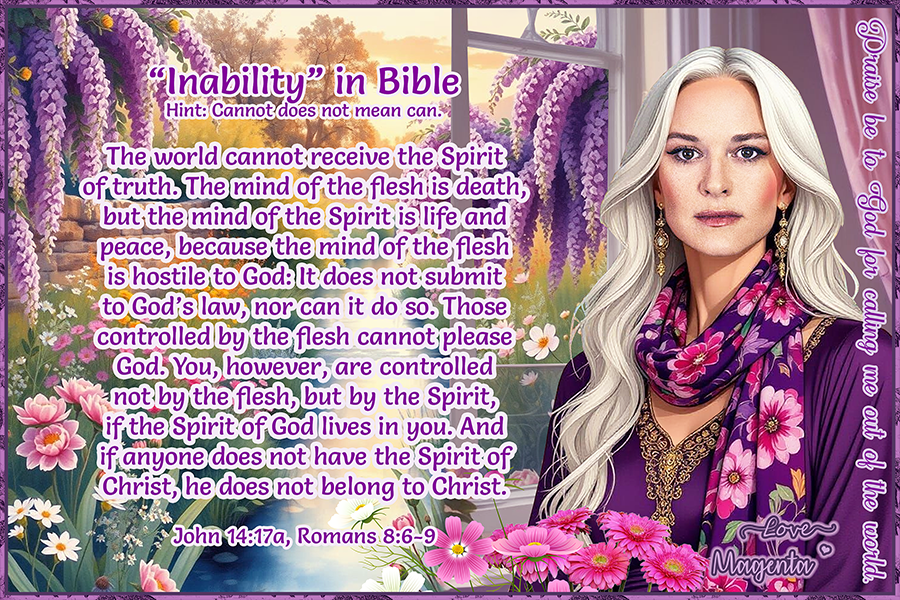
John 14 v 17a, Romans 8 v 6-9 ~ “Inability” in Bible. The world cannot receive the Spirit of truth. The mind of the flesh is death, but the mind of the Spirit is life and peace, because the mind of the flesh is hostile to God: It does not submit to God’s law, nor can it do so. Those controlled by the flesh cannot please God. You, however, are controlled not by the flesh, but by the Spirit, if the Spirit of God lives in you. And if anyone does not have the Spirit of Christ, he does not belong to Christ. Praise be to God for calling me out of the world.
B
Blue155
Guest
I became a Christian.You are correct, my thoughts are not your thoughts! Much of this has to do with what we have chosen to believe.
I personally did not become reformed by being taught that it was true. Rather, I became reformed simply because it seems to support Scripture as opposed to other teachings.
However, if someone tells me that man must DO something [unassisted by God] to become saved, then I will certainly argue the point.
Scripture teaches that we are saved by Grace, and Grace requires no assistance from us, it is a gift. We come to believe simply because God works a change in us and draws us to Him by Grace. There is no other way!
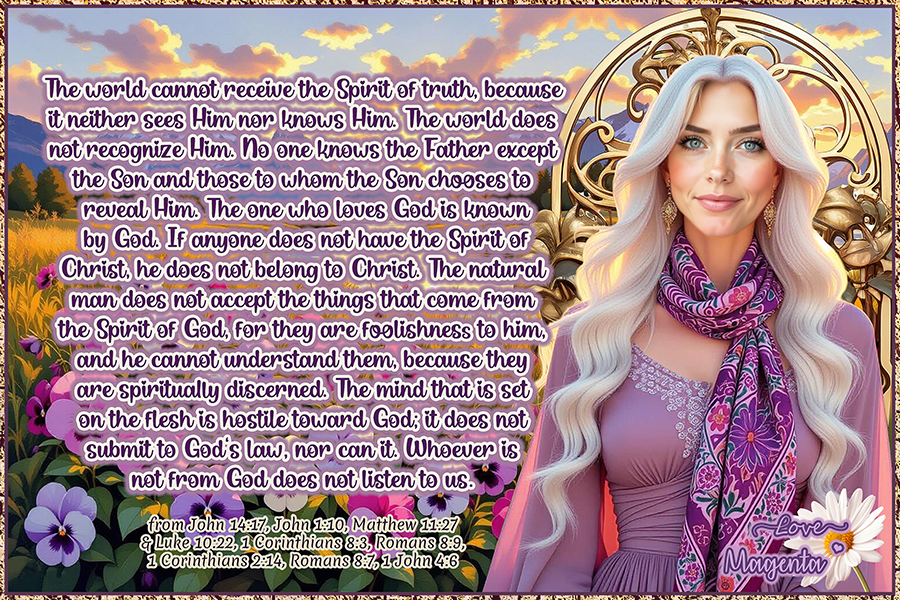
The world cannot receive the Spirit of truth, because it neither sees Him nor knows Him. The world does not recognize Him. No one knows the Father except the Son and those to whom the Son chooses to reveal Him. The one who loves God is known by God. If anyone does not have the Spirit of Christ, he does not belong to Christ. The natural man does not accept the things that come from the Spirit of God, for they are foolishness to him, and he cannot understand them, because they are spiritually discerned. The mind that is set on the flesh is hostile toward God; it does not submit to God's law, nor can it. Whoever is not from God does not listen to us.
No apologies are necessary! I haven't been posting much lately. My wife has been doing poorly and I spend a lot of time helping her. But, please know that all who are like-minded posters lift my spirit each time I sign on.I was very happy to see you when you made your appearance yesterday, as it seemed to me you had been absent for a while, and I also wanted to apologize to you for any misunderstanding if you felt included when I have denounced Hebrew Roots for all the mixing in of uninspired texts as they have a propensity to do... there are a few of those here and I know you have some association with the movement, but I do not include you when I make mention of the errors they may promote as a result of their adherence to such.
Just knowing that God is in control of all things brings me comfort.

That's 1 view.
If it is not yours?
It's probably right then....
You lost all credibility with me when you denied the rapture and claimed Jesus has already returned to the earth.
How you believe that is your business.
But it's not the Holy Spirit's.
You just like to antagonize Christians.
Why is that?
You really do.