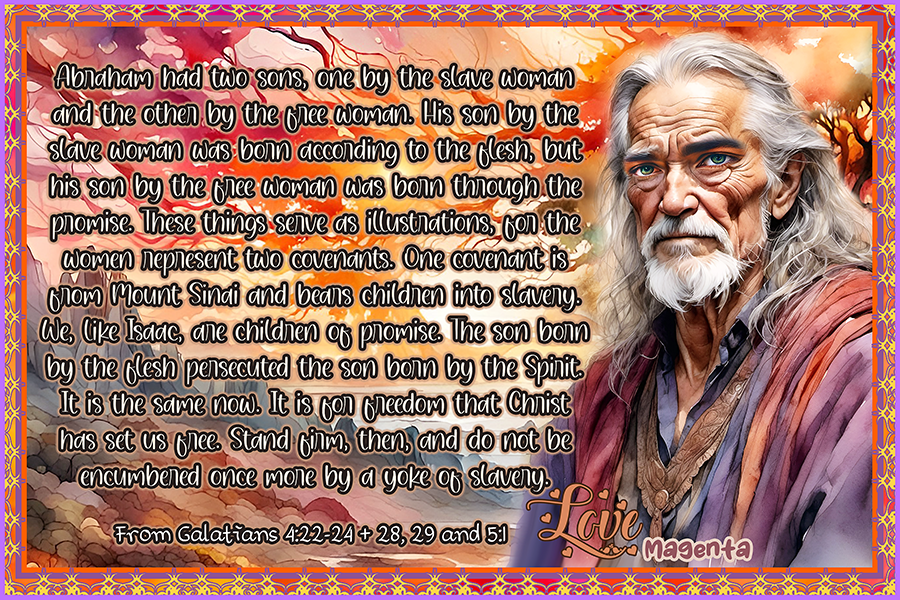
The Abrahamic covenant is part of the covenant of grace. Not all of Israel was a part of that. That was Paul's point in saying not all of Israel is of Israel. All Israelites were, however, part of the Mosaic covenant.The Jews are under the Covenant of Abraham still today -------you need to do your research ----
So now your going to post back that this is not true ----and say ------neither sources posted are Right ----Got Question is an unreliable Source and so is Google ---------Why -- because you don't want to believe the Truth ------
--So whatever you want to believe is all up to you but the Jews remain under the Abrahamic Covenant to this day ---this Covenant is UNCONDITIONAL --do your research -----
---But God Honors His Covenant to His Chosen Nation in the 7 year tribulation and saves His Chosen Nation -----the Jews come to Christ -----Folks in the end -----
People also ask
Is the Abrahamic covenant still relevant today?
God kept His word to Abraham—Isaac was born and generations later the ultimate son of Abraham, the Messiah, was also born just as promised.
The Abrahamic covenant passed to Isaac and Jacob (Israel), to each successive generation and remains today, for it is an eternal covenant based on God's fidelity, not man's.
https://www.gotquestions.org/Israel-still-chosen-people.html
Is Israel still God’s chosen people?
Israel Is Still God’s People: The Covenants
God’s covenant with Abraham promised Abraham three things: a land, a posterity, and a blessing (Genesis 12:1–3). Through Abraham’s seed, the whole world would be blessed. In Genesis 13:15, God highlights the enduring nature of this covenant: “All the land that you see I will give to you and your offspring forever” (emphasis added). Importantly, the covenant did not depend on Abraham’s power to keep it. In fact, Abraham was not even conscious when God ratified the covenant by Himself (Genesis 15). Since God alone took the responsibility of blessing Abraham’s seed, the covenant was unconditional.
God reaffirmed the covenant with Abraham’s son Isaac (Genesis 21:12; 26:3–4), and with Isaac’s son Jacob (Genesis 28:14–15). From then on, every time God referred to Himself as “the God of Abraham, Isaac, and Jacob,” that covenant was remembered. God chose to have a perpetual relationship with Abraham’s descendants from generation to generation.
The covenant God made with David (and with Solomon) was likewise a unilateral, unconditional promise. That covenant assured David that God would “provide a place for my people Israel” where they will “no longer be disturbed” (2 Samuel 7:10). God would also establish a “house” and a “kingdom” for David (verses 11–12). And then God revealed the enduring nature of this covenant: “Your house and your kingdom will endure forever before me; your throne will be established forever” (verse 16, emphasis added).
From the beginning, Israel has had a unique relationship with God. Both the Abrahamic Covenant and the Davidic Covenant detail the special blessings God gave Israel, and both covenants are said to last forever.
There are significant differences between the covenants. The latter is a covenant that is entered into by physical birth, is largely temporal, and is covenant of works. The former is entered into through faith and spiritual birth, is largely eternal in nature, and is strictly a covenant of grace.
Perhaps the greatest difference in the covenants is that one is still in operation and the other is not. The Mosaic covenant has been done away with since the 1st century destruction of the temple. Hence, my question of under what covenant. Since the new covenant is the only existing covenant, it is only under the terms of this covenant that one may be in relationship with God. Under this covenant, there is no distinction made between Jew or Greek, but only the new man.