
Poll about how you see predestination/freewill
- Thread starter Hakawaka
- Start date
-
Christian Chat is a moderated online Christian community allowing Christians around the world to fellowship with each other in real time chat via webcam, voice, and text, with the Christian Chat app. You can also start or participate in a Bible-based discussion here in the Christian Chat Forums, where members can also share with each other their own videos, pictures, or favorite Christian music.
If you are a Christian and need encouragement and fellowship, we're here for you! If you are not a Christian but interested in knowing more about Jesus our Lord, you're also welcome! Want to know what the Bible says, and how you can apply it to your life? Join us!
To make new Christian friends now around the world, click here to join Christian Chat.
You are using an out of date browser. It may not display this or other websites correctly.
You should upgrade or use an alternative browser.
You should upgrade or use an alternative browser.


Hey yall, lets get this poll going I wanna see what you guys are gonna vote. I wont include the "other" option because so many would vote for it, even though they for sure are somewhat close to one of the mentioned views.
I stand in God knows who is who and what is what for each person personally for sure, thank you
Not my will, Father, rather your will, and thank you as I go through here on earth, whatever
A short time here compared to eternity is worth it to me thank you
I do not know or care, where this puts me in anyone else's view, God knows as Romans 8 tells me so. Hoping for us all to be sincere to know this love and mercy from God through Son to all, thank you

I never knew that there were so so many isms. It might've been helpful to explain each option.
Jansensism, a movement that denied the role of freewill in salvation and affirmed God's predestination of some to grace and others to damnation.
According to wiki
The heresy of 'Jansenism', as stated by subsequent Roman Catholic doctrine, lies in the denial of the role of free will in the acceptance and use of grace. Jansenism asserts that God's role in the infusion of grace cannot be resisted and does not require human assent. The Catechism of the Catholic Church states the Roman Catholic position that "God's free initiative demands man's free response",[9] that is, humans are said to freely assent or refuse God's gift of grace.
How can anyone tell these apart just by looking at them?
Jansensism, a movement that denied the role of freewill in salvation and affirmed God's predestination of some to grace and others to damnation.
According to wiki
The heresy of 'Jansenism', as stated by subsequent Roman Catholic doctrine, lies in the denial of the role of free will in the acceptance and use of grace. Jansenism asserts that God's role in the infusion of grace cannot be resisted and does not require human assent. The Catechism of the Catholic Church states the Roman Catholic position that "God's free initiative demands man's free response",[9] that is, humans are said to freely assent or refuse God's gift of grace.
How can anyone tell these apart just by looking at them?

I've never heard of Molinism before, but it is pretty much what I believe. I summarise my thoughts thus: God is sovereign, man is responsible. Even if Calvinism is correct, I will not presume to say that an individual is condemned so I don't need to witness to them.Hey yall, lets get this poll going I wanna see what you guys are gonna vote. I wont include the "other" option because so many would vote for it, even though they for sure are somewhat close to one of the mentioned views.
It's the only way I can reconcile 2 Peter 3:9 with Romans 8:29 & 30. God predestines according to His foreknowledge. If anyone has an issue with this, I will point them to Philippians 3:15. I'm happy to agree to disagree.
The Church can't even get the elementary principles of Christ right today.
We can BOLDLY preach Christ is risen.( Nary a person in the church today knows what that entails.)
But the Church Today is :
Rev 3:16
So because you are lukewarm, and neither hot nor cold, I will vomit you out of My mouth.
We can BOLDLY preach Christ is risen.( Nary a person in the church today knows what that entails.)
But the Church Today is :
- Arminianism
- Calvinism
- Molinism
- Open theism
Rev 3:16
So because you are lukewarm, and neither hot nor cold, I will vomit you out of My mouth.

What's a Pelagian Heretic? Just curious.
Denial of Original Sin: Pelagians reject the idea that Adam's fall caused a corruption of human nature. They believe
that each individual is born with the ability to choose between good and evil, and that sin is a purely voluntary act.
Emphasis on Free Will:
Pelagians emphasize the power of the human will in achieving righteousness and salvation. They
believe that humans can choose to live a virtuous life and avoid sin through their own efforts.
Rejection of Grace:
This view contrasts with the dominant doctrines of grace, which emphasizes that humans need God's grace to overcome sin and achieve salvation. Pelagians minimize the role of grace, suggesting that humans could achieve perfection through their own efforts.
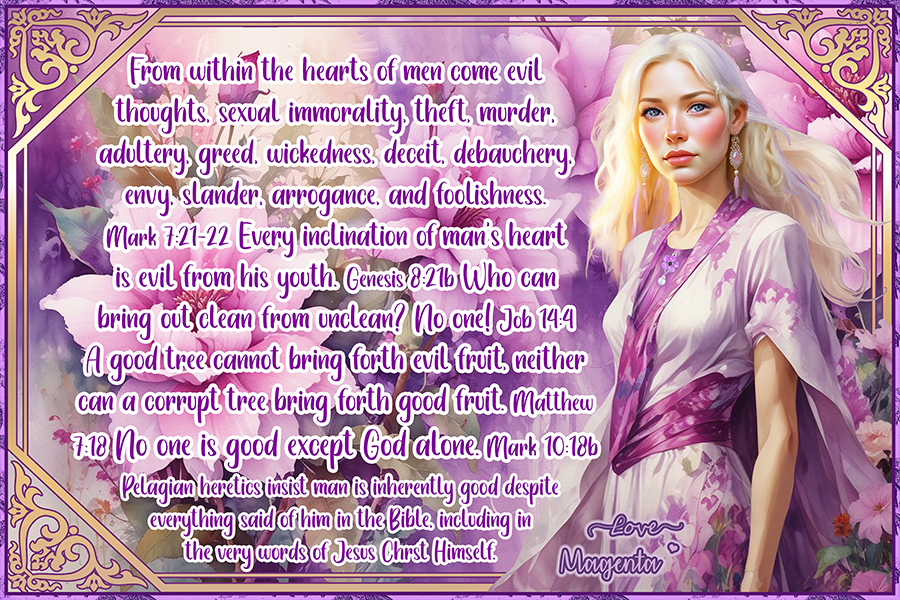
Pelagian heretics insist man is inherently good. From within the hearts of men come evil thoughts, sexual immorality, theft, murder, adultery, greed, wickedness, deceit, debauchery, envy, slander, arrogance, and foolishness. Mark 7:21-22 Every inclination of man's heart is evil from his youth. Genesis 8:21b Who can bring out clean from unclean? No one! Job 14:4 A good tree cannot bring forth evil fruit, neither can a corrupt tree bring forth good fruit. Matthew 7:18

Most regular christians probably dont know what these mean. But for those theology nerds we do.I never knew that there were so so many isms. It might've been helpful to explain each option.
How can anyone tell these apart just by looking at them?
Basically the simple version is:
- Arminianism: God gives free will; salvation is available to all, but people can reject it.
- Molinism: God knows all possible choices (via "middle knowledge") and sovereignly arranges the world without overriding free will.
- Open Theism: God knows everything knowable, but the future is partly open because humans have real freedom.
- Calvinism: God predestines everything, including who will be saved; human will is subordinate to God's sovereignty.
Hey yall, lets get this poll going I wanna see what you guys are gonna vote. I wont include the "other" option because so many would vote for it, even though they for sure are somewhat close to one of the mentioned views.
I wanna see you vote first.
My suggestion is to change the Arminian/Calvinist option to biblical MFW or blasphemous TULIP.
I vote for MFW.
What is MFW? And I did vote, I voted for open theism.I wanna see you vote first.
My suggestion is to change the Arminian/Calvinist option to biblical MFW or blasphemous TULIP.
I vote for MFW.
What is MFW? And I did vote, I voted for open theism.
Sorry, I did not notice your vote. Perhaps you will explain open theism? Here is my explanation of MFW:
M – God’s requirement for salvation (GRFS) is a Moral one: seek right/truth/love, and His moral option presumes human volition even for sinners, which makes them morally accountable.
F – God enables all morally accountable souls sufficient Freedom to satisfy GRFS—or not, because His grace is not irresistible, which means sinners are justly condemned.
W – Will refers to faith or seeking salvation—or not, and accepting God’s grace is not meritorious.
One of the clearest statements of the Moral option in Scripture is Deut. 30:19b, “I have set before you life and death, blessings and curses. Now choose life, so that you and your children may live.” Jesus equated moral right with spiritual truth and acceptance of him as Messiah (John 8:31 & 40-47), and Paul taught that the purpose of moral law and conscience is to lead sinners to faith in the Gospel of Christ (Romans 2:14-15, 3:20, Gal. 3:19 & 24).
Sinners are Free to receive God’s grace or salvation by means of volition or faith, which is the condition but not the cause of salvation. The reason this truth is a stumbling-block for TULIPists is because they have been brain-washed to believe that faith is a meritorious work. Although Jesus said in John 6:29 that “the work of God is to believe in the one he has sent”, there is no reason to think Jesus viewed such faith as meritorious instead of merely indicating that a soul’s faith willingly cooperates with the will of God.
Although sinful souls are described as depraved and unable to save themselves, this does not mean they have no Will and are mere animals who live by instinct or robots who act as programmed and are thus not accountable for moral behavior. The clearest NT Scripture supporting this view is Matthew 23:37, in which Jesus laments that Jerusalem was “not willing” to be saved.
I never knew that there were so so many isms. It might've been helpful to explain each option.
Jansensism, a movement that denied the role of freewill in salvation and affirmed God's predestination of some to grace and others to damnation.
According to wiki
The heresy of 'Jansenism', as stated by subsequent Roman Catholic doctrine, lies in the denial of the role of free will in the acceptance and use of grace. Jansenism asserts that God's role in the infusion of grace cannot be resisted and does not require human assent. The Catechism of the Catholic Church states the Roman Catholic position that "God's free initiative demands man's free response",[9] that is, humans are said to freely assent or refuse God's gift of grace.
How can anyone tell these apart just by looking at them?
only those playing God
Psalm 82, Ezekiel 17 God is not joyful over our acting as if we know better than the love of God through Son, Jesus for us all to love all, over the few that first born flesh only knows how to do. Only loving those that love them back, over loving all. Feed your enemies God's love, the same as Son did all that way to that cross that reconciled us all as reconciled, forgiven first, before any new life could ever be installed in us, God Father getting all the credit, which is the same as Jesus did willingly, having no flesh fight back. Wow! woe is me, I need the same Spirit Father, thank you fro freely giving this to me to see and rest in, which is not easy, yet worth it to me at least
Open theism is a theological view that emphasizes God’s dynamic relationship with creation, especially in regard to human free will and the future.Sorry, I did not notice your vote. Perhaps you will explain open theism? Here is my explanation of MFW:
M – God’s requirement for salvation (GRFS) is a Moral one: seek right/truth/love, and His moral option presumes human volition even for sinners, which makes them morally accountable.
F – God enables all morally accountable souls sufficient Freedom to satisfy GRFS—or not, because His grace is not irresistible, which means sinners are justly condemned.
W – Will refers to faith or seeking salvation—or not, and accepting God’s grace is not meritorious.
One of the clearest statements of the Moral option in Scripture is Deut. 30:19b, “I have set before you life and death, blessings and curses. Now choose life, so that you and your children may live.” Jesus equated moral right with spiritual truth and acceptance of him as Messiah (John 8:31 & 40-47), and Paul taught that the purpose of moral law and conscience is to lead sinners to faith in the Gospel of Christ (Romans 2:14-15, 3:20, Gal. 3:19 & 24).
Sinners are Free to receive God’s grace or salvation by means of volition or faith, which is the condition but not the cause of salvation. The reason this truth is a stumbling-block for TULIPists is because they have been brain-washed to believe that faith is a meritorious work. Although Jesus said in John 6:29 that “the work of God is to believe in the one he has sent”, there is no reason to think Jesus viewed such faith as meritorious instead of merely indicating that a soul’s faith willingly cooperates with the will of God.
Although sinful souls are described as depraved and unable to save themselves, this does not mean they have no Will and are mere animals who live by instinct or robots who act as programmed and are thus not accountable for moral behavior. The clearest NT Scripture supporting this view is Matthew 23:37, in which Jesus laments that Jerusalem was “not willing” to be saved.
Key ideas:
- God knows everything that can be known, including all possibilities.
- The future is partly open, not fully settled—because free creatures haven’t made all their choices yet.
- God is responsive: He can change His plans or emotions based on what people do.
- This view maintains God’s omniscience, but argues that knowing possibilities, not certainties, about future free actions is consistent with divine perfection.
Open theism is a theological view that emphasizes God’s dynamic relationship with creation, especially in regard to human free will and the future.
Key ideas:
- God knows everything that can be known, including all possibilities.
- The future is partly open, not fully settled—because free creatures haven’t made all their choices yet.
- God is responsive: He can change His plans or emotions based on what people do.
- This view maintains God’s omniscience, but argues that knowing possibilities, not certainties, about future free actions is consistent with divine perfection.
God that I see and am revealed by God is love for all to all to choose to stand in belief to God or not Col 1:21-23
I see, God using everything good and bad to train God's children, those that have chosen to hear from God all in all to see Romans 8:28
That is amazing to me, knowing no matter what I do or have done or even might do, I do not deserve to get given the gift of God for all, as is done for us by Son first to us all. Thank you God Psalm 103:12, Ezekiel 36:26 John 19:30, Hebrews 7:11-12, Hebrews 9:14-17
Open theism is a theological view that emphasizes God’s dynamic relationship with creation, especially in regard to human free will and the future.
Key ideas:
- God knows everything that can be known, including all possibilities.
- The future is partly open, not fully settled—because free creatures haven’t made all their choices yet.
- God is responsive: He can change His plans or emotions based on what people do.
- This view maintains God’s omniscience, but argues that knowing possibilities, not certainties, about future free actions is consistent with divine perfection.
I guess MFWism and open theism overlap, because I agree that God’s omnipotence means that He can do everything except “disown Himself” or not be God (2Tim. 2:13). It does NOT mean that God can perform logical absurdities, such as creating a rock too large for Him to move. Omnipotence or sovereignty also means that human MFW has limits with regard to how it can contradict God’s will. God provides morally competent humans the ability to resist His intentional will and plan of salvation (POS) within limits, such as the time limit that will end with death, resurrection (the last miracle) and judgment (per Heb. 9:27)–called His permissive will.
God’s power is equivalent to His omniscience. Jeremiah wrote that “God made the earth by his power; he founded the world by his wisdom.” (Jer. 10:12) Many NT passages refer to God as the source of true wisdom (e.g., Acts 6:3, 1Cor. 1:25, Col. 2:2-3, Jam. 1:5). God’s infinitely superior knowledge is extolled in Romans 11:33-34 (echoing Isa. 40:13-14) and Daniel 2:20-23.
Omniscience includes knowledge of people’s thoughts (Psa. 94:11, Matt. 12:25) and the foreknowledge of events (Acts 2:23, Rom. 8:29, 11:2, 1Pet. 1:2). Some people think that God even knows what a person will be/do before that person exists (Jer 1:5). If this view is correct (which I find incomprehensible), it must be maintained that God’s foreknowledge does not predetermine a person’s spiritual choice regarding the satisfaction of God’s requirement for salvation or else moral responsibility would be abrogated. I find it simpler to think that God merely tweaks the river of history occasionally to keep if flowing in the direction He intends but allows the fish to swim as they wish. God allows eddies in the river of salvation.
I would say that God CAN change His plan of salvation, but that He has promised never to do so;
only the revelation of His plan occurred stages, culminating in the NT/Gospel part of GW.
I came close to seeing Molinism but encountered something I considered problematic after a cursory review. I'm not one looking to necessarily 'belong' in any certain category, so I don't remember what goad? (what does a prick represent, exactly?) I came up on. But the picture comes to mind in this illustration of sovereignty, using ants for example, they can go wherever they like within the confines of the provided ant farm.Most regular christians probably dont know what these mean. But for those theology nerds we do.
Basically the simple version is:
- Arminianism: God gives free will; salvation is available to all, but people can reject it.
- Molinism: God knows all possible choices (via "middle knowledge") and sovereignly arranges the world without overriding free will.
- Open Theism: God knows everything knowable, but the future is partly open because humans have real freedom.
- Calvinism: God predestines everything, including who will be saved; human will is subordinate to God's sovereignty.
I agree that God's omniscience, His ever-present Being, would facilitate His on-the-spot decisions.Open theism is a theological view that emphasizes God’s dynamic relationship with creation, especially in regard to human free will and the future.
Key ideas:
- God knows everything that can be known, including all possibilities.
- The future is partly open, not fully settled—because free creatures haven’t made all their choices yet.
- God is responsive: He can change His plans or emotions based on what people do.
- This view maintains God’s omniscience, but argues that knowing possibilities, not certainties, about future free actions is consistent with divine perfection.
I came close to seeing Molinism but encountered something I considered problematic after a cursory review. I'm not one looking to necessarily 'belong' in any certain category, so I don't remember what goad? (what does a prick represent, exactly?) I came up on. But the picture comes to mind in this illustration of sovereignty, using ants for example, they can go wherever they like within the confines of the provided ant farm.
Molinism apparently is derived from Augustine, whose doctrine differed from Calvin's by proposing that God knows what souls would choose, so He presents the elect only with the options that lead to faith and salvation. While this view may have technically preserved human free will, it did nothing to preserve God's omnilove and justice/non-favoritism, which is the Achilles heel of both Augustine and Calvin--so I guess they are that part of the body of Christ.

The problem always comes down to defining terms, and I don't agree with how you've defined them.